Arab League Secretary-General Proposes Establishing Early Warning Tools and Monitoring Crises and Threats - Sarmad
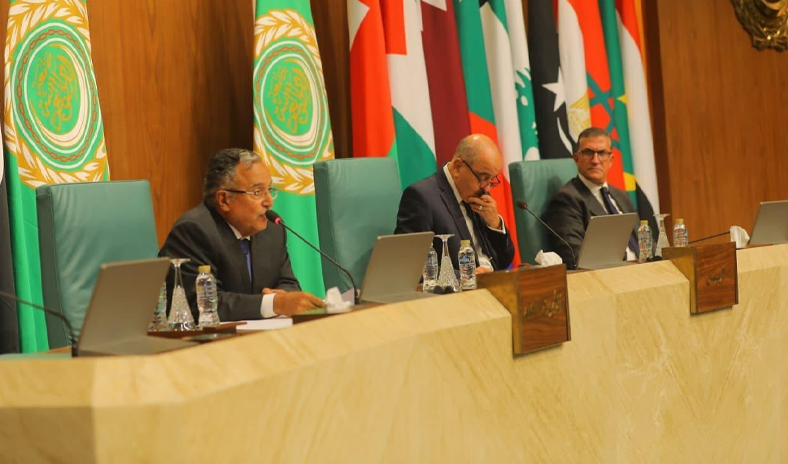
(KUNA) – Arab League Secretary-General Nabil Fahmi announced on Monday a proposal to develop mechanisms for joint Arab action by introducing early warning tools, crisis management systems, and threat monitoring, with the aim of enhancing the ability of Arab states to protect their security and interests and to influence their regional and international environment.
In his speech before the 166th session of the Arab League Council at the level of foreign ministers, Fahmi called for the development and adaptation of the Arab League to support the national and regional capacities of member states, enabling them to anticipate risks, confront crises, manage their repercussions, and support Arab decision-making with information, expertise, and proactive vision.
He stated that the League is in the process of establishing an “Excellence Center” as an Arab platform for expertise and strategic analysis to identify emerging sources of threat, prioritizing preventive diplomacy, early warning, crisis management, and support for settlement efforts.
Fahmi added that the League plans to leverage the expertise of prominent Arab figures by establishing an advisory council and appointing special envoys for certain priority files.
He also called for adopting a “renewed Arab agenda” focused on confrontation, development, and growth, accompanied by practices characterized by initiative and effectiveness, where action prevails over words. He emphasized the importance of building and strengthening Arab capabilities in the field of national security in its comprehensive sense.
Fahmi pointed out that the world and the Middle East are witnessing repeated violations of international law, increasing targeting of civilians, widening conflicts, arms races, and rising isolationism, extremism, and hatred. He stressed that the defining feature has become the predominance of the “law of force over the strength of law.”
In this regard, he affirmed that Palestine remains at the heart of challenges as “our primary regional issue and the measure of our integrity before our peoples and the world,” warning against the continued violations by the Israeli occupation in Gaza, the West Bank, and Jerusalem, as well as the expansion of settlements, land confiscation, home demolitions, and attacks on holy sites.
Fahmi noted that the occupation’s aggression is not limited to Palestinian territories but extends to southern Lebanon, Syrian lands, the Red Sea, and Somalia, in violation of sovereignty and undermining efforts to halt escalation. He reaffirmed the League’s commitment to a “just” settlement that ends the occupation, enables the Palestinian people to establish their independent state, and preserves the sovereignty of Arab states.
He also confirmed the League’s resolve to monitor and document Israeli occupation violations of international law and resolutions of the UN Security Council through a unified coordinating mechanism linking Arab observatories with relevant departments of the Secretariat General.
In the same context, Fahmi condemned Iranian attacks on Arab states, stating that the targeting of territories and facilities is unacceptable to the Arab League and lacks justification, emphasizing that Arab states are not parties to the war that erupted in the region.
He stressed that the security of Gulf Arab states is part of Arab national security, and any threat to it concerns the League and its member states. He highlighted the importance of the Hormuz Strait and Bab al-Mandab straits and the necessity of respecting the rights of littoral states and freedom of navigation in accordance with international law.
Regarding Sudan, Lebanon, Syria, Somalia, and Libya, Fahmi affirmed the League’s support for these countries, backing their unity, sovereignty, territorial integrity, political solutions, cessation of infighting, and ensuring the delivery of humanitarian aid.
He also stressed that economic integration and sustainable development are essential components of Arab capacity to protect security and shape the future, noting that the League will direct its economic and developmental work toward priorities including trade, investment, food and water security, digital transformation, artificial intelligence, technology localization, reconstruction, education, health, and joint Arab projects.
He emphasized the importance of developing the guidance and follow-up system, improving the performance of the General Secretariat’s sectors, rationalizing the use of its resources, and enhancing the efficiency of the League’s external missions.
Fahmy pointed out that while the challenges facing Arab countries are significant, their foundational strengths—comprising youth, resources, strategic location, longstanding political and diplomatic expertise, and political weight—are greater. He affirmed his commitment during his tenure to ensuring that the League remains present and active in serving joint Arab efforts, confronting challenges, promoting development, achieving progress, and building a better future for coming generations.
