High Gas Prices Sour Americans' Labor Day Holiday - Sarmad
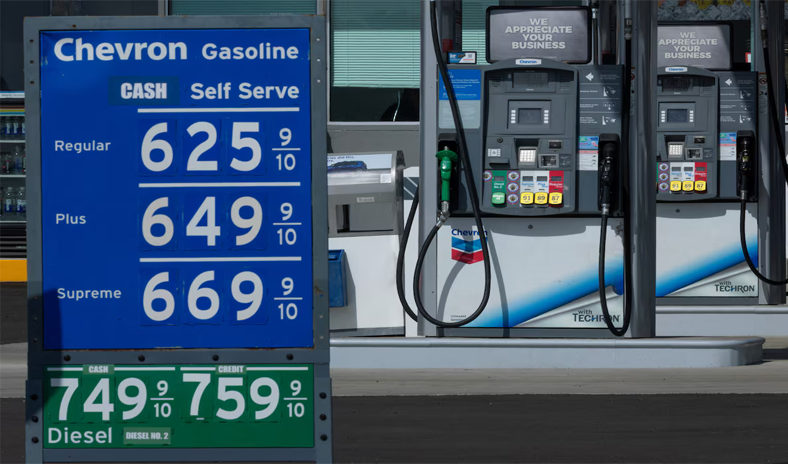
(Royters) – Americans are facing gasoline prices at unprecedented levels during the Labor Day holiday as the war in the Middle East continues to drive up energy costs, coinciding with the launch of political campaigns for the midterm congressional elections.
Patrick De Haan, an analyst at GasBuddy, projected that the national average gasoline price would reach $4.03 on Labor Day, significantly surpassing the previous record of $3.83 per gallon set in 2012.
De Haan wrote in a recent blog post, “Although gasoline prices are not at their all-time highs, they have reached the highest level ever at this late stage of the year, meaning Americans may see a national average gasoline price exceeding four dollars per gallon on Labor Day for the first time.”
According to GasBuddy’s price-tracking service, the average gasoline price in the United States was approximately $4.13 per gallon on Thursday, about a dollar higher than last year’s average. Analysts say that a price of four dollars per gallon represents a burden for many consumers.
Gasoline prices are among the most prominent economic indicators for American consumers and can quickly shape their perceptions of the economy as a whole. With prices remaining above four dollars per gallon for most of the year, this issue has become a source of concern for President Donald Trump and his Republican Party.
Trump has pledged to reduce energy costs. In recent weeks, he has intensified his criticism of oil refineries and gas stations, accusing them of profiting from rising gasoline prices. On August 14, Trump said Americans should be prepared to pay a “small additional amount” for gasoline to ensure that Iran does not obtain a nuclear weapon.
Labor Day typically serves as the final summer holiday for many Americans, with many traveling by car or air.
Fuel prices at gas stations have risen in tandem with crude oil prices, which jumped last week to surpass $90 per barrel again, as renewed military action between the United States and Iran fueled concerns about disruptions to global crude oil supplies.
Prices of distillate products, including diesel and heating oil, have also increased, partly due to ongoing attacks on Russian refineries that have raised concerns about supply disruptions.
Retail fuel and oil prices usually move in the same direction, as crude oil constitutes the main component of fuel production costs.
Randy O’Brien, 57, said while filling her truck with fuel at a station near Evergreen, Colorado, “It’s completely out of control.”
States such as Colorado, Utah, Idaho, Montana, Wyoming, and North Dakota have recorded some of the highest price increases since the war began. California, Hawaii, and Washington are currently experiencing the highest average gasoline prices in the country.
Scaling Back Holiday Travel Plans
O’Brien, who drives her truck for 40 minutes each way to work at a Home Depot store, said, “I can’t afford to spend more than $15 on gasoline right now.”
O’Brien attributes the price increases partly to higher exports of crude oil and fuel from the United States following the start of the war with Iran, which has prompted several countries to import fuel from the U.S. to secure supplies.
According to the U.S. Energy Information Administration, exports of refined products rose by more than 10 percent compared to last year.
As the cost of even the simplest grocery purchases rises and household budgets come under increasing pressure, Madison Moore, 28, who lives in Houston, said she would scale back her travel plans for the Labor Day holiday.
Moore, while filling her car with fuel at a Shell station in Houston, said, “It used to be easy to pack the car, head to Galveston, hit the beach, and have a barbecue or something like that. But people no longer want to travel that way.”
Quinn Dousmoratov, a research analyst at consulting firm Wood Mackenzie, said the continued rise in gasoline prices is primarily due to a supply problem. Concerns about disruptions to energy shipments through the Strait of Hormuz have driven up oil prices and refining margins, while attacks on Russian refineries have contributed to an overall decline in fuel inventories.
The U.S. Energy Information Administration reported last Wednesday that U.S. gasoline inventories fell by 1.2 million barrels in the previous week to 205.7 million barrels, compared to a five-year average for August of 217.6 million barrels.
Prices of other refined products also surged sharply. U.S. diesel prices hit a new record high last week, and according to the American Automobile Association, air travelers during the Labor Day holiday are expected to pay 20 percent more for tickets compared to last year.
