Mother's Death Didn't Stop Her Fetuses' Heartbeats: Twins Born in an Extraordinary Medical Case in Egypt - Sarmad
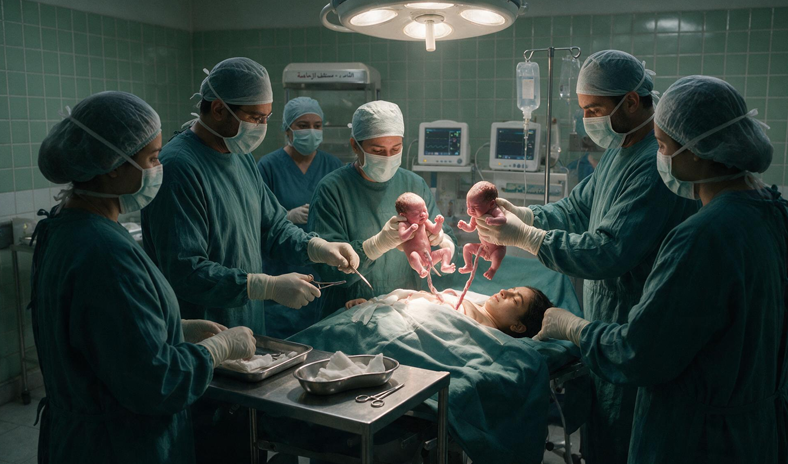
• Extraction of the twins took about 10 minutes, with immediate resuscitation
In an exceptional medical case, a hospital in Sohag Governorate, southern Egypt, witnessed the birth of twins after their mother arrived at the hospital deceased.
Medical examination of the mother’s body revealed that the fetuses still had a weak pulse, prompting the treating team to make an urgent decision to extract them in an attempt to save their lives.
The 26-year-old pregnant woman carrying twins arrived at Saqalta Model Hospital about 20 minutes after her death. She did not respond to cardiopulmonary resuscitation attempts, while an ultrasound examination of the fetuses revealed a weak pulse in each.
With time running short, urgent coordination took place between the obstetrics and gynecology, pediatrics, and intensive care teams. The mother was transferred to the operating room, where the two children were extracted within about 10 minutes, after which the pediatric teams immediately began resuscitation procedures, according to hospital data.
The twins responded to the resuscitation efforts and were then transferred to the hospital’s neonatal unit to continue receiving medical care, treatment, and close monitoring.
A Race Against Time
Officials and specialists told Sky News Arabia that the incident represented a highly complex medical situation, in which the mother’s death coincided with continued signs of life in two fetuses in an advanced stage of pregnancy. This forced the medical team to act within minutes to make a decision that could represent the last chance to save the children.
Amr Hassan, a member of the World Health Organization’s expert group on maternal mortality estimation and causes, said the incident carries a human and medical dimension that goes beyond the success of the delivery procedure. He added that “two lives began at the very moment the life of a young woman, who was preparing to welcome her children, ended.”
Hassan noted that “the rapid response of the medical and nursing teams deserves appreciation, because in such cases, every minute is decisive for survival chances.”
This incident occurs at a time when maternal deaths remain an important indicator of health systems’ ability to detect and appropriately manage pregnancy and delivery complications.
According to official data from the Egyptian Ministry of Health for 2025, there were 867 maternal deaths among approximately 1.952 million live births, yielding a rate of 44.4 deaths per 100,000 live births.
Hassan emphasized that addressing these figures should not be limited to statistical analysis. “This number does not represent cases recorded in a table, but rather 867 women, each with a family, a life, and people waiting for her return home,” he explained.
He clarified that data indicate that delivery-related hemorrhage was the leading group of direct causes of death, accounting for 244 deaths, or 28.1 percent of total maternal deaths in 2025. Hypertensive disorders of pregnancy accounted for 132 deaths (15.2 percent), microbial infections for 87 deaths (10 percent), and abortion for 46 deaths (5.3 percent).
He pointed out that the total number of deaths classified under direct causes reached 682, representing 78.7 percent of all registered maternal deaths during the year.
