Kuwait Reimagines Development and Relief in Five Countries to Chart New Paths for Giving - Sarmad
Deep within some of the world’s most complex humanitarian crises, relief aid led by the State of Kuwait, under high directives, has become a vital lifeline, flowing like warm rain to wipe away the tears of the grieving, heal the wounds of the afflicted, and restore human dignity in highly dangerous environments.
Kuwait’s humanitarian role has emerged as a living embodiment of a vigilant human conscience, serving as a global humanitarian safety valve through a series of relief campaigns recently focused on diverse geographic regions in Africa and Asia. This has cemented its status as a reliable compass for generosity and a safe haven during crises, in a world exhausted by conflicts and battered by disasters. It has also demonstrated Kuwait’s capacity to overcome logistical obstacles and secure vital supply lines, ensuring the preservation of human dignity in highly complex settings.
In Uganda, Sudan, Benin, Thailand, and India, the humanitarian projects implemented over the past week reveal the breadth of Kuwaiti humanitarian action and the diversity of its tools, proving that Kuwait’s aid has never been merely an emergency response to a disaster, but rather a consistent strategic approach and a fundamental pillar of its diplomatic philosophy.
These intensive campaigns reflect a sophisticated model of institutionalizing relief work, particularly as they combine support for crisis-affected individuals, family empowerment, educational services, water provision, and support for community institutions. This approach signifies a shift from merely meeting immediate needs to contributing to the restoration of stability and the building of the future.
In Uganda, Kuwaiti support carries a humanitarian dimension linked to the return of Sudanese refugees to their homeland. New batches are preparing to depart under a voluntary repatriation program, which funds the journey back and supports families wishing to start a new chapter after years of war and displacement.
Nour Al-Huda Al-Ajeb, Director of the Kuwait Direct Relief Association’s office in Uganda, announced the completion of preparations for the departure of 220 Sudanese refugees from Ugandan territory, as part of the voluntary repatriation program for Sudanese refugees funded by the Association.
Al-Ajeb stated that the fourth and fifth trips under the program would depart on August 30 and 31, following the completion of handing over travel tickets and departure documents to the returnees, paving the way for their transfer from Entebbe International Airport to Khartoum Airport.
He added that return flights would continue weekly, with a rate ranging between 220 and 230 refugees, until the target number under the program is reached. He expects the program’s implementation to be completed before the end of September.
He clarified that the program is part of an initiative funded by the Association to support the return of approximately 1,200 Sudanese refugees from Uganda to their country, at a cost of 300,000 Kuwaiti dinars. This contributes to supporting families wishing to return and participate in the recovery and reconstruction phase.
Al-Ajeb noted that the initiative reflects the Association’s interest in supporting those affected by the war’s repercussions, through programs that go beyond temporary relief to support return and stability, providing families with the opportunity to start anew within their homeland.
In Sudan, Kuwaiti support has taken a path linked to the recovery and reconstruction of religious and Quranic institutions damaged during the war. This involves providing copies of the Quran and supporting mosques and Quranic schools to restore their educational and community roles, coinciding with the return of residents to Khartoum State.
The International Islamic Charitable Organization launched the “Light of the Quran” project in Khartoum State to distribute 12,000 copies of the Quran, funded by 9,620 Kuwaiti dinars. This supports programs for teaching and memorizing the Holy Quran and reconstructing places of worship damaged by the war.
Dr. Osama Mohamed, Deputy Minister of Religious Affairs and Endowments in Sudan, stated that the project represents a significant step within efforts to reconstruct places of worship and Quranic institutions damaged during the war, commending the continuous support of the International Islamic Charitable Organization for its service to the Holy Quran and the rebuilding of mosques.
Mohamed added that the project contributes to supporting the education and memorization of the Holy Quran, caring for its memorizers, and enhancing the role of mosques and Quranic schools (khawwas) in society, alongside supporting efforts to rehabilitate religious institutions during the recovery and reconstruction phase.
He highlighted the importance of continuing to support the maintenance and rehabilitation of mosques, enabling them to restore their religious, educational, and social roles, particularly with the return of citizens to Khartoum State and the growing need to reactivate institutions affected by the events.
He emphasized the importance of partnership between official institutions, charitable organizations, civil society organizations, and donors in supporting religious education programs and the reconstruction of places of worship, expressing appreciation for Kuwaiti contributions aimed at supporting the Sudanese community and restoring the foundations of stability.
In Benin, another model of Kuwaiti multi-service projects was completed through a center that combines a mosque, a school, and a water source in a single location, providing religious, educational, and developmental services to thousands of beneficiaries and enhancing the local community’s ability to access basic needs in its vicinity.
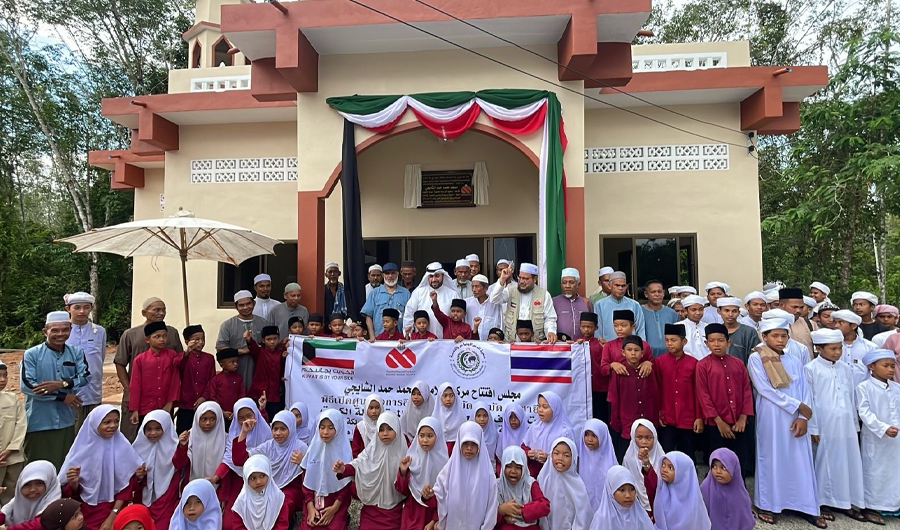
Al-Najah Charity Association opened the “Mohammed Yousef Al-Subaie Islamic Center” in Benin, as part of its educational and humanitarian projects aimed at providing integrated facilities that serve the community, combining education, community service, and water provision.
Ehab Al-Dabous, Director of Fahaheel Zakat at Al-Najah Charity Association, said the center was built on an area of 700 square meters and benefits approximately 5,000 people. It includes a two-story main mosque equipped with necessary amenities, ventilation systems, sound amplifiers, and ablution areas, along with dedicated housing for the imam.
Al-Dabous added that the mosque’s role extends beyond performing prayers; it hosts Quran memorization circles, lectures, and educational and awareness programs, thereby enhancing its religious, educational, and social role and continuously serving the residents of the area.
He noted that the center includes a comprehensive school with six classrooms designated for primary school students, welcoming children from the area and neighboring regions, thus contributing to providing educational opportunities for needy students and supporting the development of their future capabilities.
Al-Dabous clarified that the center’s facilities are completed by a well providing fresh water to school students, mosque visitors, and local residents, emphasizing that combining education, water services, and religious services in a single project embodies the concept of integrated developmental care and enhances the sustainability of the project’s impact on the local community.
In Thailand, Kuwaiti philanthropy extended to projects that combine education, community service, places of worship, and Quran memorization, within a vision aimed at making charitable facilities sustainable centers serving their surrounding communities.
For his part, Mohammed Al-Qassar, Director of the Asia, Africa, and Europe Region at Al-Rahma Global Association, confirmed that the charitable projects implemented by the association in the Kingdom reflect the continuation of Kuwaiti generosity and its commitment to creating sustainable impact in needy communities through projects that combine education, worship, and community service.
Al-Qassar stated that a delegation from the association undertook a charitable trip to Thailand, which included the opening of several mosques and Islamic centers, laying the foundation stones for new projects, as well as inspecting Quran memorization centers and reviewing their educational and developmental programs.
He added that the new projects include mosques, classrooms, and service facilities, built with support from benefactors in the State of Kuwait, thereby helping to meet the needs of local residents and enhancing the educational and community roles of these facilities, ensuring their impact is not limited to a single aspect.
He pointed out that the Association gives special attention to Quran memorization projects, noting that its office in Thailand has established more than 95 memorization centers so far, alongside linking several mosque projects to educational programs and involving children from surrounding areas in memorizing portions of the Holy Quran.
Al-Qassar clarified that these projects reflect the Kuwaiti people’s commitment to supporting initiatives that leave a sustainable impact on the lives of orphans, students of knowledge, and those in need, emphasizing the Association’s continued execution of developmental and charitable projects that respond to the needs of beneficiary communities and reinforce Kuwait’s humanitarian message.
In India, relief, empowerment, health, water, and orphan care converged in a single humanitarian mission, targeting the immediate needs of families while simultaneously providing tools to help them work and produce, thereby achieving a greater degree of independence and living stability.
On its part, Namaa Charity, affiliated with the Social Reform Association, in collaboration with the Sahabat Amal volunteer team, carried out a humanitarian and relief mission in India. This mission included food relief projects, water provision, healthcare, orphan care, assistance to needy families, alongside economic empowerment projects.
Khaled Al-Shammari, Head of the Programs and Initiatives Sector at Namaa Charity, affirmed that the mission is an extension of Namaa’s approach to providing comprehensive humanitarian work, which goes beyond immediate aid to address underlying needs and empower families to improve their living conditions and become self-reliant.
Al-Shammari stated that the mission included the distribution of food baskets, provision of sewing machines and vegetable carts for needy families, support for impoverished families, implementation of water projects, and establishment of a medical camp benefiting approximately 250 patients, in addition to several initiatives dedicated to orphan care.
He added that projects involving sewing machines and vegetable carts represent one of the economic empowerment pathways adopted by Namaa, aimed at helping families find sustainable income sources and gradually transitioning them from a state of dependency to production and self-reliance, alongside providing basic needs such as food, water, and healthcare.
He noted that cooperation with the Sahabat Amal volunteer team enhances integration between charitable institutions and volunteer groups, expanding the circle of beneficiaries. He emphasized Namaa’s continued selection of projects that combine rapid response, quality implementation, and sustainable impact, transforming benefactors’ support into tangible results in the lives of beneficiaries.
Thus, under high directives, the “Kuwait is by Your Side” campaigns continue to chart new paths of giving, placing human needs at the core of its projects and initiatives, spanning relief, education, water, health, empowerment, and support for return and stability. This reflects an approach that does not merely respond to needs but seeks to build the foundations for a safer and more dignified life.
Across distant geographical spaces, the manifestations of Kuwaiti presence have varied, while the ultimate goal remains singular. From a Sudanese refugee preparing to return to his homeland, to a student finding a classroom for learning, a family receiving a means of livelihood, a patient accessing care, and a community reclaiming its religious and educational institutions, charitable initiatives transform into daily details capable of creating a difference that transcends the project’s time and place.
Kuwait’s relief efforts, with their geographical diversity and broad scope, reveal a renewed image of generosity—one whose impact is measured not merely by the number of projects, but by the profound and lasting transformation they bring to the details of daily life. Thus, under the umbrella of “Kuwait is by Your Side,” a humanitarian mission continues, establishing the State of Kuwait as a steadfast companion to those in need across numerous regions, and cementing the institutionalization of relief work, shifting it from temporary emergency responses to sustainable, long-term strategies.
