For the first time in the world... First AI-guided brain surgery in the world - Sarmad
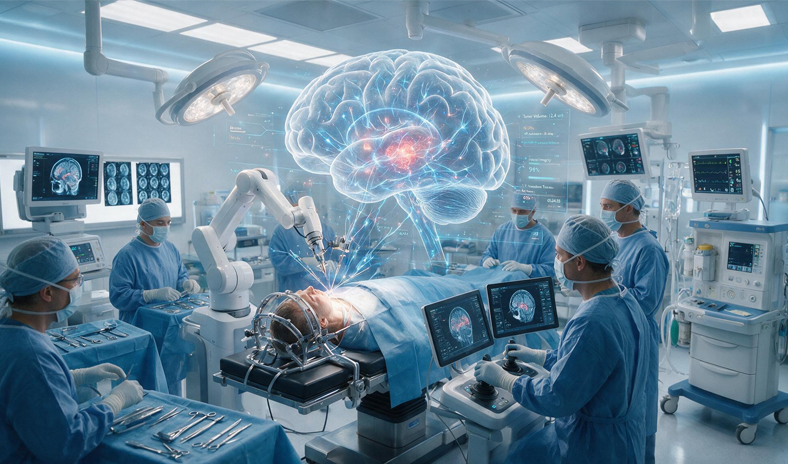
In a medical achievement described as the first of its kind globally, British surgeons successfully removed a tumor from a patient’s brain using an artificial intelligence system that provided direct guidance during the procedure, helping them identify the locations of vital blood vessels and nerves and avoid them.
According to the BBC, British resident Rees Hebert, a 48-year-old father of two from Bedfordshire, underwent surgery at University College London Hospital. The surgery was performed after a benign tumor began growing near the pituitary gland, pressing on the optic nerves and threatening to cause partial loss of his visual field, according to the surgeons.
A small tumor in a highly sensitive location
About 18 months prior, Hebert was in good health and living a normal life, walking approximately two miles during his daily lunch breaks. However, during one of his walks, he collapsed and suffered a seizure on the street.
Medical imaging revealed a non-cancerous tumor measuring 11 millimeters, growing in the pituitary gland. This small gland, located at the base of the skull, plays a fundamental role in secreting hormones that regulate various bodily functions, including growth, metabolism, blood pressure, and body temperature.
The difficulty in removing the tumor lay in its proximity to the carotid arteries, which supply blood to the brain, and the optic nerves, which are responsible for vision.
As the tumor began pressing on the optic nerves, Hebert’s peripheral vision narrowed. He also suffered from severe fatigue, dizziness, and tripped over objects while walking.
Hebert stated that the greatest impact of the illness was psychological and emotional, noting that he did not want to become a burden on others. He added that his willingness to participate in the research trial stemmed from his belief that medical progress depends on patients’ readiness to engage in new studies and experiments.
A “second pair of eyes” inside the operating room
The procedure involved inserting a thin endoscope equipped with a camera through the nose to reach the base of the skull, where the tumor was located behind layers of bone and a tough membrane. This made determining the safest path to access it complex, particularly given the anatomical variations of the human brain from person to person.
Here, the artificial intelligence system played its role. Surgeons displayed a live feed of the operation on a second screen while the system analyzed images in real time, tracked surgical instruments, and identified areas where vital blood vessels and nerves were likely located. It also highlighted positions from which surgeons could remove the tumor with the greatest possible safety.
In principle, the system resembles facial recognition technologies used in smartphones, but instead of identifying human features, it was trained to recognize important anatomical structures, including blood vessels and nerves that may be hidden from the surgeon’s view.
Professor Hani Marcus, one of the surgeons involved in the procedure, said the system was trained on more operations than most surgeons might observe or perform during their careers, allowing it to function as a “second pair of eyes” with extensive expertise.
Marcus emphasized that the standout feature of this experimental technology is its ability to operate in real time during surgery, rather than relying on image analysis after the procedure has ended.
