Guterres warns of a "global confrontation" among great powers: they must recognize the limits of their capacity - Sarmad
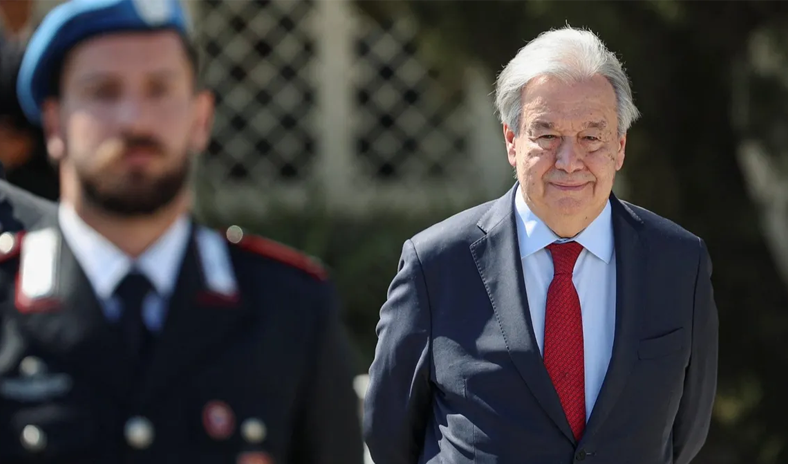
UN Secretary-General António Guterres has warned against sliding into a “global confrontation” as the role of the international organization is marginalized, arguing that the US impasse with Iran and the Russian invasion of Ukraine “reveal the clear limits of great power capabilities.” He criticized the sidelining of the UN in a multipolar world.
As he nears the end of his tenure at the helm of the UN, Guterres described, in an interview with the Financial Times, a world “reshaped by several factors,” including “the decline of US hegemony and the rise of new powers,” alongside “the harsh lessons learned” from wars that “great powers in the Cold War era (Russia and the United States) chose to fight but failed to achieve decisive victories in.”
A Multipolar World Order
While the UN faces a financial crisis, declining morale, and divisions among major powers, the Secretary-General warned that a more multipolar global system risks sliding into new confrontations “unless global institutions adapt to this reality.”
Guterres stated, “It is time for great powers to recognize the limits of their capabilities.” He added, “If we look at what has happened recently, we find that the ability of great powers to impose their will, their strength, or the use of force in many cases has become extremely limited.”
He continued, “Look at what happened with Russia and Ukraine,” referring to Russia’s 2022 invasion of Ukraine, which Moscow expected to last only a few days.
Guterres further noted, “Look at what happened with the United States and Iran,” referring to the conflict with Iran. The US had hoped Tehran would surrender when it attacked in February, but after six months, the Iranian regime remains resilient and has closed the Strait of Hormuz, the world’s most critical energy waterway.
Guterres said that “great powers must realize that things have changed, and the weight of different countries has shifted,” viewing these setbacks as part of the world’s transition from the US-led post-Cold War order to a multipolar world.
Peace Council
Guterres, the 77-year-old former Prime Minister of Portugal, rejected the idea that the “Peace Council” established by US President Donald Trump—a gathering of international leaders launched last year with an initial focus on reaching an agreement between Israel and Hamas—could compete with the UN Security Council, pointing to its failure to make progress in Gaza.
He said, “Despite all the difficulties (facing the UN), the truth is that if you look at what is happening in Gaza, and at the actions taken and the progress made, let’s be honest, the UN is not the party that should be worried. Others should be worried about what they are doing.”
During the decade Guterres has spent leading the international organization, the UN’s presence as a mediator in global crises has waned. Some current and former officials believe that Guterres and the UN erred in his second term by becoming less visible in war zones around the world, as his focus appeared to shift from conflict mediation to broader societal challenges, such as combating climate change.
Guterres acknowledges the difficulty of mediating the wars in Ukraine, Gaza, and Iran. He stated that the Security Council, the UN’s decision-making body, has become “practically paralyzed,” having been blocked by the United States and Russia, two of the five permanent members with veto power, as they pursue their own objectives.
He also acknowledges that the United Nations was pushed to the margins by the civil war in Sudan, after “saboteurs” from outside the country exploited the deadlock in the Security Council to intervene in the fighting.
He continued: “There is now a sense of impunity.” He added: “Our influence has declined significantly” due to the absence of a Security Council capable of informing states that they “must adhere to the required conduct or face punishment.”
However, he denies stepping away from mediation efforts, highlighting a recent visit to Cyprus, which has been divided for 60 years. He said: “Mediation today is extremely difficult, and results are limited. But we do not give up.” He added that the United States, in turn, has found mediation difficult in Lebanon, Gaza, Sudan, and Libya.
As for criticisms claiming that the UN’s voice has become “more muted” during his tenure, he argued that he was among the few who spoke clearly about the war in Ukraine, the “Hamas” attack on Israeli occupation on October 7, 2023, which he described as “horrific and unacceptable,” and the Israeli retaliatory attack on Gaza, which he called “completely unacceptable.”
His criticisms of Israel’s and Russia’s records angered both countries. He strongly rejects Israel’s accusation that the UN is institutionally biased against it. He said: “I believe we were on the right side of history. We defended what was necessary so that two peoples could live together.”
Financial Pressures
As with many of his eight predecessors, Guterres found that his biggest challenges often revolved around his relationship with the United States. US President Donald Trump did not hide his displeasure with the UN’s record and its multilateralism-supporting agenda.
The Trump administration withdrew its support for the World Health Organization and other UN agencies, and halted funding for dozens of the organization’s operations. According to the UN, the United States owes more than $2 billion in arrears to the UN budget and $3 billion for peacekeeping operations, although Washington has indicated its intention to release $725 million for the budget.
Guterres oversaw sharp cuts that resulted in the loss of thousands of jobs. US officials welcomed the budget reduction as a first step, but believe it should have been implemented years ago. UN insiders acknowledge that the post-Cold War era saw a massive expansion in the organization’s ambitions, as well as costly duplication in its mandates.
Guterres, referring to the financial pressures, said: “Many thought that several UN agencies would collapse. Nothing collapsed. Of course, our capacities have shrunk. Are the agencies close to collapse? No, because we were organized in a way that allowed us to adapt quickly.”
He added: “Against a massive arrears total of about $4 billion, we have been able to continue our activities. In the 2026 budget, we reduced the number of jobs by 22%. I don’t know of any public institution in the world that has done that.”
He said the number of troops participating in peacekeeping operations was reduced by 25% last year. He added: “We could have reduced these forces one by one, and perhaps the Financial Times wouldn’t have noticed.”
Guterres’s Relationship with Trump
Guterres’s relationship with Trump is strained, and the two have rarely spoken during the US president’s second term. However, Guterres said that, away from the headlines, the UN and the United States are cooperating on several conflicts, including Western Sahara, Libya, and Sudan. He also highlighted the UN’s role in helping Washington address the humanitarian crisis in Haiti. Referring to this cooperation, he said: “There are sometimes differences between what people say and what they do… between rhetoric and reality.”
The term of office signed by Secretary-General António Guterres coincided with the rise of a new class of “middle powers” as increasingly influential actors on the global stage, including giants from the Global South such as India, alongside Arab Gulf states.
Guterres views this as “a very positive trend,” one that should prompt international institutions like the International Monetary Fund and the World Bank to reform their structures to reflect the world as it is today, rather than as it was when they were founded in 1945.
However, he cautioned that this transition must be handled with extreme care. If global powers do not act swiftly to ensure these institutions reflect the changing world, “the risk lies in multipolarity devolving into greater competition, and ultimately into greater confrontation.”
He noted, “Let us not forget that Europe before the First World War was multipolar. But in the absence of multilateral institutions to manage global affairs, the result was the First World War.”
Reforming the Security Council
Middle powers and smaller states are pressing strongly for reform of the Security Council, where the United States, China, Russia, Britain, and France—the victorious powers of the Second World War in 1945—hold veto power, not only over resolutions but also in the selection of the Secretary-General.
Guterres stated that having three of the five veto-wielding countries in Europe is “unsustainable.” He added, “The reality on the ground will eventually assert itself. It will become inevitable for the Security Council to adapt… to the relative weight of different powers in the world.”
However, he acknowledged that agreeing on new permanent members for a reformed Security Council “will be difficult.” He said, “Power is never given; it must be taken. The question is how we can organize the international community to create the conditions that allow for that power to be seized.”
As competition intensifies for his successor when his second five-year term ends in December, candidates have indicated they want the United Nations to play a more prominent role in global crises.
One candidate spoke of the possibility that the UN faces a “slow death” without comprehensive reforms, hinting at a reduction in its activities. Guterres’s sole advice to his successor was: “Be yourself, and do what you believe is right.”
Guterres spoke in private sessions about his concerns regarding the potential future reduction of the UN’s authority and scope. However, he rejected the possibility that the organization would meet the same fate as the League of Nations, which lost its relevance in the period preceding the Second World War.
Guterres said that the greatest service the UN has rendered during its eight decades, despite “all its difficulties and problems,” has been preventing a war between major powers.
Guterres is particularly proud of his record in defending the fight against climate change, in the face of populist leaders who downplay the issue.
He said, “The Secretary-General has no powers. He has a voice and some ability to bring parties to the same table. Power is a different matter, and we do not possess it. But this voice will not be silenced.”
