A Refrigerator for Humans... An Innovation to Revive Workers in Japan Amidst Harsh Summer Heat - Sarmad
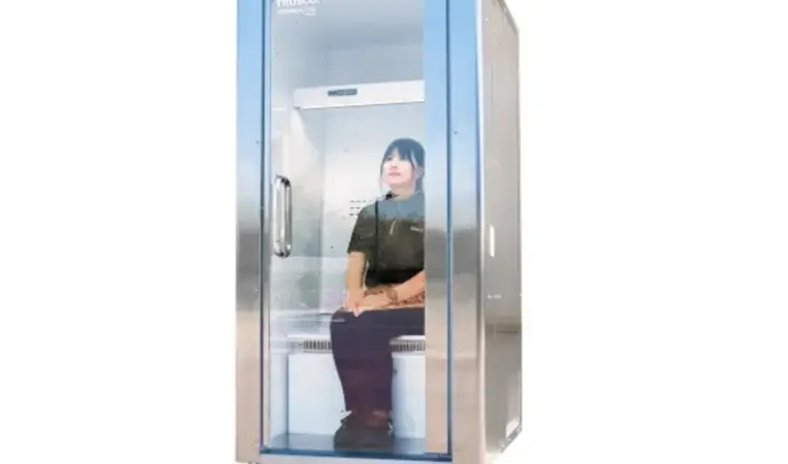
After warehouse worker Isao Tabuchi felt dizzy and exhausted from cycling to work amid Japan’s harsh summer heat, he turned to his company’s latest offering: a refrigerator designed for humans.
The device, roughly the size of a telephone booth, blasts jets of refreshing cold air. Although it was launched only this year, it has seen strong demand in a country where temperatures continue to rise.
Tabuchi, 51, from the industrial city of Higashi-Osaka in western Japan, said, “I felt a great sense of refreshment thanks to the device. Once you use it, you feel an intensely cool breeze.”
Trusco Nakayama, a Tokyo-based distributor of industrial equipment, announced that it had sold more than 300 units of the “Duo Himon Box” since April, at a price of 1.5 million yen ($9,400).
Chiyoko Yamamoto, the company’s sales agent, noted that its customers include construction sites, factories, and warehouses, adding that the company plans to expand its services to include golf courses in the future. Baseball fields may also show interest.
She added that some company employees were initially skeptical about the cooling device, saying it was “large, expensive, and not something that can be explained with words alone to make customers say, ‘Okay, let’s buy it.’ So there was a lot of skepticism.”
“An Extremely Hot Day”
Scientists say that human-caused climate change is increasing the frequency and intensity of severe heatwaves worldwide.
In 2015, Japan experienced its hottest summer on record.
This year, the Japan Meteorological Agency introduced a new term, “Kokushobi” (extremely hot day), to describe days when temperatures reach 40 degrees Celsius, urging the public to treat severe heatwaves as natural disasters.
Tokyo alone recorded approximately 120 heat-related deaths in the month ending in mid-August, while nearly 63,000 people nationwide required emergency medical care this summer.
Since last year, Japanese companies have been legally required to take stricter measures to protect employees working in extreme heat.
For example, construction sites must provide workers with appropriate clothing, such as vests equipped with fans, as well as air-conditioned rest areas and sun-protective canopies.
A new initiative launched this year allows government employees in Tokyo to wear short-sleeved clothing to work, a pioneering step in a country where formal dress codes remain prevalent.
The impact of rising temperatures on businesses in the world’s fourth-largest economy is real.
A survey conducted by Teikoku Databank in July found that 50% of companies reported that severe heatwaves had disrupted their operations.
Nearly 88% of those companies said they had strengthened efforts to help employees cope with the heat.
A Vital Investment
The “Duo Himon Box” can serve as a first line of defense against the heat, operating via a standard electrical outlet and being easily portable, while consuming relatively little energy, according to the manufacturer.
To prevent overuse, the device automatically shuts off after 20 minutes of operation.
Yutaka Kono, from Konoi, a screw and surveying equipment supplier where Tabuchi works, stated that investing in heat-mitigation measures has become essential to retaining current workers and attracting new employees.
Traditional air conditioners and spot coolers provide some relief, but Konoi has large open spaces where trucks and heavy machinery operate.
Kono told Agence France-Presse, “I was truly surprised by this new concept of placing people inside a kind of refrigerator, and I found it remarkable that entering the unit can lower body temperature to a safe level in a matter of moments.” He added, “That’s what made me think: we certainly want to install one of these devices.” Meanwhile, 24-year-old worker Taichi Konishi uses the device about three times a day. After manually moving heavy boxes of tools and metal parts between loading platforms, he walks calmly toward the unit, steps inside, sits down with a smile, and runs his fingers through his hair as if taking a shower. “It feels really great,” he said, adding, “I only stayed in for about two minutes, but even that short time was enough to stop sweating.”
