70 Years Without a Co-Wife: Tunisians Celebrate the Ban on Polygamy - Sarmad
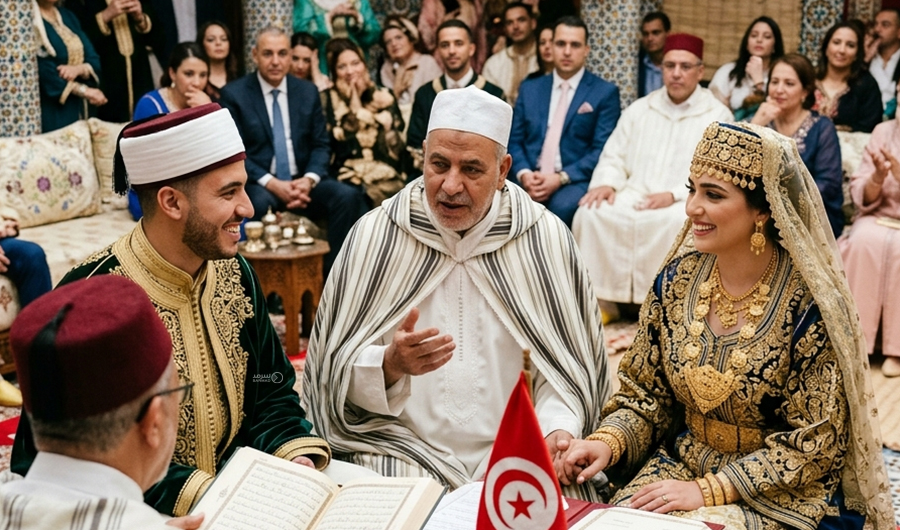
Ahead of Tunisia’s National Women’s Day on August 13, Tunisian women and feminist institutions began commemorating the 70th anniversary of the ban on polygamy, an event that has moved to social media platforms, where pride in one of the most significant gains for Tunisian women is mixed with fears of a resurgence of conservative discourse.
Tunisian accounts on X, Threads, and Instagram circulated posts bearing the phrase “70 years since the abolition of polygamy,” recalling August 8, 1956, as the date etched in Tunisian memory as the day the decision was made, before the Personal Status Code was officially promulgated five days later.
The account “Ultra Tunisia” published a blog post on X titled “The 70th Anniversary of the Ban on Polygamy,” while other Tunisian pages reposted images and documents related to the decision, viewing it as a turning point that transformed the family structure and women’s status in the country.
Interaction with the anniversary went beyond recalling the historical event, evolving into a debate over attempts to link declining fertility rates and delayed marriage to the ban on polygamy.
Tunisian writer Sami Jalloul rejected these arguments, asserting that the decline in fertility is linked to the rising age of marriage, women’s entry into the labor market, and the cost of living, rather than the Personal Status Code.
Jalloul stated that a referendum among Tunisian women would reveal that the acceptance rate for polygamy would not exceed one percent, emphasizing that “no Tunisian woman will accept polygamy,” regardless of their ideological or intellectual orientations.
He argued that this rejection reflects a profound shift in Tunisian family culture and that addressing demographic and social challenges does not require undermining the Personal Status Code, which he described as one of the most important gains for the Tunisian family.
However, available observations do not yet show a unified feminist campaign or a widely used hashtag, but rather a scattered wave of posts and journalistic pieces expected to expand as August 13, the official date for National Women’s Day, approaches.
The newspaper “Al-Eqonomiste Maghrebi” noted that the 70th anniversary arrives amid a Tunisian paradox: while women’s legal gains remain entrenched, conservative and hostile discourse is expanding on social media, amid economic and social crises and sporadic attempts to reopen the issue of polygamy.
Commemorations are not limited to the virtual world; the Ministry of Family, Women, Children, and the Elderly launched a program running from August 6 to 13 across various governorates.
The program includes seminars on the image of women in the media, honoring female researchers and successful women, exhibitions of women’s products, the launch of a national platform for women’s marketing, and the awarding of the Zoubida Bouachir Prize for women’s writing.
Additionally, the National Union of Tunisian Women organized a seminar on August 7 on the evolution of marriage contracts since the 2011 revolution, with the participation of academics, legal experts, and activists, as part of the celebrations marking seven decades since the Personal Status Code.
The seminar focused on transformations in the family and marriage contracts, as well as the legal and social challenges facing women’s gains, at a time when the Code remains one of the most sensitive legal texts in Tunisian public discourse.
Legally, the Personal Status Code was issued by decree on August 13, 1956, and entered into force on January 1, 1957. The date of August 8, widely referenced on social media, is associated with the stage of approving and politically preparing the decision.
Article 18 explicitly states that “polygamy is prohibited,” imposing a penalty of up to one year in prison and a fine on anyone who marries a second time before dissolving their previous marriage.
The Code also abolished oral divorce, restricted the dissolution of marriage to the judiciary, and required the consent of both spouses for marriage contracts.
The seventieth anniversary has acquired additional significance following the debate that took place in parliament in November 2025, when MP Abd al-Sattar al-Zara’i called for a review of the Personal Status Code and permitted polygamy, arguing that it could offer a solution to certain family problems and rising divorce rates.
His remarks sparked a wave of criticism, culminating in the resignation of MP Mohamed al-Yahyaoui from the parliamentary bloc to which al-Zara’i belongs.
Radhia al-Jarbi, president of the Union of Tunisian Women, described reopening the issue as a “political and social mistake,” while Women’s Minister Asma al-Jabiri pledged that the country would not roll back women’s gains.
Thus, the seventieth anniversary appears to be more than a mere celebration of an old law; it has become an occasion to defend a right that many Tunisian women view as integral to the identity of the state and society. Meanwhile, virtual and political debates reveal that the issue closed by the code seven decades ago remains open to renewed discussion.
