A Single Shot for $13: Laser Technology Enters the Race to Shoot Down Drones - Sarmad
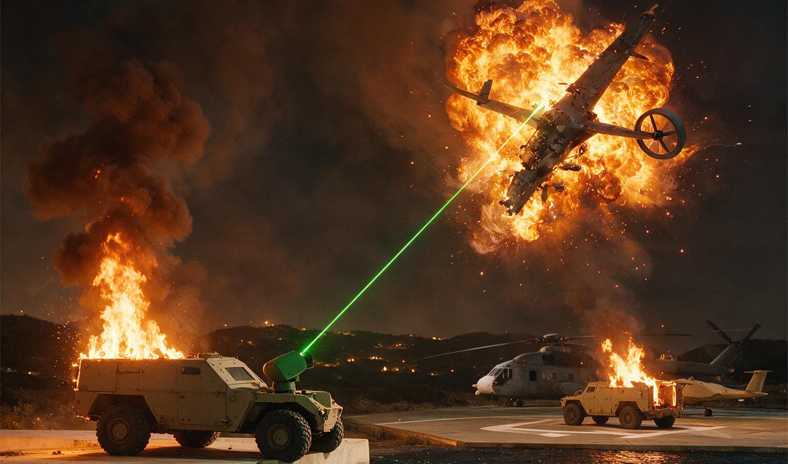
As drones have become one of the most prominent weapons of modern warfare, the international military race to develop faster and less expensive means of shooting them down is accelerating. The United States and other cou
Translated by Qiyas from سرمد — Original source
As drones have become one of the most prominent weapons of modern warfare, the international military race to develop faster and less expensive means of shooting them down is accelerating. The United States and other countries are turning to directed-energy weapons, primarily lasers, in an attempt to alter the traditional equation of air defense. Meanwhile, experts reveal the extent to which this technology can counter drones, as well as the constraints that still prevent its full reliance.
US Investment
In the latest step in this direction, the US military intends to allocate approximately $400 million to develop high-energy laser capabilities specifically designed to counter drones. This effort is part of a program aimed at transitioning directed-energy weapons from the testing and experimentation phase to operational capabilities, according to Al Arabiya.
This comes amid an expansion of US tests on anti-drone laser systems. In May 2026, the US military tested the AMP-HEL system, a high-energy laser mounted on a tactical vehicle, during a field exercise that included engaging a drone.
The US military is also working on the Enduring High Energy Laser program, which aims to develop a laser capability that can be integrated into air defense units, with a focus on providing a mobile and relatively low-cost means to counter unmanned aerial vehicles. The US military notes that the proliferation of cheap drones has led it to redirect part of its directed-energy weapons efforts toward short-range air defense.
British Laser
Earlier, the UK Ministry of Defence announced the testing of the DragonFire system, confirming that the operating cost of the laser is less than $13 per shot (£10), compared to air defense missiles that can cost hundreds of thousands of pounds each.
The UK confirmed that DragonFire successfully shot down high-speed drones during tests. It also signed a contract worth approximately $423 million (£316 million) to deploy the system on Royal Navy ships and destroyers starting in 2027, as announced by the British government.
Israeli and Chinese Lasers
In Israel, the Israeli military received the first operational Iron Beam system in December 2025, following a series of tests that included intercepting drones, rockets, and mortar shells.
The Israeli military states that the system will serve as an additional layer within the air defense network, alongside the Iron Dome, David’s Sling, and Arrow systems.
In China, smaller and more portable models have emerged to counter drones, including 2-kilowatt laser systems developed by Chinese companies, equipped with AI-supported targeting systems.
How Does a Laser Weapon Work?
A high-energy laser weapon does not fire a projectile or missile at the target; instead, it directs a concentrated beam of energy to a specific point on the drone’s body.
The beam remains focused on the target for a specific period, raising the temperature of a part of it to a level that causes damage, such as the engine, control components, or essential structural parts. This deprives the drone of its ability to fly, causing it to crash.
One of the most significant advantages of this technology is speed, as the beam travels at the speed of light. Additionally, the system does not require firing traditional ammunition for each interception; it primarily needs a power source capable of operating the laser.
A Weapon That Reverses the Economic Equation
Military and strategic expert, Brigadier Naji Malaab, states that the growing interest in laser weapons stems primarily from the significant shift in the nature of the threat posed by drones.
Al-Malaeb told Al Arabiya.net and Al Hadath that militaries are no longer facing only individual drones, but large swarms of low-cost unmanned aerial vehicles, noting that trials have demonstrated the laser’s capability to engage drones, particularly in terms of cost.
The cost of firing a laser beam can amount to just a few dollars or pounds in some systems, compared to the cost of an interceptor missile, which can reach hundreds of thousands or even millions of dollars, Al-Malaeb pointed out.
He noted that “the United States has developed this technology over decades, but it is no longer the exclusive domain of a single country. There are programs and systems in Britain, Israel, China, Germany, and other nations, and laser weapons are now present at defense exhibitions and in air defense development plans.”
However, current advancements are linked to increased power source capabilities and improvements in guidance and cooling systems, making the systems more viable for military use, Al-Malaeb added.
An effective weapon... but
Despite its significant advantages, the laser does not serve as a complete substitute for missiles, guns, or electronic warfare.
Lasers require a direct line of sight to the target, and the beam travels in a straight line. Their effectiveness is also affected by distance and weather conditions, particularly dust, sand, smoke, fog, humidity, and rain.
The system must keep the beam focused on a specific point on the target for a sufficient duration to cause damage, a task that becomes more complex as drones become faster or more maneuverable.
Another challenge emerges when dealing with drone swarms, as conventional lasers cannot destroy a large number of targets simultaneously. This underscores the continued need for radars, sensor systems, electronic warfare capabilities, guns, and missiles to intercept targets that exceed the laser’s capacity or attack in large numbers.
High-energy laser systems require substantial amounts of electricity and cooling systems, posing challenges that are particularly significant in hot environments, including the Middle East. Nevertheless, Al-Malaeb believes that obstacles remain that limit the laser’s ability to become a complete replacement for missiles.
