Ministerial Meeting to Support Jerusalem Rejects Changes to the City's Arab, Islamic, and Christian Identity - Sarmad
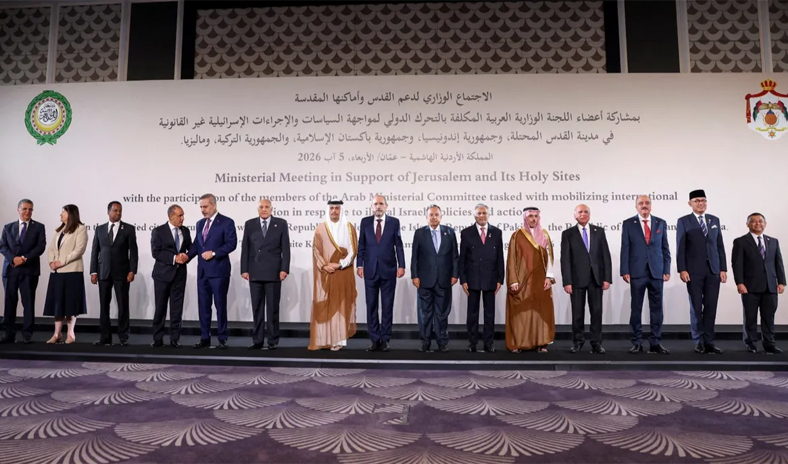
Ministers participating in the ministerial meeting on Jerusalem, held in Amman on Wednesday, condemned and rejected Israeli occupation policies and measures aimed at altering the Arab, Islamic, and Christian identity of occupied Jerusalem, as well as its legal and demographic status.
This was stated in a joint statement issued at the conclusion of the meeting held in the Jordanian capital, “to discuss the dangerous and unprecedented Israeli escalation in the city of occupied Jerusalem and its Islamic and Christian holy sites, and to launch a joint initiative to confront all illegal Israeli measures that are pushing the region toward further conflict.”
The meeting was attended by the Secretary-General of the Arab League and the foreign ministers of the Arab countries that are members of the Arab Ministerial Committee mandated to undertake international action against illegal Israeli policies and measures in occupied Jerusalem. These countries are Palestine, Jordan, Saudi Arabia, Egypt, Qatar, Iraq, Tunisia, Algeria, Morocco, and Somalia, along with the foreign ministers and representatives of Pakistan, Turkey, Indonesia, and Malaysia.
Participants agreed that Israeli policies and measures in Jerusalem are null and void, having no legal effect, and constitute “a blatant violation of international law and of Israel’s obligations as the occupying power.”
The statement warned that “Israeli assaults on Islamic holy sites in occupied Jerusalem constitute a blatant provocation of the sentiments of approximately two billion Muslims worldwide, and are driving toward the outbreak of a religious conflict whose repercussions will not be confined to the region, threatening regional and international peace and security.”
“No sovereignty for Israel over occupied Jerusalem”
The statement emphasized that “East Jerusalem is part of the occupied Palestinian territory over which Israel has no sovereignty, and is the capital of the State of Palestine, which must be realized as a free, independent, and sovereign state along the lines of June 4, 1967, to live in peace and security alongside Israel, based on the two-state solution, in accordance with international legitimacy resolutions and the Arab Peace Initiative, as the sole means to achieve a just and comprehensive peace, and reaffirming the New York Declaration for the peaceful settlement of the Palestinian question and the implementation of the two-state solution.”
The ministers also condemned Israeli violations at Al-Aqsa Mosque, as well as all attempts to change its established historical and legal status, including the imposition of temporal and spatial segregation. This includes escalating raids carried out by extremist Israeli settlers, ministers, and officials, facilitated and protected by the Israeli occupation authorities, as well as restrictions on worshippers’ access to the mosque and assaults against them, and the continuation of illegal excavation works beneath the mosque and in its vicinity.
The statement reiterated that Al-Aqsa Mosque in its entirety is a place of worship exclusively for Muslims, and that “the Jerusalem Waqf Administration and Al-Aqsa Mosque Affairs, under the Jordanian Ministry of Waqfs, Islamic Affairs, and Holy Places, is the sole legal authority with exclusive jurisdiction over the management of all its affairs and the regulation of access to it.”
Furthermore, the statement condemned Israeli violations affecting “Christian holy sites, which threaten the historic Christian presence in Jerusalem. These include restrictions on access to the Church of the Holy Sepulchre and the practice of religious rituals there, interference in church affairs, pressure on church institutions and their properties, and assaults targeting clergy, worshippers, and religious symbols.”
The participating ministers expressed “support for the Hashemite historical custodianship over the Islamic and Christian holy sites in Jerusalem,” as well as support for the resilience and empowerment of Jerusalem’s residents in the face of challenges, and for consolidating their presence in their city through the provision of all forms of developmental support.
The statement called on the international community and the Security Council to take immediate action to halt all illegal Israeli measures in occupied Jerusalem and its holy sites.
It pointed out that these measures “are escalating in the context of a systematic Israeli policy aimed at entrenching the occupation in Jerusalem and all occupied Palestinian territory, through settlement expansion, annexation of land, strangulation of the Palestinian economy, targeting Palestinian national institutions, rising settler violence, and attacks on the UN Relief and Works Agency for Palestine Refugees in the Near East (UNRWA). At the same time, Israel continues to violate the ceasefire agreement in Gaza and exacerbate the humanitarian catastrophe in the Strip, thereby undermining the two-state solution and all prospects for a just and comprehensive peace, while fueling tension and conflict in the region.”
Launching a Joint International Initiative
The ministers rejected any unilateral decision that undermines the legal status of occupied Jerusalem, including the opening or transfer of diplomatic missions to the city, affirming that such actions violate international law and relevant UN resolutions, and calling on these countries to rescind them.
The ministers announced the launch of a joint initiative to mobilize an effective international stance to halt these escalating and illegal Israeli practices, measures, and policies, and to compel Israel, as the occupying Power, to respect the existing historical and legal status quo in Jerusalem and its holy sites.
A sustainable mechanism of action will also be launched, including a media platform, “to document Israeli violations against holy sites and worshippers, expose them, and clarify their catastrophic repercussions that push toward religious conflict, before international organizations and global public opinion, and to provide the necessary support for this mechanism.”
The statement called for a joint ministerial meeting of the Organization of Islamic Cooperation and the Arab League during the high-level segment of the UN General Assembly in New York in September, to discuss the dangerous Israeli escalation in Jerusalem and its holy sites and ways to confront it.
Jordan’s King Calls for a Unified Stance
Jordan’s King Abdullah II called for a unified Arab and Islamic position and joint efforts to halt the “unprecedented” Israeli measures in Jerusalem, particularly at the Al-Aqsa Mosque compound.
In a statement, the Royal Court noted that the Jordanian monarch emphasized, upon receiving members of the Arab ministerial committee tasked with launching an international initiative to confront Israeli policies and measures in occupied Jerusalem, that Jordan will continue to play its historical and legal role in safeguarding Islamic and Christian holy sites in Jerusalem.
The King warned against “the danger of exploiting the unrest sweeping the region to impose a new reality in the holy city,” pointing to the risks of expanding the conflict due to continued Israeli escalation in the West Bank, along with attempts to annex land and expand settlements there.
