Qatar: Mediation efforts continue between Washington and Tehran to end the crisis - Sarmad
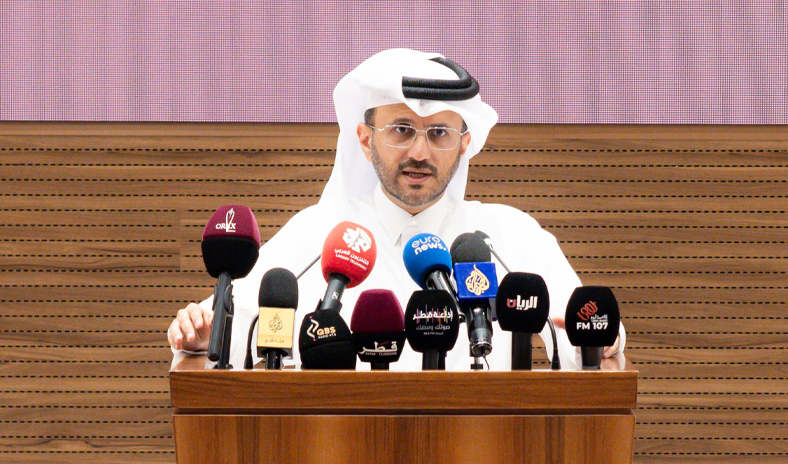
Dr. Majed bin Mohammed Al-Ansari, advisor to the Prime Minister and official spokesperson for the Qatari Ministry of Foreign Affairs, stated today that Qatar, Oman, and Pakistan have been making continuous efforts to fac
Translated by Qiyas from سرمد — Original source
Dr. Majed bin Mohammed Al-Ansari, advisor to the Prime Minister and official spokesperson for the Qatari Ministry of Foreign Affairs, stated today that Qatar, Oman, and Pakistan have been making continuous efforts to facilitate communication between Iran and the United States to bridge differences between the two sides. He noted that there is ongoing coordination among the Gulf Cooperation Council (GCC) countries and regional partners to support initiatives aimed at reaching a permanent resolution to the crisis.
During the weekly press briefing at the Ministry of Foreign Affairs, Al-Ansari clarified that the current priority is to contain the escalation and reopen avenues for diplomatic efforts, emphasizing the necessity of returning to the negotiating table as the optimal means to address existing disputes.
He pointed out that regional and international efforts to de-escalate tensions and promote a diplomatic solution remain ongoing. He affirmed that countries in the region are acting collectively to avoid any new escalation and to return to a dialogue track, with mediators continuing to work toward creating suitable conditions for resuming direct talks. He added that everyone hopes these efforts will yield positive results in the near future.
Al-Ansari highlighted that, drawing on its experience in international mediation, Qatar does not impose specific timelines for reaching agreements, explaining that the success of any accord depends on the readiness of the concerned parties to arrive at one.
He also mentioned that Qatari communications continue across various leadership levels with relevant parties, seeking progress in the negotiation process, while stressing that no final agreement has been reached thus far.
Regarding navigation security in the Strait of Hormuz, the advisor to the Prime Minister and official spokesperson for the Ministry of Foreign Affairs emphasized Qatar’s firm position calling for ensuring freedom of navigation in accordance with international law, and for not using the strait as a means of political pressure or to pursue unilateral interests. He explained that the minimum demand at this stage is a return to the previous status quo in the strait, consistent with international law and in coordination with all coastal and concerned states.
He stressed that any future arrangements concerning the management of the strait or the regulation of navigation there must be reached by consensus among all affected regional states, noting that ensuring the smooth flow of trade and freedom of passage represents a shared priority for the international community.
On the Gaza file, Dr. Majed Al-Ansari stated that the statement issued by mediators regarding ongoing Israeli violations in Gaza aims to hold the Israeli entity accountable for its obligations under the ceasefire agreement in the Strip. He noted that efforts remain ongoing in coordination with various parties, particularly the United States, alongside mediators from Qatar, the Arab Republic of Egypt, and the Republic of Türkiye, to ensure the accelerated implementation of the second phase of the agreement.
He indicated that the international community has become clearly aware of the party obstructing the implementation of the agreement on the ground. He added that moving to the second phase, as outlined in the plan by US President Donald Trump and supported by him, places full responsibility on the Israeli side. He pointed out that Hamas has fulfilled its commitments, whereas clear obligations remain on the Israeli side under the agreement that have not been implemented.
He recalled that the negotiation track since 2023 has witnessed several stages of Israeli delay in implementing the agreement’s provisions, referring to the recent Israeli escalation and targeting of civilians in the Gaza Strip, which resulted in the death of more than 30 martyrs. This, he noted, represents a new attempt to derail progress in the negotiations and hinder the achievement of peaceful solutions to the conflict.
He emphasized the necessity of the Israeli entity’s withdrawal from all occupied territories, affirming that occupation cannot be justified under any circumstances, and that Qatar’s positions are grounded in international law and relevant frameworks. He called on the international community to exert greater pressure to ensure the implementation of the agreement, facilitate the reconstruction of the Gaza Strip, and improve the humanitarian conditions of its residents, who have been suffering for more than two years.
Regarding the phone call between His Excellency Sheikh Mohammed bin Abdulrahman bin Jassim Al Thani, Prime Minister and Minister of Foreign Affairs, and Sergey Lavrov, Minister of Foreign Affairs of the Russian Federation, Al-Ansari stated that Qatar is committed to keeping all its regional and international partners informed about developments in the region. He noted that the current crisis extends beyond its regional implications, underscoring the need to enhance coordination and consultation with various international partners to support diplomatic efforts aimed at reaching solutions.
He clarified that communications with the Russian side continue across various files, and that the recent call addressed recent regional developments and the latest updates on ongoing diplomatic initiatives. He stressed the importance of keeping international partners informed about the progress of negotiations and the efforts made to advance them.
