Record surge in European gas prices to reach $637 in July - Sarmad
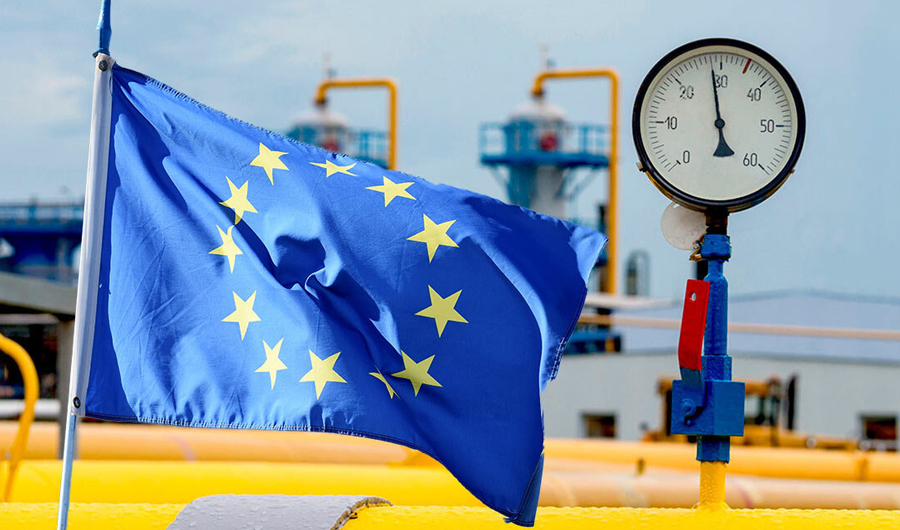
The average price of gas in Europe rose by 1.5 times in late July compared to the same month last year, reaching approximately $637 per thousand cubic meters, amid the conflict in the Middle East.
According to data from the London ICE futures exchange and calculations by TASS, futures contracts for gas closed on July 31 at around $709 per thousand cubic meters, a 39% increase compared to the end of the previous month ($510 on June 30). Gas prices in July were also 55% higher than the July 2025 average and 19% higher than in June of the previous year.
Overall, the average price since the beginning of summer stood at $586 per thousand cubic meters, which is 38% higher than the June-July 2025 index. In the first quarter of 2026, gas prices in European hubs averaged around $481, and approximately $550 in the second quarter.
The following monthly prices were recorded in Europe in 2025: “January: $517 (+53% year-on-year), February: $542 (+88%), March: $467 (+55%), April: $409 (+28%), May: $412 (+15%), June: $439 (+14%), July: $410 (+12%), August: $394 (-10%), September: $393 (-5.5%), October: $384 (-16%), November: $368 (-25%), December: $334 (-32%)”.
In 2026: “January: $415 (-20% year-on-year), February 2026: $396 (-27%), March: $632 (+35%), April: $544 (+33%), May: $570 (+39%), June: $534 (+22%), July: $637 (+55%)”.
The sharp rise in gas prices during July is primarily attributed to a new phase in the US-Iran conflict, which began on July 8 when US forces launched a series of strikes on the territory of the Islamic Republic in response to an attack on a commercial vessel in the Strait of Hormuz, and President Trump’s announcement to end the truce with Iran. Tehran retaliated by launching attacks on US targets in Bahrain, Jordan, Qatar, Kuwait, the United Arab Emirates, and Oman.
The closure of the Strait of Hormuz, through which one-fifth of global oil and gas supplies pass, disrupted shipments, driving up prices in Europe and Asia, where regions compete for available market quantities.
Meanwhile, Europe faces unprecedented challenges in its winter gas injection season. Storage injection rates in EU gas storage facilities recorded their lowest levels since monitoring began in 2011 during July, surpassed only by 2020 and 2024. Estimates suggest that Europe may fill its storage facilities to only 70-75% by the start of the traditional autumn-winter period, which would represent the absolute minimum level for the start of the heating season in history.
Under European Commission requirements, EU member states must ensure their storage facilities are filled to 90% between October 1 and December 1 each year, with a 10% flexibility allowance under difficult circumstances. This means net injection into storage facilities must reach at least 68 billion cubic meters by the beginning of next winter, whereas Europe has so far managed to inject only 46% of the required volumes.
This year’s filling rates were affected by a “losing battle” with Asia for available liquefied natural gas (LNG) quantities, rising fuel prices, and an intense heatwave in June and July, which increased electricity demand for cooling systems and air conditioning. Gas remains one of the primary sources for electricity generation, alongside nuclear, wind, and solar energy.
