Killed and injured after a strong earthquake strikes southern Japan - Sarmad
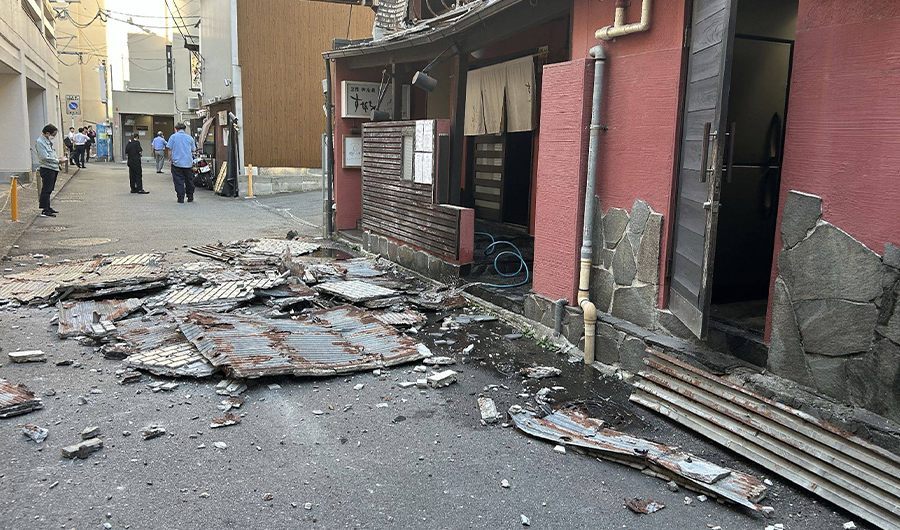
A 7.1-magnitude earthquake struck southern Japan on Tuesday, according to the Japan Meteorological Agency (JMA), which issued a tsunami warning before later lifting it. Dozens of injuries, fatalities, and building collap
Translated by Qiyas from سرمد — Original source
A 7.1-magnitude earthquake struck southern Japan on Tuesday, according to the Japan Meteorological Agency (JMA), which issued a tsunami warning before later lifting it. Dozens of injuries, fatalities, and building collapses were reported in the aftermath.
The quake’s intensity reached level 7, the highest on Japan’s seismic Shindo scale, according to the Associated Press.
Japan’s public broadcaster, NHK, reported that at least 50 people were hospitalized following the severe earthquake that hit the southwestern part of the country. It also reported that 12 houses collapsed, four of which still had people trapped under the rubble.
NHK later reported that a “large number” of people had died at a damaged shopping center following the earthquake.
Firefighters had previously reported that “many people” were trapped inside a shopping complex that was damaged after one of its floors collapsed.
In a statement, fire authorities said, “The second floor of a shopping complex in Kashima town collapsed, trapping many people inside.”
Local police had earlier reported receiving calls about an explosion at the Iyon Mall shopping center in Kumamoto, without providing any information on casualties or damage.
The JMA stated that the tsunami warning covered the nearby Ariake Bay on Kumamoto’s western coast, approximately 900 kilometers (560 miles) southwest of Tokyo. The Japanese government issued emergency earthquake warnings for the prefectures of Kumamoto, Nagasaki, Kagoshima, Fukuoka, Saga, Oita, and Miyazaki, all located on the southern island of Kyushu.
Kumamoto was previously hit by a devastating earthquake in 2016, which killed more than 50 people, injured 1,800 others, and damaged or destroyed tens of thousands of homes.
The JMA later announced the lifting of the tsunami warning, noting that “this earthquake occurred on land and no tsunami activity has been observed so far.”
Japanese Prime Minister Sanae Takaichi announced that several injuries, building collapses, and fires had been reported following the severe earthquake in the southwest.
Takaichi said, “We are still assessing the extent of injuries and material damage, but I have been informed of several injuries so far,” adding that there were “power outages, fires in some areas, and damage to roads, bridges, and collapsed buildings.”
The Nuclear Regulation Authority announced that no immediate malfunctions had been recorded at nuclear power plants following the quake.
Kyushu Electric Power Company, a local utility, stated that three nuclear reactors operating in the area at the time of the earthquake continued to operate normally.
The region hit by the earthquake is home to factories for companies such as Sony and TSMC, the world’s largest semiconductor contract manufacturer, according to Reuters. A Sony spokesperson said the company was assessing the situation. TSMC did not respond to a request for comment.
Kyushu Electric Power Company said power was cut to approximately 40,000 homes due to the earthquake. JR Kyushu railway company announced it had suspended services, including bullet trains.
NHK reported that one hospital in Kumamoto announced that more than 50 people had been injured in the earthquake.
Japan is one of the most earthquake-prone countries in the world, experiencing at least one tremor every five minutes. The country lies along the “Ring of Fire,” a chain of volcanoes and oceanic faults that partially encircles the Pacific basin, and accounts for about 20% of the world’s earthquakes with a magnitude of 6.0 or higher, according to Reuters.
