US seeks to develop carrier-launched drones with range exceeding 1,850 kilometers - Sarmad
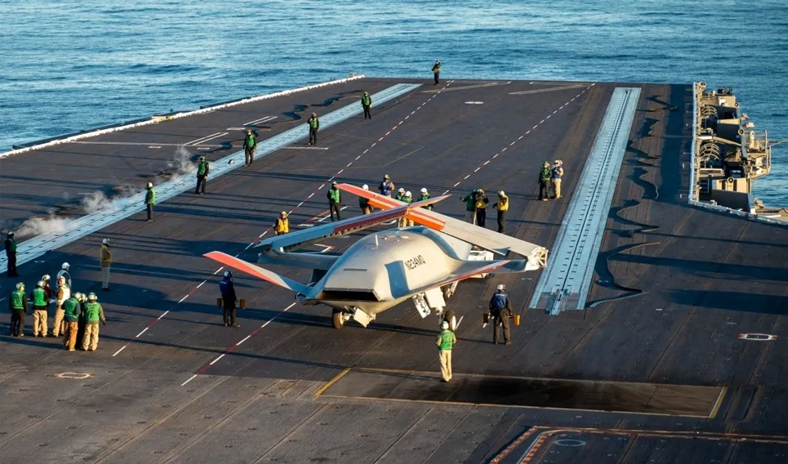
The U.S. Navy is seeking to develop a new generation of carrier-based unmanned combat aircraft capable of launching from nuclear-powered aircraft carriers and conducting combat missions at distances of no less than 1,000 nautical miles (1,852 kilometers) without refueling, as part of its plan to restructure its air wing in preparation for future wars.
On July 14, the Navy’s Aircraft Acquisition Management Office, part of the Naval Air Systems Command (NAVAIR), issued a “Sources Sought” notice. This request for information is directed at defense industry companies to gauge their capabilities in designing, producing, and deploying a new generation of unmanned aircraft intended for operation from nuclear-powered aircraft carriers, according to Asharq Al-Awsat.
The notice does not constitute a formal solicitation or purchase contract, but rather serves as an initial step to assess available industrial capacity before launching a new weapons program. The U.S. Navy will accept company responses until August 13.
This move falls under the “Air Wing of the Future” program, which aims to restructure the air power operating from aircraft carriers by transitioning from reliance on fourth-generation fighters, such as the F/A-18 Super Hornet, to an integrated force comprising manned and unmanned fifth- and sixth-generation aircraft operating jointly, according to Defense Blog.
The program is also part of a broader initiative known as the “Golden Fleet,” launched by the administration of U.S. President Donald Trump to expand and modernize the U.S. Navy’s capabilities in shipbuilding and military aviation. The goal is to accelerate the introduction of new combat platforms compared to the slow contracting processes that characterized previous decades.
The U.S. Navy’s approach builds on existing programs, most notably the MQ-25A Stingray unmanned aerial vehicle developed by Boeing for aerial refueling. The aircraft conducted its first operational test in April 2026, paving the way for deployment on Nimitz- and Ford-class aircraft carriers. These nuclear-powered supercarriers, designated CVN in military terminology, form the backbone of U.S. strike carrier groups worldwide.
Simultaneously, the Cooperative Combat Aircraft (CCA) program continues to develop low-cost unmanned aircraft designed to operate alongside manned fighters as “Loyal Wingmen,” thereby extending operational range and reducing risks to pilots.
Companies Anduril, Boeing, General Atomics, and Northrop Grumman are competing to develop a carrier-capable version, while Lockheed Martin is developing the software infrastructure required to control multiple unmanned aircraft through a single operator.
The new information request imposes more ambitious requirements. The U.S. Navy mandates that the new aircraft be fully compatible with the launch and recovery systems used on Nimitz- and Ford-class carriers. These systems rely on steam-powered catapults or the Electromagnetic Aircraft Launch System (EMALS), along with arresting gear to capture aircraft during landing.
At the same time, the U.S. Navy expressed interest in designs that enable vertical takeoff and landing, allowing operations from smaller naval platforms such as destroyers and mobile sea bases without the need for a full-length flight deck.
For strike-capable aircraft, the Navy specified a minimum combat radius of 1,000 nautical miles from the aircraft carrier without aerial refueling, a requirement that reflects the growing threat of long-range anti-ship missiles, which now compel carriers to conduct operations from greater distances away from combat zones.
The notice also requires companies to address the so-called “Spot Factor,” meaning the footprint an aircraft occupies on the carrier deck relative to its combat capabilities, given that flight deck space is one of the most limited resources on carriers, with all aircraft competing for storage, takeoff, and landing areas.
The U.S. Navy further mandates that any new system integrate directly with existing control systems for unmanned naval aviation, already used in the MQ-25 program, rather than establishing independent control architectures for each new unmanned aircraft.
The notice also emphasized industrial and production aspects, requesting companies to submit manufacturing plans demonstrating their ability to rapidly scale up production in the event of a large-scale conflict, along with proposals to reduce the per-unit production cost to ensure the program’s long-term sustainability.
Companies must also provide a timeline including the date of the first test flight, the first successful carrier landing, and the achievement of Initial Operational Capability (IOC), giving the Navy a realistic view of the time required to transition the project from concept to an operational combat platform.
The U.S. Navy stressed that issuing the request for information does not commit it to awarding contracts to any company. However, the nature of the stated requirements—focusing on combat radius, autonomy, efficient use of carrier space, and production speed—reflects a shift in the Navy’s vision for the future of its air wing, aligning with the demands of future conflicts rather than relying on operational concepts that dominated previous wars.
