The Law before Parliament: We are writing a new history.. Syria consolidates the state of institutions - Sarmad
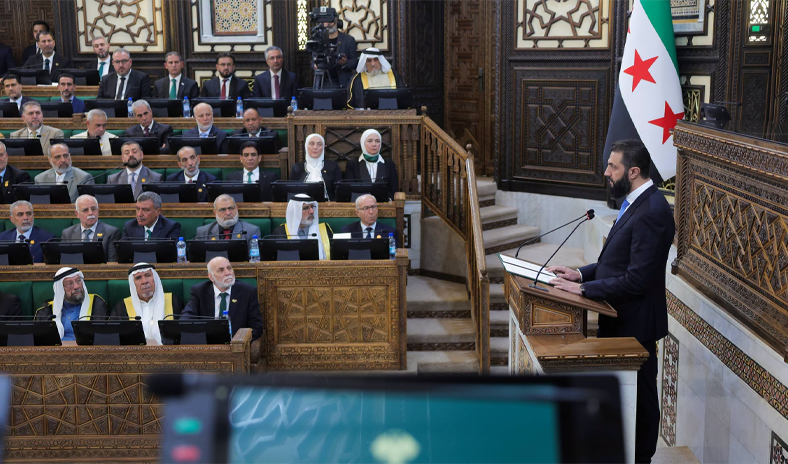
Syrian President Ahmed al-Sharaa called for consolidating the state of institutions and the rule of law. In his speech at the opening session of the new People’s Assembly on Sunday, al-Sharaa said that humanity “has been
Translated by Qiyas from سرمد — Original source
Syrian President Ahmed al-Sharaa called for consolidating the state of institutions and the rule of law. In his speech at the opening session of the new People’s Assembly on Sunday, al-Sharaa said that humanity “has been searching since its inception for the optimal path to manage its interests, as acceptance and satisfaction are means to dispel discord.” He added that Syria “is today writing a new history that reflects its civilization, values, and heritage.” Al-Sharaa emphasized that the current stage imposes on everyone the responsibility of building the nation and its people, and prioritizing the public interest.
He pointed out that “consultation and the exchange of views represent the best path to reaching sound decisions, and that diversity of opinions contributes to achieving consensus and limits division and disagreement.” He noted that opinion “is not infallible, and its success depends on good faith, avoiding personal bias, and prioritizing the public interest.”
Al-Sharaa viewed the current phase as a transition from liberating the country and restoring freedom to consolidating state institutions on the basis of responsibility and competence, thereby ensuring the preservation of dignity and respect for citizens’ will. He stressed that rebuilding the economy, improving services, creating an investment-friendly environment, providing job opportunities, and increasing production constitute a shared national responsibility among various state institutions.
The Syrian president stated that the People’s Assembly plays a pivotal role in this stage by enacting legislation that keeps pace with the reconstruction process and meets the aspirations of Syrians. He urged assembly members to make the legislative institution “a model of responsibility and competence,” and to contribute to consolidating a culture of dialogue, the rule of law, and respect for institutions, affirming that they are partners in building a new Syria.
For his part, Muhammad Taha al-Ahmad, head of the Supreme Commission for People’s Assembly elections, described the convening of the session as “a historic turning point,” stating that it represents “the blood of the martyrs” and sends a message to the world that “Syria has shaken off the dust of war.” He added that what has been achieved “cannot be measured by words, but by the scale of sacrifices made by the Syrian people.”
The convening of the assembly’s first session follows the completion of its formation, after President al-Sharaa issued a decree on July 1 naming its 207 members out of a total of 210. Among them, 137 members were selected through indirect elections, and 70 were appointed by the president in accordance with the powers stipulated in the Constitutional Declaration. The three seats reserved for As-Suwayda Governorate remained vacant due to the impossibility of holding elections there.
The new assembly enjoys broad legislative powers, most notably the formation of a committee tasked with drafting the new constitution, a step considered one of the key milestones of Syria’s transitional phase.
