Human Rights Council adopts resolution submitted by Kuwait - Sarmad
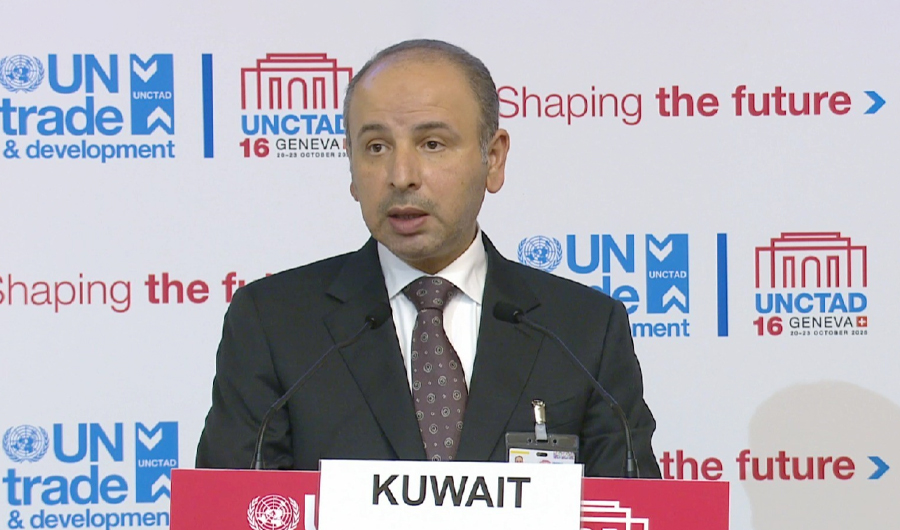
UN Human Rights Council adopts resolution submitted by Kuwait • To address the catastrophic humanitarian situation resulting from armed conflicts The United Nations Human Rights Council, at its current 62nd session, unan
Translated by Qiyas from سرمد — Original source
UN Human Rights Council adopts resolution submitted by Kuwait
• To address the catastrophic humanitarian situation resulting from armed conflicts
The United Nations Human Rights Council, at its current 62nd session, unanimously adopted a resolution submitted by the State of Kuwait titled “Protection of humanitarian workers and ensuring access to aid in armed conflicts,” aimed at addressing the catastrophic humanitarian situation civilians are enduring as a result of armed conflicts.
Ambassador Nasser Al-Hin, Kuwait’s Permanent Representative to the United Nations and other international organizations, praised the Council’s adoption of the resolution in his speech before the 62nd session, which began on June 15 and continues until the 8th of this month. He stated that the issuance of this resolution represents an urgent legal and political response to address the serious deterioration in the operational environment for humanitarian work.
He added that the resolution aligns with alarming indicators in the UN Secretary-General’s report, which classified the previous year as the deadliest in the history of relief work, resulting in the deaths of 373 humanitarian workers, the vast majority of whom were local and national staff.
Ambassador Al-Hin emphasized that the resolution places an explicit obligation on conflict parties to protect national staff, combat misinformation, and halt attacks on relief teams, particularly volunteers and local workers who face compounded risks. It also calls for decisive action against smear campaigns, media misinformation, and hate speech directed against neutral humanitarian work.
He noted that this resolution constitutes a significant addition to the UN’s body of resolutions and a historic document for strengthening human rights, based on solid strategic pillars. The first pillar affirms the interdependence and complementarity between international humanitarian law and international human rights law, stressing that the protection of fundamental rights remains in force and continuous during times of conflict and occupation.
The second pillar is the absolute criminalization of obstructing aid and the condemnation of arbitrary delays and illegal denial of humanitarian access. Depriving civilians of essential goods and materials necessary for survival, such as food, water, medicine, and petroleum derivatives, constitutes a grave violation that directly undermines the right to life, the right to health, and the right to a decent standard of living.
He further stated that combating impunity and enforcing accountability by urging states to conduct immediate, independent, and comprehensive investigations into violations committed against individuals and humanitarian facilities forms a cornerstone for ensuring the rule of law.
Ambassador Al-Hin warned that any military escalation affecting the safety and freedom of navigation in international waterways, particularly the Strait of Hormuz, would trigger a humanitarian disaster whose boundaries would not be confined to the conflict zone but would extend to choke global supply chains. He noted that closing or obstructing movement in such vital straits constitutes an indirect application of a policy of collective deprivation.
He explained that the interruption of energy flows and the halt of food and medicine shipments cause a complete paralysis of international relief operations, raising indicators of civilian suffering worldwide to unprecedented levels. This places those responsible under direct international condemnation in accordance with the spirit of this new UN resolution.
Ambassador Al-Hin highlighted the mandate given to the High Commissioner for Human Rights to prepare an objective and comprehensive report on the human rights impact of violations committed against individuals and humanitarian facilities, while issuing an urgent call to the international community and all parties to armed conflicts to immediately move from the stage of theoretical commitment to the resolution to the stage of actual implementation, in order to ensure the safety of civilians and United Nations teams, and to keep vital corridors for the economy and human livelihoods free from political and military conflicts.
