Trump: Ceasefire with Iran 'on the verge of collapse'
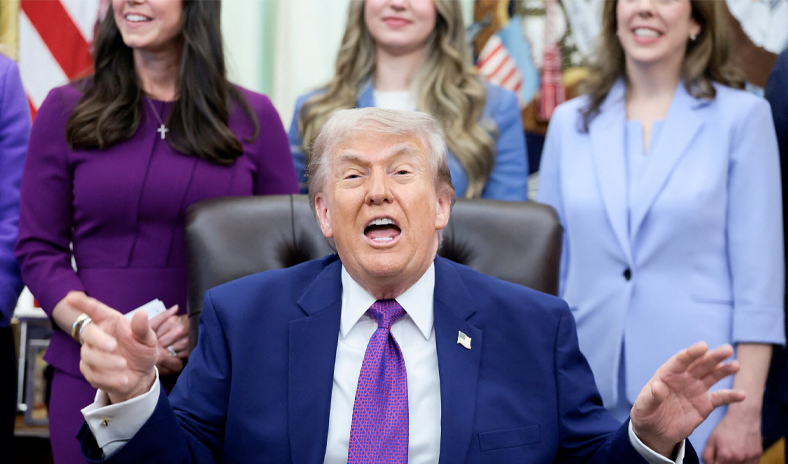
US President Donald Trump described the ceasefire with Iran as on the verge of collapse after Tehran rejected its proposals, raising fears of continued conflict and its impact on global trade.
Translated by Alqyas from Sarmad — Original source
(Royters) – US President Donald Trump said on Monday that the ceasefire with Iran is “on the verge of collapse” after he rejected Tehran’s response to a peace proposal put forward by Washington, amid fears that the nearly 10-week-old conflict, which has claimed thousands of lives and halted energy trade, could be prolonged.
Days after the United States presented an offer in hopes of resuming negotiations, Iran issued a response on Sunday focusing on ending the war on all fronts, particularly in Lebanon, where Israel, a US ally, is fighting the Iran-backed Hezbollah group. Trump immediately rejected this response.
When asked about the status of the ceasefire, Trump told reporters, “I describe it as the weakest currently, after reading this garbage (response) they sent us. I didn’t even finish reading it.”
In its response, Tehran also demanded compensation for war damages and stressed Iran’s sovereignty over the Strait of Hormuz, calling on the United States to end its naval blockade, ensure no further attacks are launched, lift sanctions, and terminate the US ban on Iranian oil sales.
The United States had proposed ending hostilities before starting talks on the most sensitive issues, including Iran’s nuclear program.
Tehran defended its position on Monday.
Ismail Baghai, spokesperson for Iran’s Foreign Ministry, said, “Our demand is legitimate: ending the war, lifting the blockade and piracy (by Americans), and releasing Iranian assets unjustly frozen in banks due to US pressure.”
Baghai added, “Safe passage through the Strait of Hormuz and establishing security in the region and Lebanon are other demands of Iran, and this is a generous and responsible offer for the security of the region.”
Brent crude futures rose 2.7 percent to around $104 per barrel, as the deadlock led to a near-total closure of the Strait of Hormuz. Before the war broke out on February 28, the waterway transported about one-fifth of global oil supplies and has become one of the strongest leverage points in the conflict.
A Reuters poll on Monday showed that disruptions caused by the strait’s closure have forced oil producers to cut exports. OPEC oil production fell sharply in April to its lowest level in over two decades.
Although traffic through the Strait of Hormuz is extremely low compared to pre-war levels, shipping data from Kpler and the London Metal Exchange showed that three crude oil tankers crossed the waterway in recent days, with their tracking devices turned off to avoid Iranian attacks.
The data also showed a second Qatari liquefied natural gas tanker attempting to cross the strait, days after the first shipment of its kind passed under an agreement between Iran and Pakistan.
Occasional clashes around the strait in recent days have tested the ceasefire that came into effect in early April.
Polls show the war is unpopular among US voters, who are facing a sharp rise in gasoline prices less than six months before midterm elections that will determine whether Trump’s Republican Party retains control of Congress.
The United States has also received minimal international support, as NATO member states have rejected calls to send ships to open the Strait of Hormuz without a comprehensive peace agreement and an international mandate to secure the passage.
A Turkish diplomatic source said on Monday that Foreign Minister Hakan Fidan will visit Qatar on Tuesday to hold talks on the Iran war, its impact on the Gulf region, and efforts to ensure safe navigation in the Strait of Hormuz. Fidan maintains close ties with the United States, Iran, and Pakistan, which has played a mediating role since the outset of the war.
It remains unclear what new diplomatic or military steps might be taken in the near future. Trump is expected to arrive in Beijing on Wednesday. As pressure mounts to end the war and the global energy crisis it has ignited, Iran is among the topics Trump and Chinese President Xi Jinping are scheduled to discuss.
Trump is counting on China to use its influence to push Tehran to reach an agreement with Washington.
Baqai noted that China could instead exploit the visit to resist objectives the United States seeks to achieve in the Gulf region.
When asked about Trump’s visit to China, he said, “Our Chinese friends know very well how to exploit such opportunities to warn of the consequences of U.S. actions that lack a legal basis and involve intimidation of regional security and peace, as well as global economic stability and international security.”
Responding to a question about whether combat operations against Iran had ended, Trump said in remarks broadcast on Sunday, “They have been defeated, but that does not mean it is over.”
Israeli Prime Minister Benjamin Netanyahu said the war is not over because “more work remains” to remove enriched uranium from Iran, dismantle enrichment facilities, and confront Iran’s proxies and ballistic missile capabilities.
In an interview broadcast on Sunday on CBS News, Netanyahu said diplomacy is the best option but did not rule out the use of force.
Clashes also continued in southern Lebanon between Israel and Hezbollah, despite a U.S.-brokered ceasefire that took effect on April 16.
