Oman Begins Electric Vehicle and Battery Cell Manufacturing in Duqm
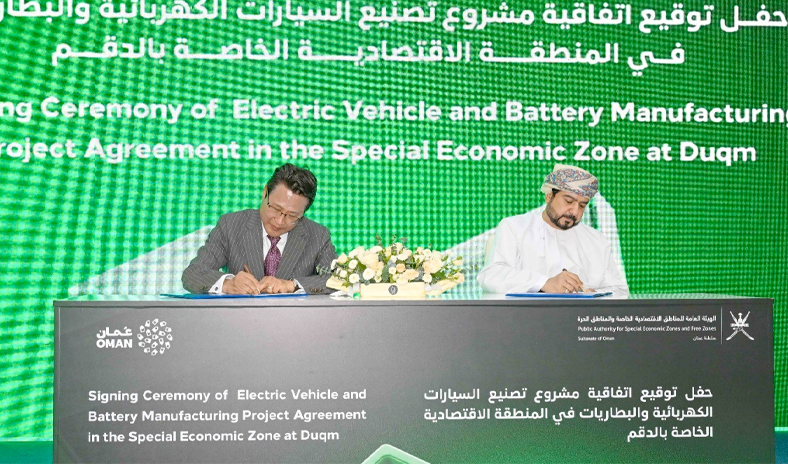
The Authority signed an agreement with a Korean company to produce electric vehicles and battery cells worth 96.2 million Omani rials
Translated by Alqyas from Sarmad — Original source
(KUNA) — The General Authority for Special Economic Zones and Free Zones in Oman signed an investment agreement today, Sunday, with a South Korean company for the production of electric vehicles and battery cells at the Special Economic Zone in Duqm, at a cost of 96.2 million Omani rials (approximately 250 million US dollars).
Ahmed Al-Dhaib, Deputy Chairman of the Oman Economic Zones Authority, said in a speech during the signing ceremony with ALB&T that the project aligns with government efforts to localize various industries in the Sultanate and attract multiple investments in the vehicle sector. In this regard, he referred to an agreement signed earlier this month to establish an advanced center for assembling and producing cars in the Khaznah Economic City in partnership with the Chinese group Spruce.
Al-Dhaib added that this project represents a new addition to the vehicle sector in the Duqm Special Economic Zone, noting that it is the second in this sector following the Kora car factory, which began production several years ago.
He emphasized that the Authority aims, through these projects, to localize advanced industries in the electric vehicle sector and enhance investment in green manufacturing industries, in line with the objectives of Oman Vision 2040 and the Sultanate’s strategy for net-zero carbon emissions and the transition to clean energy.
For his part, Ahmed Akkak, Chief Executive Officer of the Duqm Economic Zone, said in a similar speech that the electric vehicle and battery cell production project reflects the growing confidence in Duqm as a promising investment destination at both the regional and international levels.
According to the Omani Authority, the project with the South Korean company ALB&T will be implemented in two phases, with a production capacity reaching 60,000 cars annually and 1.6 million battery cells upon completion of the second phase.
The project, expected to resume commercial production in March 2028, marks a step toward developing an integrated industrial ecosystem for the electric vehicle sector in the Duqm Special Economic Zone by strengthening value chains related to batteries and other components, thereby helping to attract complementary industries in the future.
In its first phase, the project will focus on meeting demand in the local Omani market, with plans for gradual expansion into the markets of the Gulf Cooperation Council countries, the Middle East, and North Africa.
