Military and Security Institutions: The Impregnable Shield for Protecting the Homeland and Resisting Iranian Aggression
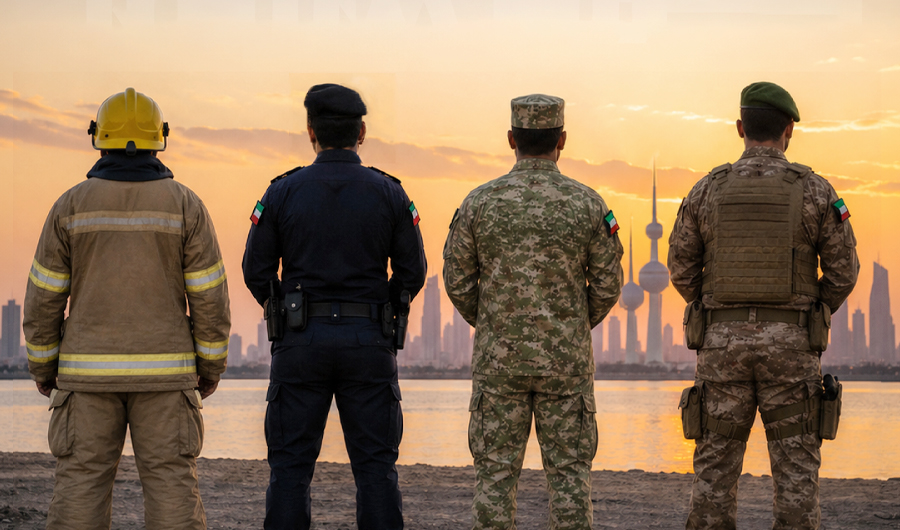
Military and security institutions succeeded in countering Iranian attacks through comprehensive cooperation.
Translated by Alqyas from Sarmad — Original source
With unyielding resolve and steadfast determination, and hearts overflowing with love for Kuwait, the sons of Kuwait’s military and security institutions inscribed an immortal record in the ink of blood, sacrifice, and selflessness, forming Kuwait’s impregnable shield through an integrated and harmonious operational system that thwarted the baseless Iranian aggression.
The resilience of those vigilant eyes is embodied in continuous field operations and deep operational coordination that linked the Kuwaiti Armed Forces, the Ministry of Interior, the National Guard, the General Fireforce, and other relevant entities, creating a defensive wall characterized by the highest standards of competence and readiness.
From the vigilance of the Armed Forces in countering aggression breaches, to the National Guard securing vital sites and providing strategic support and reinforcement, to the Ministry of Interior’s preemptive strikes dismantling cells aiming to destabilize the country’s security, and culminating in the heroism of the General Fireforce personnel, roles were integrated into a single system that imposed a steel cordon to safeguard the nation’s security and protect its assets.
Since the outbreak of war on February 28 last year, the Ministry of Defense has served as the cornerstone of the comprehensive national response system, encompassing its military, field, and logistical dimensions. This presence was evident in the mobilization of all the Ministry’s capabilities, which relied on proactive plans and highly qualified human and technical resources.
Kuwaiti Army units and formations began their duties defending the country’s airspace and territory on the afternoon of Saturday, February 28. The Armed Forces and air defense systems monitored and tracked hostile targets and engaged them in accordance with established operational procedures.
Thanks to the high state of readiness and the patriotic spirit of the Armed Forces, the country was able, from the first hours, to respond to the challenges imposed by the baseless aggression through an organized sequence of defensive and protective measures that encompassed all facets of the state.
Field movements were accompanied by an intensive media effort characterized by responsibility and clarity. The Ministry of Defense, through a series of consecutive official statements, sought to convey direct messages of reassurance to citizens and residents, highlighting the maximum readiness of all army sectors and units to confront various potential scenarios.
The Ministry’s statements emphasized that operations are managed under a high-level coordination system linking the military institution with all state agencies and institutions to ensure unified decision-making and rapid response, in addition to adopting a policy of updating information and facts in real time to keep public opinion informed about the true situation.
On April 10 this year, the Kuwaiti Armed Forces announced that the toll of the baseless Iranian aggression on the country amounted to 852 drones, 354 ballistic missiles, and 15 cruise missiles. It also announced that the Explosive Ordnance Disposal (EOD) group under the Army Engineering Corps handled a large number of reports as part of continuous field efforts to deal with debris and remnants resulting from the aggression.
The group also handled fragments and explosive remnants in separate operations aimed at their disposal, while army fire teams responded to several reports in accordance with established procedures.
Ministry of Defense statements revealed that hostile targets included military bases, vital oil facilities, power stations, and several operational facilities belonging to the Kuwait Petroleum Corporation, one building of the Ministries Complex, Kuwait International Airport, several Kuwaiti ports, and warehouses of a private logistics company.
The Ministry of Defense issued its first statement on February 28, affirming that the Armed Forces are carrying out their duties to defend Kuwait’s sovereignty and counter any threats to the country’s security and stability. It urged citizens and residents to stay away from any objects or debris resulting from interception operations or falling missile wreckage, advising them not to approach or touch such items and to immediately report them to the relevant authorities.
The National Guard also emerged as a cornerstone in the triangle of defense ensuring the nation’s security and stability, with its efforts integrated into a unified operational framework alongside the Army, Police, and General Fireforce.
The National Guard’s efforts were distributed across a range of tracks, including defensive integration, support for the internal front, combat readiness, air and facility protection, as well as technical operations and radiation monitoring.
Who could forget the beginning of last March, when members of the Explosive Ordnance Disposal unit within the National Guard’s Engineering Battalion faced a dangerous confrontation with the warhead of a drone that had landed at the bottom of a fuel tank saturated with oil and flammable chemical vapors, turning the site into a time bomb.
This complex operation, which concluded with the successful extraction and destruction of the warhead after seven days of arduous work under time pressure and the hazardous conditions of the site, was merely one chapter in a broader narrative of heroism embodied by Kuwait’s military and security institutions on the ground throughout the 40 days of the reprehensible Iranian aggression.
In parallel, amid strategic deployment, the Duty Force of the National Guard continued to carry out its missions with high efficiency and readiness, securing 67 vital sites within an integrated system to protect the country’s critical infrastructure and providing support and assistance to various state entities.
The National Guard forces also demonstrated distinctive defensive capabilities in countering hostile drones and “Dornier” aircraft through a precise weapons system adhering to specific firing arcs and carefully studied geographical ranges.
This mechanism included directing interception and firing operations to drop wreckage and munitions in open areas, whether in uninhabited land zones or at sea, to neutralize the threat without causing damage to critical infrastructure or endangering lives and property, reflecting operational discipline and a commitment to environmental safety during combat missions.
The National Guard placed the system of the Sheikh Salem Al-Ali Center for Chemical Defense and Radiation Monitoring at the service of Kuwait’s national objectives, in cooperation with state entities, to safeguard the country’s security and protect its environment from pollution.
The Center represents a cutting-edge technical interface, equipped with the latest high-precision equipment and devices, undertaking vital tasks including chemical and radiation detection through an integrated network of fixed monitoring stations, reinforced by specialized field reconnaissance patrols.
This system continuously records accurate readings of pollution levels, enhancing the efficiency of immediate response to any potential radiation leaks and ensuring full control in accordance with the highest security and environmental standards.
Concurrently, the signs of security vigilance were evident in the performance of the Ministry of Interior, which successfully transformed current challenges into a field of excellence through three tracks: tightening security control, executing precise preemptive strikes, and maintaining effective media communication.
These efforts began with the adoption of a comprehensive preventive strategy that included launching a package of precautionary measures to ensure the efficiency of field operations, such as banning the use of “drones,” prohibiting the filming of security operations, and suspending maritime activities, camps, and public events to reduce risk opportunities.
In parallel, the Ministry raised the alert level at vital sites and border crossings, supported by inspection tours at various levels to emphasize maximum readiness and preparedness to handle diverse circumstances.
On the front of direct confrontation with threats, security agencies since mid-March last year successfully transitioned from a response posture to an initiative-driven approach by launching targeted preemptive strikes that foiled sabotage plots. They managed to detect and dismantle four cells targeting national security and destabilizing the country, which included Kuwaiti citizens, residents, and non-Kuwaiti individuals whose citizenship had been revoked.
These strikes extended to the digital field through the apprehension and pursuit of rumor and fake news spreaders. This was accompanied by the Ministry of Interior’s reaffirmation of its resolve to thwart any plans threatening the country’s security or exploiting its territory to support terrorist groups or entities.
The Ministry stressed that security personnel continue to perform their duties with dedication and high vigilance across various domains to safeguard national security and the safety of all, maintaining full readiness to respond immediately to any threat or field development under exceptional circumstances.
Meanwhile, effective media communication by the Ministry’s spokespeople kept the public continuously informed about the scale of field efforts, accurate statistics on developments, and the handling of various reports. This also helped cut off misleading interpretations, enhance public awareness, and reinforce responsible behavior among citizens and residents.
From heroic efforts to defend the nation’s sanctity to epic measures in containing damages, the General Fireforce recorded exceptional chapters of success in combating fires resulting from the unprovoked Iranian aggression, turning major challenges into living models of control and efficiency.
In one of the complex field operations, fire teams successfully controlled a massive fire that broke out in fuel tanks at Kuwait International Airport following a treacherous drone attack. Firefighters executed meticulously planned operations over 58 consecutive hours of heroic work.
From the first moments of the aggression, the Fireforce responded to hundreds of field reports, including more than 90 unusual incidents involving fires caused by shrapnel or direct targeting, in addition to carrying out readiness tasks and securing sites across the country.
Operationally, the Force activated the “Major Incident Room” under the leadership of the Commander of the General Fireforce, Major General Talal Al-Roumi, summoning directors of departments and heads of relevant centers and units. Liaison officers were also attached to relevant entities to provide support and reinforcement to military and civilian bodies, alongside activating technical support and service teams and securing vital sites.
The Force also enhanced its precautionary measures to handle emergency events, which included dividing the “Search and Rescue Center” into four teams: Southern, Northern, and two teams for the Central region. The “Hazardous Materials Center” was divided into three sections: Northern, Central, and Southern. Additionally, female personnel were integrated into decontamination teams, two temporary fire stations were established, and full readiness was raised for all its land, sea, and airport centers.
The Force established a specialized media center to disseminate reliable and accurate information, serving as a secure link between the institution and the public under the exceptional circumstances the country is experiencing.
The flow of information from various state agencies, notably security and military bodies, particularly through daily media briefings, helped curb rumors and demonstrated astute crisis management at all levels.
Kuwaiti personnel in the country’s military and security institutions have demonstrated the highest levels of sacrifice by offering a group of martyrs and dozens of wounded on the fields of honor, ensuring that their sacrifices remain a living testament to the steadfast creed of loyalty ingrained in the hearts of the nation’s defenders.
