'Liberation of Kuwait': An Epic of People's Resilience and Leadership's Acumen Crowned by International Consensus
US President George H.W. Bush announced the liberation of Kuwait, marking the end of aggression and a victory for international law.
Translated by Alqyas from Sarmad — Original source
“The Ambassador of Al-Sabah… Tonight, Kuwait is liberated.” With these words, which captured the depth of the moment, U.S. President George H.W. Bush, standing beneath the dome of the U.S. Congress, declared the completion of the chapters of the epic liberation of the State of Kuwait, gazing with eyes full of accomplishment at Kuwait’s ambassador to the United States at the time, Sheikh Saud Al-Nasser Al-Sabah, may God have mercy on him.
Hardly had the echo of his words settled in Washington when capitals of decision-making around the world erupted with a wave of reactions, laden with exceptional praise for the resilience of the Kuwaiti people and the remarkable political acumen with which Kuwait’s political leadership conducted the struggle politically and diplomatically, as well as for the unprecedented global coalition that brought to an end one of the most dangerous crises in the history of the contemporary international system.
U.S. President George H.W. Bush stated in a televised address to the American public that the liberation of Kuwait represented a victory for international law, emphasizing that aggression could not serve as the basis for political legitimacy, and that the international community had demonstrated its capacity for joint action when a member state of the United Nations was subjected to aggression.
For her part, British Prime Minister Margaret Thatcher described the liberation of Kuwait from the invaders as “a day of victory for justice and the rule of law.”
Thatcher praised the steadfastness and composure of Kuwaitis in the face of occupation, considering their resilience to have played a pivotal role in maintaining the international momentum supporting liberation.
For his part, French President François Mitterrand, in a statement issued from the Élysée Palace, affirmed that Kuwait’s restoration of its sovereignty represented a success of shared international will, and that respect for internationally recognized borders constituted the cornerstone of global stability.
German Chancellor Helmut Kohl, for his part, viewed the liberation of Kuwait as a step that strengthened confidence in the international system following the end of the Cold War, emphasizing that a unified position within the Security Council formed a crucial element in the legitimacy of the international action to liberate Kuwait and return it to its people and legitimate leadership.
In Moscow, then-Soviet President Mikhail Gorbachev affirmed that ending the occupation and restoring Kuwaiti sovereignty was an important development toward consolidating the rules of international law, stressing that resolving crises through international legitimacy and multilateral consensus represented the safest path to global stability.
Regionally, official statements from the leaders of the Gulf Cooperation Council (GCC) countries followed in succession, conveying sincere congratulations to Kuwait’s leadership and people. These statements embodied a sincere expression of shared destiny, affirming that any aggression against one GCC state amounted to a complete aggression against the GCC entity as a whole.
His Majesty King Fahd bin Abdulaziz Al Saud, may God have mercy on him, affirmed that the liberation of Kuwait represented a victory for Arab justice, and that Kuwait’s security was an integral part of the security of the Kingdom of Saudi Arabia and the region. He added that Gulf and Arab solidarity played a significant role in consolidating the international position supporting Kuwait’s legitimacy.
For his part, UAE President Sheikh Zayed bin Sultan Al Nahyan, may God have mercy on him, congratulated Kuwait’s leadership and people, affirming that what had been achieved was the fruit of Gulf, Arab, and international cohesion.
Sheikh Zayed called for a phase of reconstruction and stability, stressing the importance of not allowing such aggression by enemies against any Gulf state to be repeated.
For his part, Qatar’s Emir Sheikh Khalifa bin Hamad Al Thani, may God have mercy on him, welcomed the liberation, considering the return of liberated Kuwait to its people a victory for international legitimacy.
Sheikh Khalifa affirmed the GCC states’ commitment to collective defense and the necessity of military, political, and Gulf coordination in the future.
In the Sultanate of Oman, Sultan Qaboos bin Said, may God have mercy on him, expressed his satisfaction with the restoration of Kuwaiti sovereignty, calling for the consolidation of regional stability through cooperation, political solutions, and the strengthening of the Gulf collective security system.
In Manama, Prince Isa bin Salman Al Khalifa, may God have mercy on him, described the liberation as an achievement for legitimacy and international solidarity, affirming Bahrain’s full support for its sister state, Kuwait.
In Cairo, former Egyptian President Hosni Mubarak stated that the liberation of Kuwait confirms that the Arab system is capable of joint action when one of its states is attacked, noting the participation of Egyptian forces within the coalition and that Kuwait’s return to its people represents a return of balance to the region.
For his part, the Moroccan King Hassan II sent a congratulatory message to the Kuwaiti leadership, stating that Kuwait’s resilience had entered the pages of history and that legitimacy had triumphed thanks to the convergence of international and Arab efforts.
Syrian President Hafez Assad also issued a statement affirming that the end of the occupation restores rights to their rightful owners and closes a dangerous chapter in the region’s history.
For his part, Arab League Secretary-General Esmat Abd al-Meguid emphasized that Kuwait’s return to its sovereignty represents a pivotal moment in joint Arab action, calling for lessons to be drawn and conflict prevention mechanisms to be strengthened.
On the international level, UN Secretary-General Javier Pérez de Cuéllar described the liberation of Kuwait as the practical implementation of relevant Security Council resolutions, noting that their execution reaffirmed the importance of the collective security system.
In the same context, the President of the Security Council during its then-current term, Thomas Pickering, considered Kuwait’s restoration of sovereignty as a clear implementation of the will of the international community as reflected in the Council’s resolutions.
The corridors of the international organization witnessed widespread praise from representatives of member states for the unity of position and high-level political and military coordination, as well as for the resilience of Kuwaitis in the face of aggression.
The UN General Assembly platform also turned into a global show of support, where representatives of Asian, African, and Latin American countries described the liberation as a deterrent message to anyone considering violating state borders by force or imposing facts on the ground.
In Brussels, NATO Secretary-General Manfred Wörner issued a statement saying that the liberation of Kuwait enhances the concept of cooperative security and underscores the importance of international partnerships in facing major threats.
The European Community institutions, comprising its seven bodies, also welcomed the liberation of Kuwait, considering it a consolidation of the rules of the international system.
In a parallel development, parliamentary assemblies around the world held special sessions and issued official statements to celebrate the restoration of rights to their rightful owners. The U.S. Congress praised the success of the liberation mission, while then-Speaker of the House Tom Foley described the commitment to the international coalition as a model in sharing burdens and responsibilities.
In Europe, the British, French, and German parliaments held sessions and delivered historic speeches in which MPs affirmed full support for Kuwait and the necessity of protecting international legitimacy and preventing the erasure of state legitimacy.
While the Canadian Parliament congratulated the Kuwaiti people on their liberation, the European Parliament issued a celebratory resolution calling for support for reconstruction and addressing the consequences of the aggression.
The environmental dimension was not absent from the discussions, as European parliamentarians called for urgent international action to address the environmental and infrastructural damage caused by the oil well fires set by the former Iraqi regime in Kuwait.
For her part, international financial institutions hastened to build bridges of cooperation. The World Bank announced its readiness to contribute to reconstruction programs, while the International Monetary Fund expressed its willingness to provide advisory and technical support to the Kuwaiti government in the post-liberation phase.
On the humanitarian front, international human rights organizations welcomed the end of the occupation and praised the resilience of Kuwaitis, calling for the documentation of violations and ensuring accountability within the framework of international law.
Foreign ministers of the major powers agreed that liberation consolidated sovereignty as a red line and forged a unique model for managing international crises through active diplomacy, which laid the foundation for the legitimacy of international action.
Kuwaiti diplomacy was described as the crown jewel, garnering widespread appreciation in international political circles. Its intensive efforts during the occupation, continuous communications with capitals, and systematic presentation of facts played a significant role in solidifying the legal and political narrative of the crisis.
Diplomats from various parts of the world described Kuwait’s diplomatic performance as steady and sober, affirming that it served as an exemplary model for crisis management for states with an active international presence.
International media outlets devoted extensive coverage to the moment of liberation, with major global newspapers describing the event as a victory for the rules-based international order, while praising Kuwait’s ability to transform its cause into a matter of global public opinion.
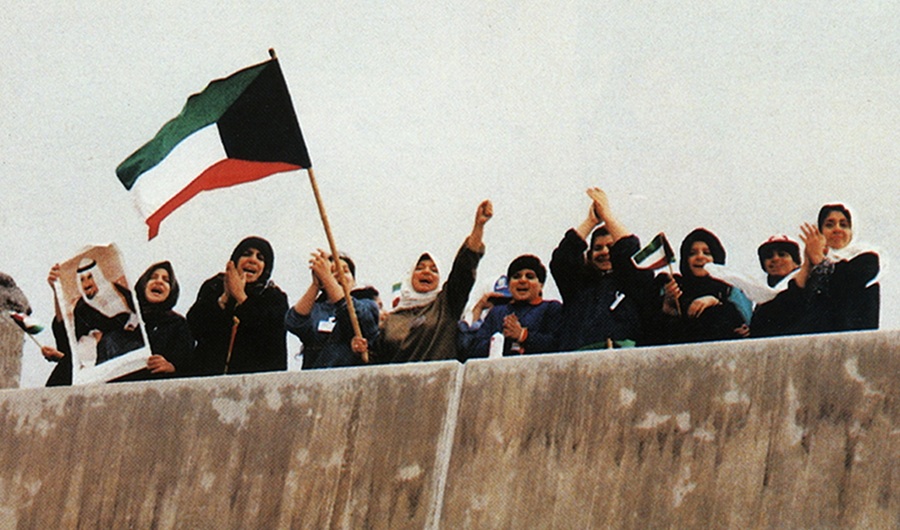
Television networks broadcast scenes of the Kuwaiti flag being raised and the resumption of state institutions’ work. International law experts noted that the liberation of Kuwait set an important precedent in the implementation of United Nations Security Council resolutions through the use of multinational force with a clear mandate and defined objectives.
At the heart of Kuwait, the most radiant displays of national unity between the leadership and the people were evident. The return of the late Emir, Sheikh Jaber Al-Ahmad Al-Jaber Al-Sabah, a symbol of legitimacy, to the homeland marked the beginning of another chapter of construction and reconstruction. The liberation era has become firmly embedded in the national memory as a solid pillar of modern Kuwait’s identity and a living testament to the will of peoples when armed with determination and conviction.
