The West Bank on the Brink of the Abyss... State Terrorism and Settlers May Ignite a "Third Intifada"
- Crime is no longer distant from justice; it is now openly celebrated. - Netanyahu’s political project has prevented the establishment of a Palestinian state. In a scene that repeats daily in the occupied West Bank, Pal
Translated by Qiyas from الراي — Original source
- Crime is no longer distant from justice; it is now openly celebrated.
- Netanyahu’s political project has prevented the establishment of a Palestinian state.
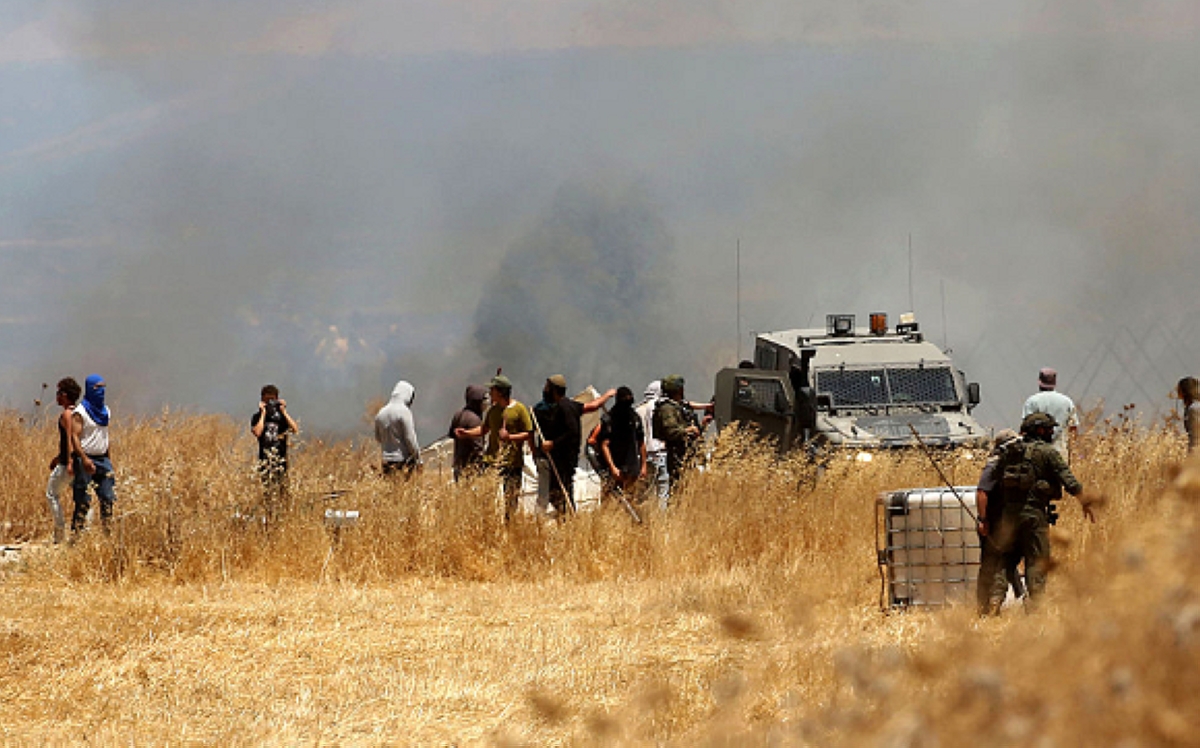
In a scene that repeats daily in the occupied West Bank, Palestinian lives have turned into an escalating hell, not merely due to traditional military occupation, but because settlers have transformed into “armed militias” operating under the protection of the occupation army. These militias kill, steal, destroy, and make life unbearable for innocent citizens, with the army providing protection, care, and arms, alongside explicit political approval from the most right-wing government in Israel’s history.
Settler crimes are no longer mere “isolated incidents” or “transgressions”; they have become a systematic tool for dismantling Palestinian social fabric, terrorizing the population, and forcing them into exile, within the framework of a clear settlement plan aimed at preventing the establishment of a Palestinian state and gradually annexing the West Bank.
The current situation suggests that the region is closer than ever to a comprehensive explosion, potentially more dangerous than traditional wars, as it constitutes an existential struggle waged through tools of apartheid and organized terrorism.
Military analyst Yossi Yehoshua, in a report for the newspaper “Yedioth Ahronoth,” stated that “the West Bank has turned into a quagmire that drains the Palestinian people and land on an unprecedented scale.” He explained that “three main factors are pushing the region toward an explosion... including the insane expansion of settlements, with approval granted for the creation of 80 new settlements, in addition to more than 100 outposts and pastoral farms, thereby expanding the area of land the army must protect and draining its human and logistical resources.”
These factors also include the deployment of 26 battalions in the West Bank—an unprecedented number that is not a sign of strength, but rather an indicator of “drainage,” as the army uses training forces to confront Palestinian protests and protect settlers during their attacks on villages and towns.
The final factor is the vortex of retaliation. Following every Palestinian shooting incident, settlers launch organized retaliatory attacks, as occurred after the “Havat Gilad” operation that resulted in the deaths of four Palestinians and injured dozens. In that incident, settlers burned mosques and vehicles in Palestinian villages and wrote racist slogans, in a scene reminiscent of the worst days of sectarian violence.
Yehoshua concludes that the army, which is supposed to separate innocent Palestinians from heavily armed settlers, has become “a party to the assaults.” He noted that crimes committed by “Jewish nationalists” increased by 63 percent in the first half of 2026 compared to the previous period.
They cite a report by “Bara Bilg” (Haaretz) regarding the opening of numerous investigation files into Palestinian deaths in Israeli prisons, noting that none of these investigations have led to accountability for settler criminals.
Bondi and Raz describe this situation not as a “structural flaw,” but as a “system designed to spread ignorance,” where the army and police deliberately sabotage investigations by coordinating testimonies, labeling Palestinian eyewitnesses as liars, and destroying evidence.
Regarding the settlers, they emphasize that the perpetrators carry out their attacks “with the army’s protection and complicity,” roaming the outskirts of Palestinian villages “to spread terror,” while their crimes are treated as innocent “picnics.”
In this context, analyst Rogel Alpher, writing in Haaretz, highlights the catastrophic dimensions of Israeli policy, asserting that Prime Minister Benjamin Netanyahu is pushing Palestinians “as far as he can” toward a “third intifada,” as this serves his political project of preventing the establishment of a Palestinian state and transforming the conflict from a political one into a bloody struggle that allows for the imposition of facts on the ground.
Al-Hur further notes that Netanyahu is using the Iranian threat as a distraction card, while reserving the “best option” for last, a move that could ignite tensions in the West Bank and place it under racist military rule, where Palestinians endure daily oppression: their mosques are burned, their property stolen, and their lives taken with impunity, in a scene reminiscent of the worst apartheid regimes of the twentieth century.
Meanwhile, the far-right Finance Minister, Betzalel Smotrich, smiles proudly over reports of accelerating annexation, while the racist Defense Minister, Israel Katz, visits a settler held in administrative detention on charges of harassing Palestinians, sending a clear message that “crime is no longer just beyond justice, but is now openly celebrated,” according to Bondi and Raz.
Al-Hur points out that settlers carry out their attacks under clear military cover; the army is present around villages during assaults and intervenes only to protect settlers if they face resistance, stepping in to suppress and beat Palestinians.
Approximately 1,200 settler attacks were documented in the first half of 2026, including the burning of mosques, destruction of orchards, theft of livestock, and terrorizing women and children, in a systematic attempt to “disintegrate the social fabric and force Palestinians into emigration.”
Meanwhile, analyst Nahum Barnea wrote in Yedioth Ahronoth an article titled “The Government Is Leading to an Intifada,” in which he argues that if a Third Intifada erupts, it will be “the first to be launched at the initiative of the Israeli government and according to its vision.”
He clearly describes the government’s plan: transforming illegal outposts into farms of evil, stripping Palestinians of their land, pushing them toward forced emigration, and achieving “mass deportation to the East.”
Barnea sharply criticizes the military leadership for burying its head in the sand and treating settler terrorism as “isolated incidents,” when in reality it is part of a clear political vision. He notes that a military commander’s duty is not only to protect settlers, but also to “impose his rule on the area and ensure the security of all residents—especially those under occupation”—whether Palestinian or Israeli.
Israeli, Palestinian, and international analyses converge on the view that the West Bank stands on the brink of the abyss. The current government, through its rapidly accelerating settlement policies, open support for settler violence, and impunity for perpetrators, not only neglects the tragic humanitarian situation of Palestinians but deliberately seeks to ignite a comprehensive confrontation, for domestic political reasons (diverting attention from economic and legal crises) and ideological reasons (imposing Jewish sovereignty over the West Bank and preventing the establishment of a Palestinian state).
Expected scenarios point to an armed popular intifada. If daily raids on cities and villages continue and settler crimes escalate, spontaneous protests could transform into a comprehensive intifada involving armed factions, leading to a long-term vortex of violence.
The scenario of international intervention, with growing evidence of crimes against humanity, may force the International Criminal Court to open a formal investigation, placing Israel in an unprecedented international confrontation, particularly as the European stance gradually shifts toward imposing sanctions.
What is happening in the West Bank is not merely a “temporary escalation,” but a systematic policy aimed at changing its demographic and geographic reality through force and terror. Settlers, protected by the army and encouraged by the government, practice organized terrorism, not just against individuals, but against the Palestinian presence as a whole.
If the international community does not intervene swiftly, and if Israeli policy does not undergo a fundamental shift, the region is on the brink of an explosion whose repercussions will be even more dire, as it constitutes a struggle over identity and existence, marked by crimes and acts of terrorism carried out under Israeli patronage.
