Peace in Baghdad Anchors “Strategic Linkage” with the “Beneficial Region”
As the likelihoods equalized that the region was facing either a “calm before the storm” on the Iran front or a partial breakthrough that would allow for an extension of the truce and a return to the negotiating table un
Translated by Qiyas from الراي — Original source
As the likelihoods equalized that the region was facing either a “calm before the storm” on the Iran front or a partial breakthrough that would allow for an extension of the truce and a return to the negotiating table under the terms set by US President Donald Trump, it was no coincidence that Lebanon, while simultaneously wresting the file of negotiations with Israel from Washington’s grasp away from Tehran’s insistence on “linking” the two tracks, moved toward “interlocking” with the “day after” the war in the region and connecting with the “useful region” that is carving its path based on economic interests and projects driven by energy, transport, and telecommunications.
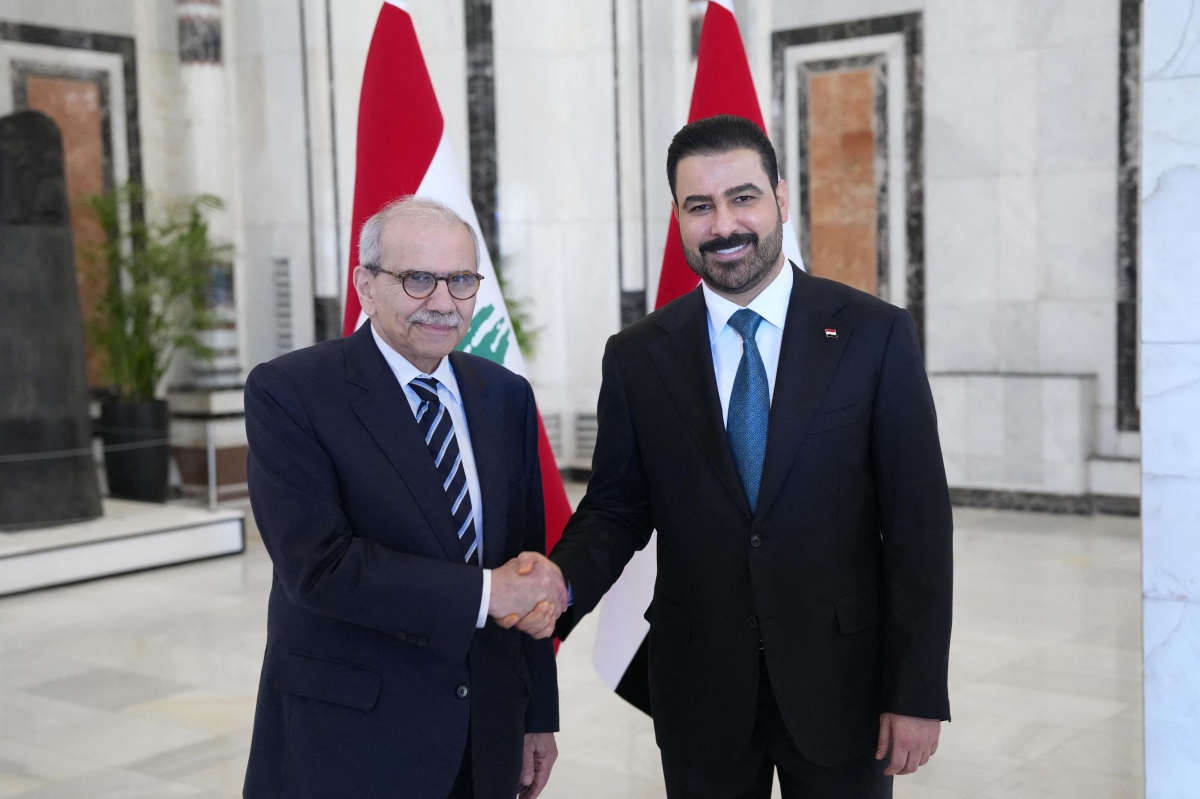
In this context, Prime Minister Nawaf Salam’s visit to Baghdad, leading a ministerial delegation and meeting his Iraqi counterpart Ali al-Zaidi and President Nizar al-Ahmed, featured talks that “discussed ways to consolidate bilateral relations in economic, political, and security fields, alongside consultations on the prospects of developing partnerships to contribute to comprehensive and sustainable development steps, and to achieve the interests of the two brotherly peoples.”
According to a statement issued by al-Zaidi’s office, the Iraqi Prime Minister “underscored the depth of relations between the two countries and Baghdad’s commitment to developing them,” emphasizing “the importance of entering into fruitful economic partnerships in various developmental sectors.” Both sides also stressed the necessity of joint coordination to confront the challenges facing the region, and to support bilateral efforts to strengthen regional stability, reduce tensions, and halt conflicts.
For his part, Salam “stressed that Lebanon is determined to enhance projects of linkage and strategic integration with regional countries across various sectors, particularly energy, telecommunications, and transport, thereby enabling the exploitation of opportunities presented by current transformations.”
He added, “Economic cooperation among regional countries constitutes a fundamental pillar for strength, stability, and shared prosperity, especially if it is based on a vision that realizes mutual benefits. He confirmed that Lebanon looks forward to being an active partner with Iraq in shaping these regional projects, thereby opening new horizons for investment and supporting development and sustainable growth pathways in our two brotherly countries.”
Salam’s remarks, and the nature of the Lebanese delegation—which included Finance Minister Yassin Jaber, Energy and Water Minister Joe Sader, Communications Minister Charles Hajj, as well as the Director General of General Security, Major General Hassan Chkair—reflected the objectives of the visit. It was noted in Beirut that the discussions included the Iraqi-Syrian-Lebanese oil pipeline project, the operation of Tripoli’s facilities, and revitalizing the role of its port, thereby opening the door to economic cooperation with Baghdad and Damascus and enhancing Lebanon’s position as an energy corridor in the Eastern Mediterranean.
According to political circles, Lebanon’s “early linkage” with the emerging regional landscape closes the last doors to any Iranian attempts to keep the “Land of the Cedars” within its sphere of influence. Beirut, which now intersects with Baghdad on the files of “monopolizing weapons in state hands” and combating corruption, and finds in a new Syria a bulwark against the reconstitution of Hezbollah’s military stockpile and a brake on smuggling in both directions, has secured for itself a place and standing in the “triangle” emerging from under Iran’s umbrella into the realm of developmental, economic, and investment “mobilization” based on strategic economic integrations, with the blessing of Washington, which will become a partner in implementing the rehabilitation of the oil pipeline between Hadera and Baniyas through the US company Chevron, according to a memorandum of understanding signed ten days ago between Baghdad and Damascus.
The daily Al-Nahar reported that the anticipated oil step between Beirut and Baghdad enjoys American support and backing. The plan relies on refining, storing, and exporting oil via the port of Tripoli, whose quay has a greater capacity to accommodate tankers than the port of Baniyas. The anticipated agreement aims to reconstruct the refining stations of the Tripoli refineries, build new petrochemical plants, and maintain the storage tanks.
It added: “The first phase involves exporting Iraqi oil via tankers to Tripoli, pending the completion of repairs to the pipeline and its restart following damage inflicted by the Syrian war. The maintenance of the oil pipeline requires approximately 13 months, and the economic viability of the project is estimated at more than $1 billion annually.”
In a phone call, Lebanese President Joseph Aoun discussed with French President Emmanuel Macron “the general situation in Lebanon and the region in light of recent developments.”
According to the Lebanese Presidency, the discussion with Macron also addressed the situation in the south in light of continued Israeli attacks on several southern villages and towns, and the necessity of putting an end to them and committing to a ceasefire. The two presidents reviewed the post-UNIFIL phase in the south (end of the year) and the importance of international follow-up to ensure stability in the area.
Earlier, the Lebanese Army announced in a statement that “Israeli occupation forces continue their attacks and violations of existing understandings and international laws through the systematic destruction and bulldozing of homes, as well as shelling and sweeping operations with machine guns in several southern areas,” considering that “the continuation of these attacks hinders the completion of the army’s deployment in accordance with existing understandings.”
For its part, Hezbollah, which insists on “defying” the Framework Agreement and any expansion of it north of the Litani River, through MP Hassan Fadlallah, hinted that “our opposition to the authority remains and continues in various political, media, and popular forms. At the same time, we say to all our people and loved ones: we are keen on our country, and those who push Lebanon into internal conflict will pack their bags and leave, abandoning the Lebanese people to their problems if such a conflict occurs, God forbid. Therefore, we will protect and defend this country. This does not, under any circumstances, mean allowing this authority to pass its decisions or implement its measures outside the framework of the Constitution, the law, and the National Pact. While Hezbollah is keen on national peace and the country, it will not accept in any way any infringement on its resistance, the rights of its people, or its national partnership.”
For his part, Parliament Speaker Nabih Berri continued to issue signals distinguishing himself from Hezbollah, according to positions attributed to him by the website Asas Media. He reiterated his comment regarding remarks made by the US President about him, stating that he is “a good man, and will join the existing path when he sees the progress made”: “It seems that President Trump understands me better than some Lebanese. Whoever the Kingdom of Saudi Arabia loves, the whole world loves, and it seems that the Kingdom of Saudi Arabia loves me more than some Lebanese.”
Emphasizing that “my relationship with Saudi Arabia is firm, and throughout my political life, no offensive word has ever come from me against the Kingdom, because I am convinced of its love for Lebanon and its concern for it, and the pivotal role it plays in consolidating national stability,” he said: “In recent periods, there has been intensive contact with our brothers in the Kingdom of Saudi Arabia, particularly with Prince Faisal bin Farhan, who informed me that they support the current path and are keen on its success and follow-up with Washington.”
He described his relationship with the Lebanese president as “excellent. We differ on some political viewpoints, but we maintain constant communication. Before his trip to Washington, he called me and asked, ‘What do you advise me to do?’ I told him: ‘Secure the ceasefire, achieve a comprehensive Israeli withdrawal, and ensure the return of people to their villages and homes... I will visit him soon.’”
