Trump to Iran: We will target a bridge or power plant for every ship
US President Donald Trump threatened to bomb Iran’s vital facilities every time it targets a ship attempting to cross the Strait of Hormuz, while Tehran announced it would retaliate by striking regional infrastructure li
Translated by Qiyas from الراي — Original source
US President Donald Trump threatened to bomb Iran’s vital facilities every time it targets a ship attempting to cross the Strait of Hormuz, while Tehran announced it would retaliate by striking regional infrastructure linked to the United States. Iran continued its brazen attacks on Kuwait, Bahrain, and Jordan, endangering maritime navigation in the region, in a new escalation of tensions over control of this critical energy supply chokepoint.
Trump wrote on social media platforms, “Whenever the Islamic Republic of Iran fires on a ship in the Strait of Hormuz, whether by missile, artillery shell, drone, or any other means or weapon... the United States will bomb and destroy one bridge or one power plant, including those located in or near the capital, Tehran.”
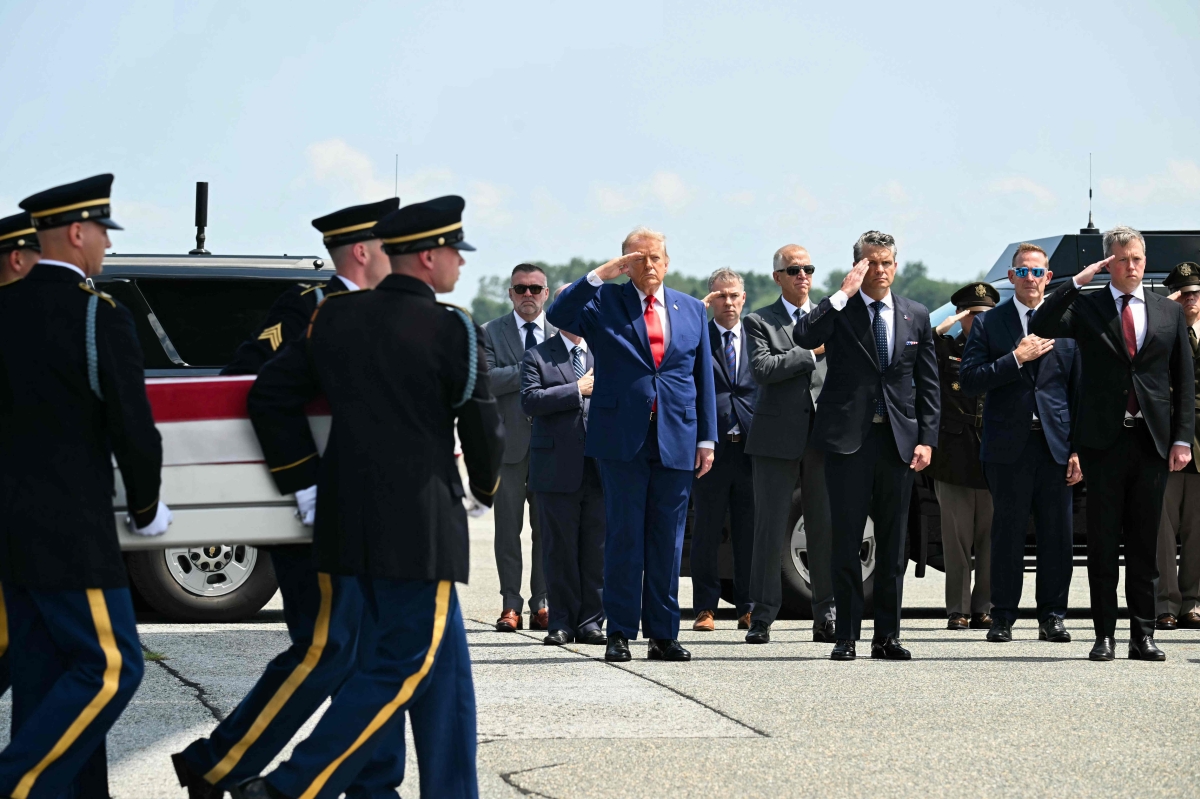
The US president issued the threat just before heading to an airbase, where he attended a ceremony to receive the remains of three US soldiers killed in Iranian attacks targeting facilities in Jordan and Iraq.
Speaking to reporters before departing, he said, “They all strongly affirmed that we cannot allow Iran to possess a nuclear weapon, and so we will fulfill that commitment... For me, this is one of the most difficult things I have to do as president, but it must be done.”
He added that “ship traffic through the strait will be safe if conducted in coordination with Iran and according to arrangements it establishes; otherwise, Tehran will not back down from its determined will to control the strait.”
For his part, US Secretary of State Marco Rubio emphasized that Iran is in a dire situation, affirming that Trump has many options if Tehran does not cooperate.
During a meeting of the Association of Southeast Asian Nations (ASEAN) in Manila, he stated, “If we set a precedent in the Middle East that allows a state to control an international waterway, impose transit fees, and blow up your ships if you don’t pay, we are setting a very dangerous precedent that will be repeated in other parts of the world, including this region.”
He added, “The problem we are facing now is that they are not taking negotiations seriously (...) If they are serious, we will be too. If they are not, we will do whatever is necessary to protect our interests and those of our allies.”
Speaking to reporters after his meeting with his Chinese counterpart Wang Yi, which lasted about 90 minutes, he said Iran had not honored its commitments under the memorandum of understanding, and affirmed that Washington seeks to reach an agreement ensuring that Tehran does not acquire a nuclear weapon.
He also announced that the United States is monitoring any threats to navigation in the Red Sea.
He confirmed that “Iran has sent planes to Yemen carrying equipment and weapons,” stressing that Tehran “has spent money on terrorist groups in the region.”
This came hours after US Central Command (CENTCOM) announced it had carried out strikes “for the eleventh consecutive night,” targeting “Iranian military operational centers, naval capabilities, aircraft hangars, drone storage facilities, and military logistics infrastructure,” with the aim of “undermining Iran’s ability to threaten commercial navigation in the Strait of Hormuz.”
Iranian state media reported strikes in various locations, including the coastal city of Bushehr (south), home to the country’s only nuclear power plant.
State television had previously reported in the morning via Telegram that “air defense activity was heard in western, eastern, and northeastern Tehran,” without providing further details.
Tehran remained untouched by attacks since the resumption of hostilities. The strikes were concentrated in southern Iran and the islands located in the Strait of Hormuz.
Tasnim News Agency reported that a US strike targeted Larak Island, while the state-run IRNA news agency reported hearing explosions in the provinces of Khuzestan, Bushehr, Hormozgan, and Baluchestan along the southern coast, as well as in East Azerbaijan (northwest) and Hamadan in the west.
Foreign Ministry spokesperson Esmail Baghaei, speaking on the X platform, stated that “Washington’s obsession with the Kolangan mountain, where no nuclear activity is taking place, is nothing but a fabricated pretext.”
Iranian forces had previously warned that any attack on the mountain would be considered an expansion of the war in the region, threatening to launch strikes targeting all US, allied, and supporter interests.
