Trump to Aoun: Biased toward Lebanon, neglected for decades... and I will help it
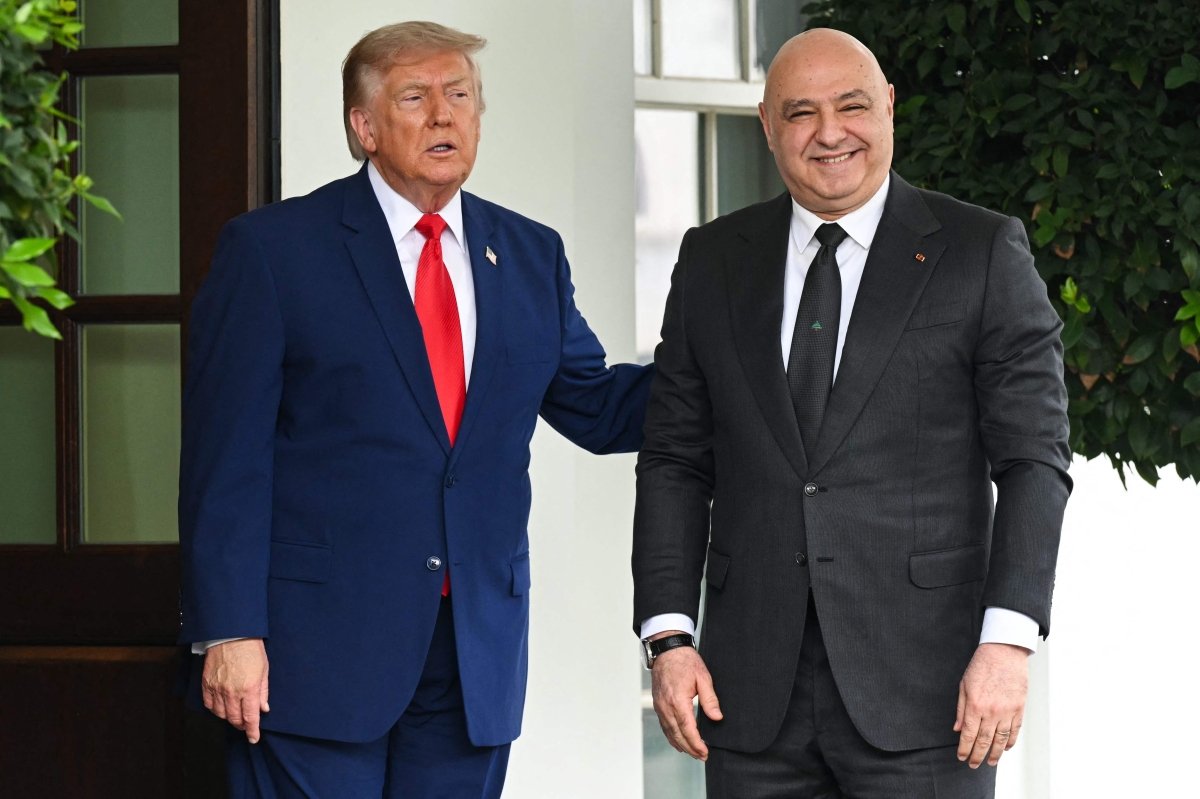
- If Aoun wants me to speak with Hezbollah, I will do so. - Tehran is begging for an agreement... We will soon strike Mount al-Aks with force and will deal with Houthi threats. - Aoun: The time has come to realize Trump’
Translated by Qiyas from الراي — Original source
- If Aoun wants me to speak with Hezbollah, I will do so.
- Tehran is begging for an agreement... We will soon strike Mount al-Aks with force and will deal with Houthi threats.
- Aoun: The time has come to realize Trump’s vision that peace should prevail in the region.
- Lebanese Army deploys in “experimental zones.”
For the first time since 2009, Lebanon returned to the White House on Tuesday, which hosted an extraordinary summit in form, substance, and timing, bringing together President of the Republic General Joseph Aoun and U.S. President Donald Trump. Since last April, Trump has become the sponsor of the Lebanese file, the guarantor of its resolution toward a sustainable settlement, and the manager of the southern front in relation to Israel, setting the pace as he orchestrates the largest stage shaped by the war with Iran.
From the official reception to the talks between Trump and Aoun, covering their military, security, political, and economic dimensions, as well as the prominent stances taken by both men before the media that capped the historic visit, it was clear the weight that the “Land of the Cedars” file now holds on the U.S. administration’s priority agenda, and the administration’s keenness to anchor its “independence” from Iran’s trajectory, sending a signal closer to a “reversal” of its inclusion as the first item in the currently “suspended” memorandum of understanding with Tehran, with all the dimensions attached to this matter gradually falling away.
Trump welcomed the reception with great warmth, greeting “a man very respected by everyone,” as he said at the entrance of the White House, while carefully avoiding any form of embarrassment for the Lebanese President during the open press conference that lasted about 40 minutes. During it, he repeatedly praised “Lebanon, which has been mistreated and neglected for decades, and the time has come for that to end. It possesses elites of intellectuals and educated people, and I am biased toward it; I have many friends from there, and we will help him,” considering that Aoun “can be among the best leaders in the Middle East.”
While speaking about “the Hezbollah problem, and what we have done regarding it that the world will feel,” Trump clarified, “If the Lebanese President wants me to speak with Hezbollah, I will do so,” describing Parliament Speaker Nabih Berri as “a good man, and when he sees progress, he will change his mind” regarding his rejection of the framework agreement signed on June 26.
Trump pointed out that “the Israelis are in the process of redeployment (in southern Lebanon), and will redeploy in other sectors as well, and they have signed a wonderful agreement.” He reiterated his previous comments about Syrian President Ahmed al-Sharaa’s intervention in Lebanon to help address the “Hezbollah file,” stating that “al-Sharaa is doing a very good job, and he wants to enter and do something with Hezbollah, having fought him for a long time, and I believe that will be highly effective.”
Regarding Iran, Trump said, “We are not yet finished with Iran, which is begging for an agreement with us, and they have not seen anything yet. We have been good to them so far, and it will need 20 or 25 years to rebuild after the damage we have inflicted on it.” He emphasized, “There are evil people leading this country, and any nuclear site the Iranians might think of reactivating, we will strike again. Our new agreement will be like an impenetrable wall; Tehran cannot currently possess a nuclear weapon and will need years to produce it.”
Referring to “the blockade in the Strait of Hormuz continuing, and no one crossing,” he said, “If something happens in the Red Sea, we will simply have to deal with it. If something happens in the Bab al-Mandab, we will deal with it, as we have done before with the Houthis. We carried out about 45 days of extremely strong measures against them, and we have not experienced any problems with them since then.”
As for Aoun, he thanked Trump for the assistance in achieving the “historic milestone” of signing the Framework Agreement (with Israel) with the aim of ending the state of hostility forever, which is the ultimate goal, and that the time has come for Lebanon to enjoy stability and security. He stated that they align with Trump’s vision for stability in the region and that it is time to realize the President’s vision that peace should prevail.
He emphasized that Berri is “from the South, supports the end of hostilities, and is making great efforts, wanting to see the war end and supporting what we are doing.” He clarified, “I told President Trump that I need his political support and support for the Lebanese Army, which is doing a very good job and is the most reliable institution and pillar of stability in the country. I have full confidence in the Army and its leadership.”
Aoun entered the White House, where the summit was held, attended by Vice President J.D. Vance and Secretary of Defense Pete Hegseth, against the backdrop of the “gift” Trump had presented to him: his pressure on Tel Aviv to launch the implementation track of the “Framework Agreement” and the executive mechanism approved by the tripartite Rome negotiations for the experimental phase, which began on Monday in three areas where the Lebanese Army had deployed. One of these areas is Western Zouar, from the outskirts of which the Israeli Army withdrew, while Froun and Srayfa were under fire control.
It was learned that Aoun brought to the summit with Trump a set of demands and proposals related to the state’s vision on how to achieve monopoly over weapons, which requires support for the Army to deploy in every area from which Israel withdraws, to dismantle any military infrastructure of Hezbollah there, and to prevent its return. This includes a parallel track modeled on “step-by-step” and gradual “one step after another” basis from Tel Aviv.
In this context, Al-Ahad Channel noted that Aoun presented “a work plan for the post-Israeli withdrawal phase” during his meeting with Trump. Citing a Lebanese official source, the channel reported that “this plan includes proposals for monopolizing weapons, strengthening the army, and organizing conferences to support the economy,” and that the Lebanese President requested “setting timelines for complete Israeli withdrawal.”
Anticipation prevailed in Lebanon regarding the outcomes of the White House summit, amid a “leap” by Tel Aviv. Israeli Prime Minister Benjamin Netanyahu failed, during his meeting with Trump before Aoun’s visit, to force Washington into further concessions to the Lebanese state, thereby strengthening its position domestically and Hezbollah’s narrative regarding the futile negotiations and the claim that Iran, through its path, achieved the ceasefire for Lebanon and that only it will bring about the Israeli withdrawal.
It was also learned that Aoun touched upon the issue of raising financial support for the army and Trump’s repeated calls for the Syrian President to intervene in Lebanon and contribute to addressing the Hezbollah issue, while affirming the Lebanese President’s commitment to an equal relationship with Damascus based on respecting each country’s sovereignty. The meeting did not hide from public view the start of the implementation of the experimental phase of Israeli withdrawal and the Lebanese Army’s disarmament of Hezbollah within the framework of the model areas, according to the statement issued by the US State Department on Monday afternoon, which appeared to be an “order” to launch the implementation track of the Framework Agreement under the supervision of the Lebanon Military Coordination Group, comprising Beirut and Tel Aviv, led by US Central Command (CENTCOM).
While the deployment of the Lebanese Army in Froun and Srayfa occurred without obstacles, the positioning in Western Zouar did not pass without its military units being fired upon by Israeli occupation forces while carrying out the deployment operation.
While this development has been linked to the Zour site in the west and its overlap with the Zour site in the east—which Israel has refused to withdraw from at this stage due to its proximity to the strategic Qalaat Shqif fortress—the occurrence of Froun and Sraifa, like Zour, along the border of the security zone established by the Israeli army in southern Lebanon (covering an area of approximately 600 square kilometers), raises several challenges. These challenges are not only related to testing the Lebanese army in a highly sensitive area, but also to Tel Aviv’s attempt to frame the withdrawals within a scope that forms a “yellow zone” belt, which it insists must be fully evacuated only upon the complete withdrawal of Hezbollah’s weapons.
It was no passing remark when the Axios website reported, citing a US official, that “Washington is negotiating with Israel and Lebanon regarding a mechanism for verifying the disarmament of Hezbollah within experimental zones in southern Lebanon.” The official clarified that the Lebanese army would be responsible for securing these areas, carrying out operations to remove Hezbollah’s weapons and military infrastructure, and conducting verification operations to ensure compliance.
In response, Hezbollah continued to raise the stakes of confrontation, with MP Hassan Zeineddine of its parliamentary bloc declaring that “the stubbornness of the President of the Republic and his insistence on pursuing direct negotiations will affect social peace, stability, and calm.” He added that “disarming the resistance is equivalent to taking the lives of those who hold this rifle to defend this country.”
In a new escalation, driven by Iran and mirroring the Houthi involvement in the regional conflict and their threats following the ban on Iranian flights landing in Sana’a, Political Council member Mahmoud Qammati threatened the Lebanese authorities, stating that “if they do not correct relations with Iran and resolve the issue of Iranian flights (banned from landing in Lebanon since autumn 2024), our patience may run out... There are many peaceful ways, after which no flight will land in Lebanon and no ambassador will remain in Beirut.”
This threat also came in the wake of the government’s decision in March to reinstate the requirement for Iranian nationals to obtain entry visas to Lebanon, following evidence that elements and leaders of the Islamic Revolutionary Guard Corps were participating in managing the war alongside Hezbollah.
