Mursal Al-Ajmi paused at currency transformations... and Al-Zawawi in Baghura documented the journey of human thought
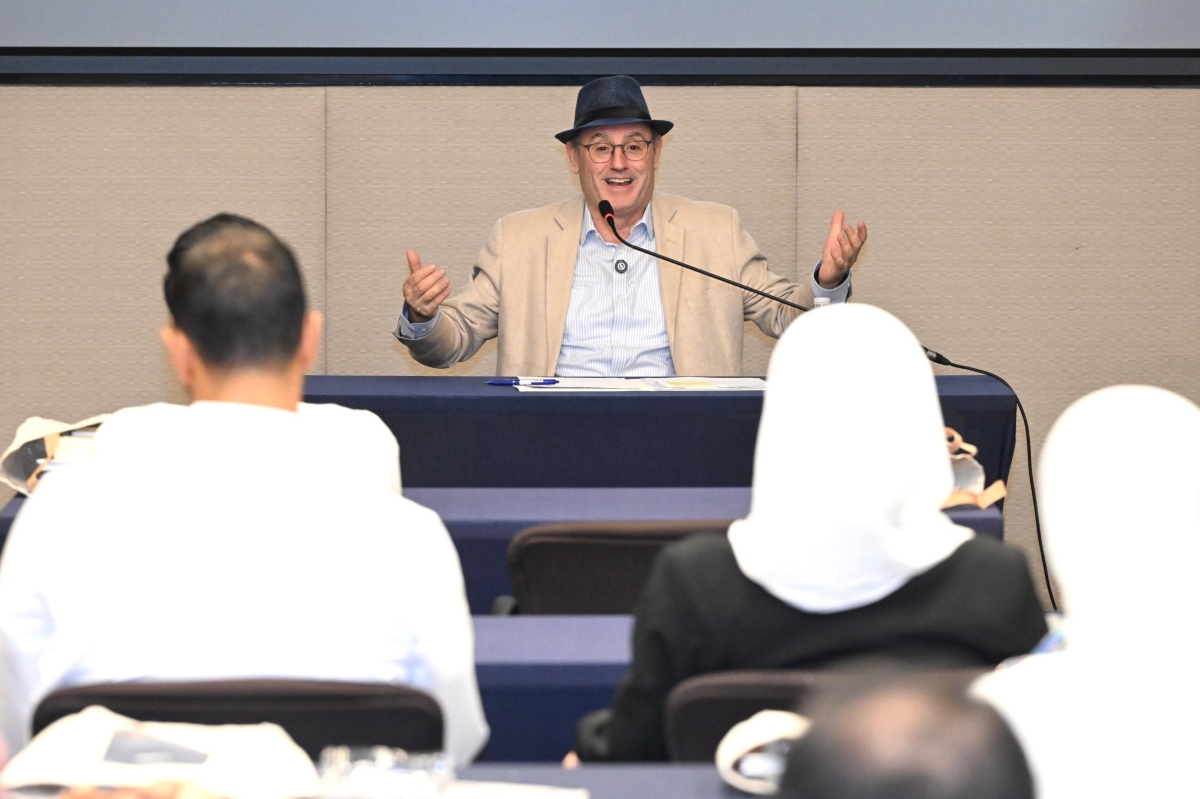
The first events of the “Oasis of Thought and Creativity” program, organized by the General Secretariat of the National Council for Culture, Arts and Letters, kicked off yesterday evening at the Kuwait National Library. The program opened with a discussion addressing questions in philosophy, literature, and criticism, through a series of lectures delivered by a distinguished group of academics and specialists, running until July 28.
The program’s first day featured two lectures. The first, titled “An Introduction to Literary Criticism Theories... (The Nature of the Literary Text),” was presented by Dr. Mursal Falih Al-Ajmi, Professor of Arabic Language and Literature at Kuwait University. He addressed the transformations undergone by critical theories and the roles of the author, the text, and the reader in shaping a literary work. The second lecture, titled “The History of Philosophy: From Myth to Reason (The Question and the Attempt at an Answer),” was delivered by Dr. Al-Zawawi Bagoura, Professor of Contemporary Philosophy at the College of Arts, Kuwait University.
Dr. Al-Ajmi began his lecture by defining literary criticism, distinguishing between the reading experience as an aesthetic encounter for the reader and critical writing, which is based on analysis, interpretation, and knowledge production. He highlighted the difference between what he termed the “pleasure of the text,” which accompanies the act of reading, and the “labor of criticism,” which requires methodological tools and an analytical perspective that goes beyond immediate impression.
He then outlined three main milestones in the history of literary criticism. The first was linked to the author, as seen in Romanticism and social criticism, where the writer’s personality, biography, and circumstances were considered essential for understanding the text.
He noted that the second milestone shifted the focus to the text itself, with Russian Formalism and the New American Criticism viewing the literary work as an independent structure with its own internal laws, separate from the author and the context of its production.
The third milestone centered on the reader, through reception theories and reader response, which granted the reader a pivotal role in meaning production and made reading a complementary act to the text’s existence, rather than merely a means of receiving it.
In the second lecture, Dr. Al-Zawawi Bagoura, one of the most prominent Arab researchers specializing in the philosophy of Michel Foucault, with additional interests in the philosophy of language, political philosophy, and contemporary Arab thought, took the audience on a journey through the history of human thought. He traced the earliest beginnings of philosophy and how humanity transitioned from interpreting the world through myth to building knowledge based on questioning and rational contemplation.
He emphasized that ancient Eastern civilizations knew various forms of wisdom and contemplation. He paused to discuss the concept of myth, clarifying that it was not merely fictional narratives to explain phenomena, but an early stage of human consciousness through which humans attempted to give meaning to the world and establish a worldview to interpret nature.
He explained that the transition from myth to reason was not sudden, but the result of a long evolution in human consciousness, until Greek philosophy emerged as a crucial milestone that shifted thinking from narrative and myth to demonstration and rational contemplation.
Dr. Al-Ajmi shed light on the nature of the literary text, explaining that the text begins at the moment of the author’s writing, but it is only completed when it meets the reader. Reading thus becomes an aesthetic experience that reproduces the text and grants it renewed presence.
Dr. Bagoura pointed out that Greek philosophy did not emerge in isolation from previous cultural heritage, but was the fruit of accumulated knowledge and thought. He affirmed that the history of philosophy is, at its core, the history of the evolution of human reason and its constant endeavor to understand humanity and the world.
