Positive and successful meeting between Aoun and Rubio paving the way for the summit with Trump
The temporal gap between December 14, 2009, when the last Lebanese president, Michel Suleiman, met then-US President Barack Obama in the White House, and July 21, 2026, when President Joseph Aoun will meet his American c
Translated by Qiyas from الراي — Original source
The temporal gap between December 14, 2009, when the last Lebanese president, Michel Suleiman, met then-US President Barack Obama in the White House, and July 21, 2026, when President Joseph Aoun will meet his American counterpart, Donald Trump, in the Oval Office, is not merely a matter of the 17 years that have passed. Rather, those 17 years practically define the depth of the chasm into which Lebanon has been gradually pushed through the excavation of the “Iranian axis” of the state and its foundations, and the gnawing away of its pillars to enable Hezbollah’s ascendancy. This trajectory culminated in placing the country since 2023 in the mouth of “Al-Aqsa Flood,” and then exposing it to the lava of the most dangerous “fire volcano” since last March, in support of Tehran.
This is precisely what gives Aoun’s US visit exceptional dimensions, amid the Lebanese authority’s thorny path toward reclaiming all keys to decision-making, in war and peace, and restoring the country’s status as a “normal state” that holds the monopoly on arms and exerts control over its territory solely through its own forces. This is a path that was delayed from launching for more than 36 years, and over which internal and external convergences have aligned in the past year to push it forward, making it a realistic “lifeline” for Lebanon to avoid being further driven into the eye of the “greater storm” in the region and having its fate tied to Iran’s front and the outcomes of its confrontation or “reconciliation” with Washington.
Aoun, who inherited decades of the state’s “dissolution” and its marginalization by the force of Syrian oversight at times and the surplus power of Hezbollah at others, is seeking to capitalize on a rare opportunity that has returned Lebanon to the top of US attention. He is no longer viewed as a file on the table, but as a player sitting around the table, speaking for himself, and as a state not subject to “contracting out,” but rather one whose role helps draw the map of the newly forming regional system, politically and economically, as an active part of it. This is according to a grand equation with which Washington manages the process of closing the southern front once and for all, based on the principle of “security for Israel and sovereignty for Lebanon.” In practical terms, this means the withdrawal of Hezbollah’s weapons and the withdrawal of Tel Aviv from the areas it occupies in the “Land of the Cedars.”
This equation constitutes the realistic core of the “Framework Formula” tripartite agreement signed in Washington on June 26 last, amidst direct Lebanese-Israeli negotiations sponsored by the United States. Trump himself previously attended the second round of these talks in April inside the Oval Office. The broad outlines of its implementation mechanism were set in Rome on Tuesday and Wednesday last, pending final touches on the model areas from which the trains of gradual Israeli withdrawal and the removal of Hezbollah’s weapons will run in parallel, following the deployment of the Lebanese army and on the basis of preventing the return of Hezbollah elements to those areas. This is amid attempts by Tel Aviv to evade a full exit from occupied towns, settling instead for points and villages it controls by fire, while Beirut insists on linking the areas occupied by land and by air.
From this, attention has focused on Israel: whether it will announce the start of the experimental phase in tandem with the Lebanese president’s stop in Washington and his meeting with Trump on Tuesday, anticipating a wave of US pressure on it in this regard; or whether this matter will be left to tripartite military meetings that may be held this week during a possible visit by the commander of the US Central Command (CENTCOM), Admiral Brad Cooper, to Beirut to complete discussions on the experimental phase, its geographical scope, and the mechanisms of implementation. Several European countries, including Italy, Germany, France, and Spain, wish to be part of these mechanisms.
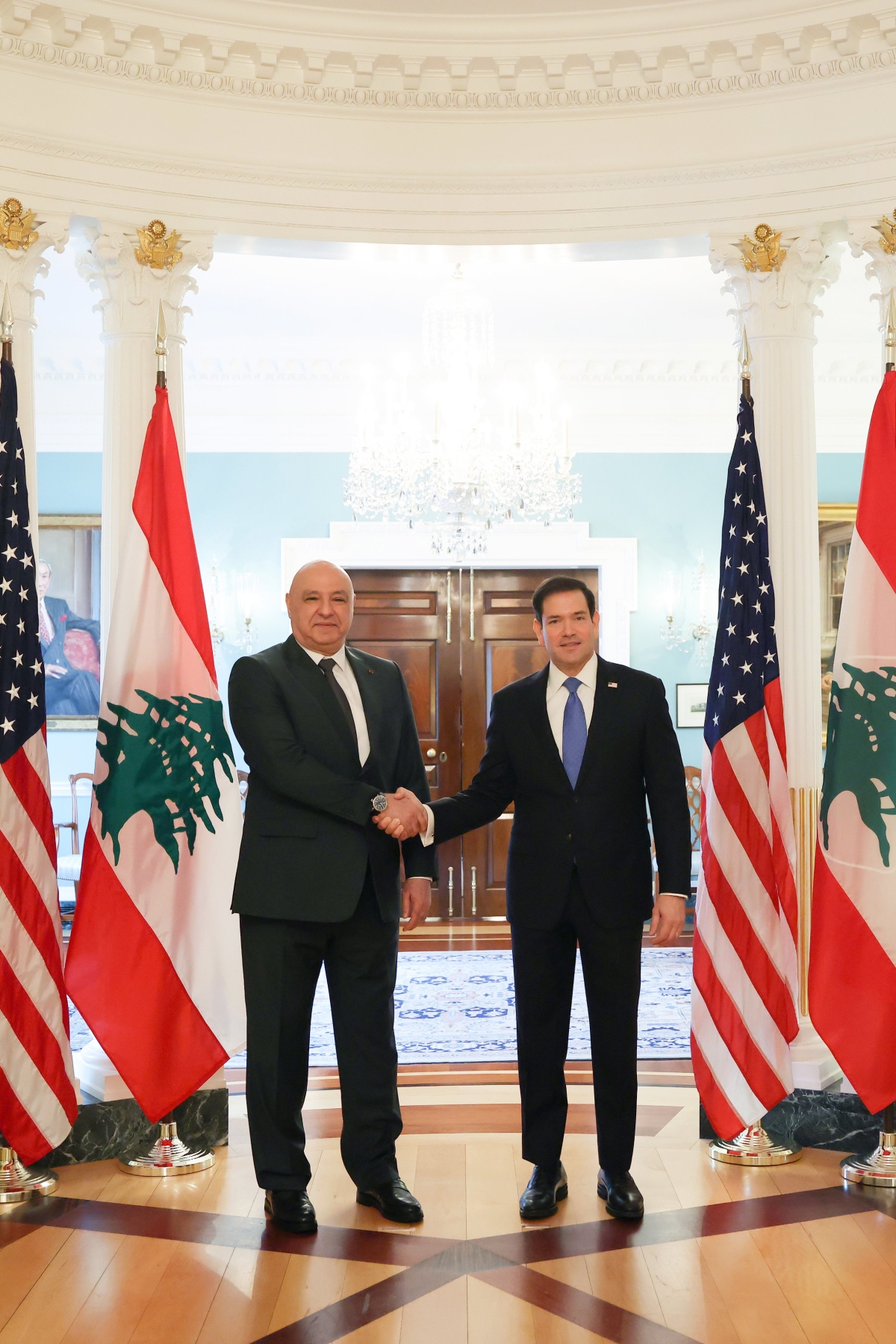
This file formed part of the first high-profile meetings held by Aoun, on Sunday, with US Secretary of State Marco Rubio, at the State Department headquarters. Lebanese media reported that the building is rarely open on Sundays, but it was opened exceptionally for a meeting between the President of the Republic and the “broker” of the Lebanese file and its main guarantor, who has been handling the success of his mission on the Lebanon-Israel front as a key factor in his rise up the ladder in the upcoming US presidential elections.
Aoun’s meeting with Rubio, which lasted about an hour and a half, was insisted upon to take place on Sunday because Rubio will be outside the United States during the White House summit on Tuesday. During the talks, they discussed the format of the framework and ways to implement it, starting with the pilot phase, securing a ceasefire, and extending state authority over all areas, in addition to preparations for the meeting with Trump.
Shortly after the meeting, the US State Department announced that Rubio had met with the Lebanese President and “discussed the implementation of the trilateral framework.” The Secretary of State praised the courage of the Lebanese government, under President Aoun’s leadership, for its firm efforts to restore Lebanon’s sovereignty, disarm Hezbollah, dismantle its terrorist infrastructure, and move forward toward peace. The Secretary also reiterated the United States’ commitment to supporting the successful implementation of the trilateral framework and the Lebanese government’s efforts to achieve peace, economic recovery, and a better future for the Lebanese people.
US Ambassador to Beirut Michel Issa said that the meeting between President Aoun and Rubio was successful and positive, and that all files were presented during it. He emphasized that the Lebanese President would not return from Washington “empty-handed.”
When asked about Syrian military intervention against Hezbollah in Lebanon, Issa replied: “We are certain that this involvement is meaningless, and Rubio does not support it.”
Prior to the meeting, Al-Jadeed TV reported from Washington that the Lebanese President would raise, alongside the request to pressure Israel to begin implementing the framework format, a clarification from the US State Department regarding Trump’s repeated remarks about asking Syrian President Ahmed al-Sharaa to intervene in Lebanon to address the Hezbollah issue. Aoun would reaffirm Lebanon’s commitment to its sovereignty and reject any Syrian military intervention in Lebanon, maintaining a relationship with Damascus on an equal footing. He would also request that the US administration increase support for the Lebanese Army, after the amount allocated for this purpose in the US budget was reduced to $37 million, while the military institution needs approximately $150 million to implement its southward deployment plan.
Meanwhile, attention is turning to Aoun’s schedule on Monday, which includes a meeting described as very important at the Lebanese Embassy in Washington with the heads of the most prominent political research centers in the US capital. These centers are considered a lobby that feeds decision-making circles in the United States, from the White House to the State and Defense Departments, with information and studies on the Middle East. A dinner attended by Lebanese, Arab, and American diplomats and businessmen will be held in the evening. Between these two events, the Lebanese President will hold a series of meetings with members of the Senate and US administration officials, before returning to Beirut after the anticipated summit with Trump on Tuesday morning.
At this time, Hezbollah has escalated its challenge to the state and to Prime Minister Najib Mikati, in the context of its attempt to demonstrate that any commitments made to Washington are merely “ink on paper” and that there is no feasibility for any executive path related to disarming the group outside the framework of negotiations between Iran and the United States. This approach is designed to keep all options open regarding the Lebanese front, linked to the dictates of Tehran’s decisions on how to manage the new wave of confrontation, should it escalate beyond “war by points” into a comprehensive clash with the prospect of a “decisive strike.”
Speaking on behalf of his parliamentary bloc, MP Hussein Jashy warned that the framework agreement would share the fate of the May 17, 1983 agreement, which collapsed along with its signatories. Meanwhile, MP Hussein al-Hajj Hassan vowed that the agreement, as presented, also involves bringing in foreign forces to contribute to the disarmament of the resistance. He stated that “any force coming to Lebanon under this banner is an occupying force (...) and the agreement contains the seeds of internal strife,” placing the responsibility for any repercussions stemming from the commitments undertaken by the authorities, particularly concerning the file of the resistance’s weapons, squarely on the government.
