Hamad bin Khalifa... The Architect of the Influential State
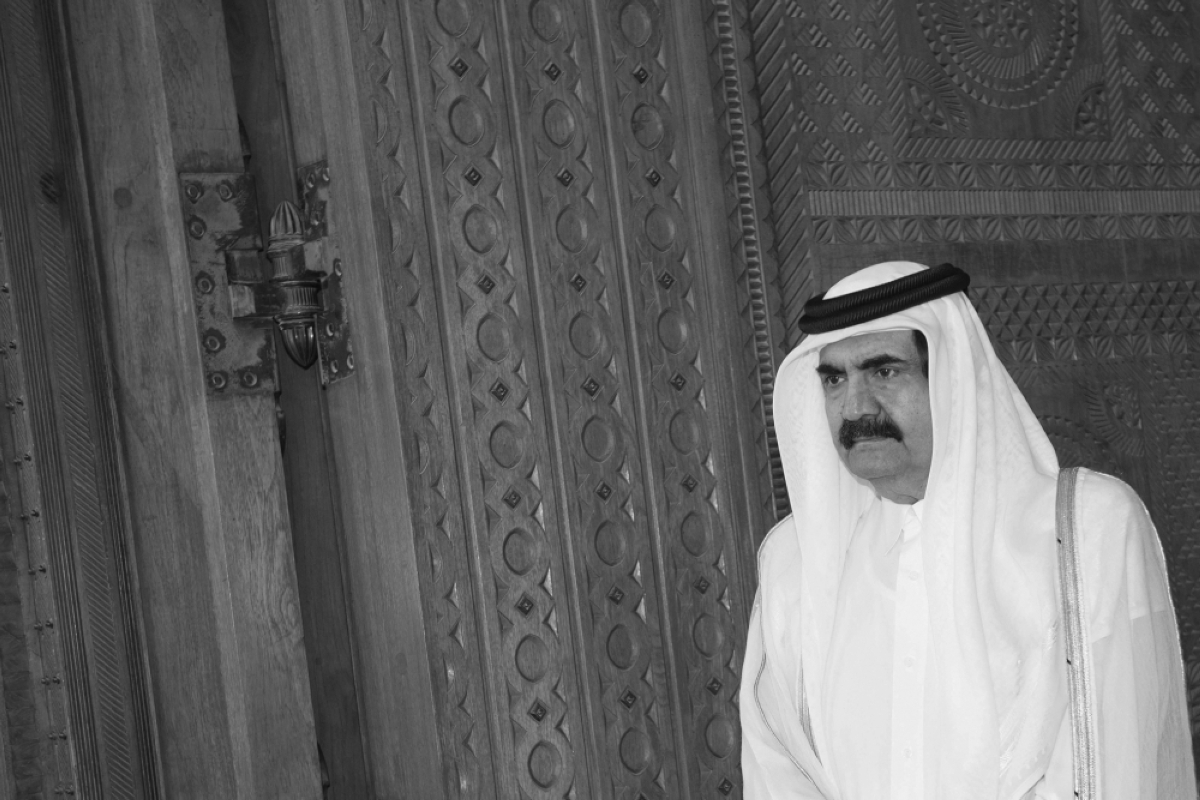
Sheikh Hamad bin Khalifa Al Thani, the Emir Emeritus, was more than a ruler who guided his country for years; he was the architect of a national project that transformed Qatar and redefined its place on the global map. W
Translated by Qiyas from الراي — Original source
Sheikh Hamad bin Khalifa Al Thani, the Emir Emeritus, was more than a ruler who guided his country for years; he was the architect of a national project that transformed Qatar and redefined its place on the global map. With his passing, Doha recalls the legacy of a leader whose name is inextricably linked to the most significant transformation in the nation’s modern history, having laid the foundations for a state that built its influence through human capital, knowledge, economy, and diplomacy.
Sheikh Hamad bin Khalifa Al Thani was born in Doha in 1952. He graduated from the Royal Military Academy Sandhurst in the United Kingdom in 1971, before ascending through various responsibilities until he was appointed Crown Prince in 1977. He assumed the throne in 1995 and abdicated in 2013, handing over power to his son, Sheikh Tamim bin Hamad Al Thani.
The Emir Emeritus’s biography is better understood as the story of a state-building project rather than merely that of an individual. His name became synonymous with the renaissance that redrew Qatar’s political and economic landscape, making his presence an integral part of the country’s standing in both Arab and global consciousness.
The transformations witnessed in the country during his reign encapsulate the philosophy of his leadership. It began with building human capital, extended to institution-building, and culminated in cementing Qatar’s status as a nation whose influence transcends its geographical size and population, according to a report by Al Jazeera Media Network.
The transfer of power in 2013 was not an ordinary political event but a milestone reflecting a distinct vision for state governance. In his historic speech, the Emir Emeritus stated that he did not relinquish power for its own sake, but rather that the national interest dictated opening a new chapter under the leadership of a new generation.
This decision was an extension of a political trajectory characterized by long-term calculations, prioritizing the continuity of the national project over the retention of individuals in power. It presented a rare model in the region for the voluntary transfer of power under conditions of complete stability.
From the early years of his rule, Qatar turned to investing in tools of soft power. The launch of Al Jazeera channel was among the most prominent shifts that altered the Arab media landscape, expanded Qatar’s global presence, and entrenched its name in the sphere of political and cultural influence.
In the same vein, the issuance of the Permanent Constitution in 2004, following a popular referendum, inaugurated a new phase in state institution-building. It established a constitutional framework regulating relations between branches of government and enhancing public participation in civic affairs.
Economically, the export of liquefied natural gas (LNG) marked a new era in the country’s history. With the first shipments departing in 1996, growth accelerated until Qatar became the world’s largest LNG exporter in 2006.
The value of this boom was not merely reflected in figures, but in how the revenues were managed. Wealth was transformed into a lever for building infrastructure, developing education and healthcare, expanding services, and strengthening the role of the individual at the heart of the development project.
When Qatar’s LNG production reached 77 million tons in 2010, the Emir Emeritus described it as an achievement that would be enshrined in the history of the global gas industry, as Qatar officially assumed the top position among nations producing this strategic resource.
That same year, Doha achieved another milestone by announcing its successful bid to host the 2022 FIFA World Cup. This step transcended sports, cementing the presence of the first Arab nation to earn the honor of organizing the world’s largest football event.
This victory crowned a long process of building international trust and leveraging the country’s political and economic stature, making the World Cup one of the most prominent expressions of a project that bet on Qatar’s ability to achieve what seemed beyond traditional calculations.
Alongside these transformations, Qatar National Vision 2030 was established as a roadmap for the country’s future, aiming to diversify the economy, enhance human development, and achieve a balance between modernity and preserving national identity.
For this reason, the name of Sheikh Hamad bin Khalifa Al Thani is etched in popular memory with the title “the Eradicator of Poverty,” a moniker reflecting the social and economic transformations the country underwent, following an economic boom coupled with policies aimed at improving citizens’ living standards.
The legacy of the Amir al-Walid (Father Emir) appears to extend today through state institutions and major projects, as well as in the standing Qatar holds on the international stage. The landmarks that define the country’s modern face bear the imprint of an era that redefined its role in its region and the world.
With the passing of the founder of modern Qatar’s renaissance, his biography remains present in the trajectory of a state that chose to place human beings at the center of development and long-term vision as the foundation for shaping the future, making its experience one of the most prominent transformation stories in the region in recent decades.
The Qatari Diwan (Amiri Diwan) mourned the passing of His Highness the Father Emir, Sheikh Hamad bin Khalifa Al Thani, who died on Sunday morning at the age of 74. The Diwan’s statement read: “May God have mercy on the great son of the nation, forgive him, and grant him entrance into His spacious Paradise alongside the prophets, the truthful, the martyrs, and the righteous. What excellent companions they are! May God reward him with the best recompense for the monumental, enduring achievements he contributed to his homeland and the Arab and Islamic Ummah, and grant us all patience and solace. To God we belong and to Him we shall return.”
In another statement, the Qatari Diwan announced a general mourning period across the country for four days, starting on Sunday.
The Qatar News Agency (QNA) reported that work in ministries, other government bodies, and public institutions would be suspended starting Monday, with employees resuming duties on Sunday, July 19, 2026. Flags across the country will be flown at half-mast throughout the mourning period.
The statement added that the Emir of Qatar, Sheikh Tamim bin Hamad Al Thani, will receive condolences from foreign leaders, members of the ruling family, dignitaries, and citizens at Lusail Palace on Monday, Tuesday, and Wednesday, corresponding to July 13, 14, and 15, 2026.
The sisterly State of Qatar has lost the Father Emir, Sheikh Hamad bin Khalifa Al Thani, may God have mercy on him, who passed away at the age of 74 after a career filled with generosity and achievements that contributed to elevating his country to a distinguished position regionally, internationally, and globally.
• Sheikh Hamad bin Khalifa was born in Doha in 1952.
• He received his primary, preparatory, and secondary education in Qatari schools, then enrolled at the Royal Military Academy Sandhurst in the United Kingdom, graduating in July 1971.
• After graduation, he joined the Qatari Armed Forces and was appointed commander of the 1st Mobile Battalion, which later became known as the Hamad Mobile Battalion. He was subsequently promoted to the rank of Major General and appointed Commander-in-Chief of the Qatari Armed Forces, becoming the first Qatari to hold this position.
• On May 31, 1977, Sheikh Hamad bin Khalifa was sworn in as Crown Prince and appointed Minister of Defense and Chairman of the Supreme Planning Council, entrusted with developing and modernizing the country, thereby exercising executive governance functions early on.
• Since the late Emir assumed power on June 27, 1995, Qatar embarked on a new phase of comprehensive renaissance and institutional modernization, witnessing qualitative and pivotal developments across all sectors during his reign.
• Externally, Qatari policy played important roles through active diplomacy with all parties and states, keen on building bridges of understanding and cooperation with all countries in both the regional and international spheres.
• The economy and energy sectors witnessed significant development, contributing to making the country the world’s largest exporter of liquefied natural gas (LNG). This was accompanied by the completion of several major energy projects, alongside economic openness and the attraction of global investments.
• Qatar became a hub for political, economic, cultural, health, and scientific conferences, achieving a prestigious regional and international standing in this field, in addition to attracting several leading global universities.
• The late Emir was keen on supporting the youth and sports sector, believing in the vital role this sector plays in building and developing society. His country hosted a number of the most important regional and international tournaments, including the historic announcement in December 2010 that Qatar would become the first Arab and Islamic country to win the right to host the FIFA World Cup, which took place in 2022.
• His reign witnessed broad-based changes across various fields, granting women the right to vote and run in local elections, as well as the right to work and drive. This was complemented by efforts to enhance press freedom and increase investment in gas fields to accelerate the pace of comprehensive development.
• The late Emir sought to strengthen the country’s transition to a knowledge-based economy, transforming Qatar into an advanced nation capable of achieving sustainable development and ensuring a decent standard of living for its people, generation after generation.
• On June 25, 2013, Sheikh Hamad bin Khalifa Al Thani announced in a message to the Qatari people that he was handing over power to his heir apparent, Sheikh Tamim bin Hamad Al Thani, marking the beginning of a new phase in Qatar’s journey of construction, development, and progress.
• The late Emir, Sheikh Hamad bin Khalifa Al Thani, visited numerous Arab and foreign countries to strengthen bilateral relations and conclude agreements and memoranda of understanding with them. He received numerous awards from Arab and foreign countries in recognition of his efforts to enhance bilateral relations and develop cooperation areas with those nations.
• In 1995, he received the Collar of Hussein bin Ali from Jordan and the First Class Order of Oman from the Sultanate of Oman. In 1997, he was awarded the November 7 Order from Tunisia, and in 1998, he received the Legion of Honour from France and the Order of the Lion from Senegal.
• In 1999, the late Emir received the Nishan-e-Pakistan from Pakistan, the Order of Merit of the Federal Republic of Germany from Germany, and the Ordre National du Mérite from Romania. In 2000, he was awarded the Grand Cordon of the Order of the Cedar from Lebanon, the Knight Grand Cross Order from Italy, and the Order of the Republic from Yemen.
