Israeli Media Discusses 'Secret Addendum' to Framework Agreement: Reshaping Reality in Southern Lebanon According to Tel Aviv's Agenda
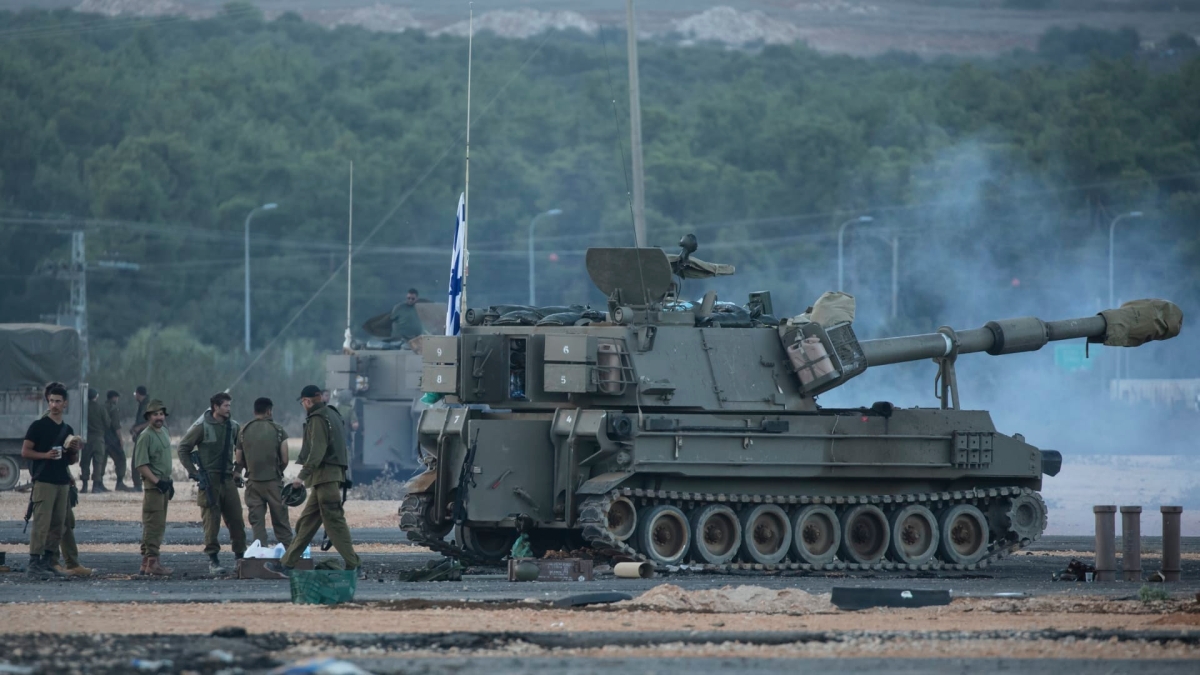
A report reveals secret clauses in the framework agreement granting Israel freedom of military action in southern Lebanon and linking withdrawal to field requirements.
Translated by Alqyas from Al-Rai — Original source
The Tel Aviv Vision...
- Treating Lebanon as a fragile entity susceptible to partition or indirect control.
- Seeking a “weak Lebanon” that can be infiltrated and reshaped to serve Israel’s interests.
- Aiming to push Lebanon toward a federal system granting different sects autonomy.
- Weakening the central state... and placing the south under indirect Israeli control.
Channel 12 of Israel revealed details of a “classified security annex” to the framework agreement signed last week between Lebanon and Israel under US auspices, after it had remained concealed.
Although the main agreement was published on the US State Department website, the annex, which contained essential provisions affecting Lebanese sovereignty, remained hidden from public view until journalist Yaron Abraham disclosed its core principles.
An official familiar with the agreement’s terms told the *Times of Israel* on Sunday that the framework agreement, signed last week, explicitly preserves full freedom for the Israeli military to act against threats within the security zone in southern Lebanon.
According to the official, the classified security annex also stipulates that there will be no automatic withdrawal of Israeli forces, although Tel Aviv still fears that Iranian pressure through negotiations with the United States could hinder the implementation of the agreement.
He noted that the security annex, referenced in the public text of the agreement, was classified as secret at the request of the Lebanese government.
This revelation raises fundamental questions about the nature of the agreement, its implications for Lebanese sovereignty, and the deep Israeli objectives that go beyond the stated texts, aiming to entrench a new security reality in southern Lebanon and reproduce the “security zone” experience in a contemporary manner, while undermining the authority of the Lebanese government and making it subordinate to Israeli and American will.
Article 4 of the security annex, as revealed by Channel 12, stipulates an agreement between the Israeli and Lebanese governments “not to implement any withdrawal according to a pre-determined timeline, but only according to field needs and assessment of results.”
This means canceling any time-bound commitment to end the occupation, and linking withdrawal to a unilateral Israeli assessment of the Lebanese army’s performance and the disarmament of “Hezbollah.” The Lebanese government agreed to this condition, according to the same report.
The annex grants “freedom of action for the Israeli military within the Yellow Line,” allowing the army to operate within the designated area “to confront emerging and immediate threats.” This wording provides Israel with a legal cover to continue its military operations deep inside Lebanon under the pretext of confronting “emerging threats”—a vague term that allows for broad interpretations.
The agreement included a mutual commitment to “work on releasing prisoners and recovering remains,” but Israeli sources confirmed that there is no commitment to release specific individuals, and that the wording is ambiguous, referring only to a commitment to “work on” doing so.
The report indicated that this wording might refer to the case of Israeli pilot Ron Arad, but there is no confirmation that Lebanon possesses any information regarding him.
Media leaks revealed other provisions in the security annex, including:
The first strategic objective for Israel is to transform the military presence in southern Lebanon from a temporary occupation into a permanent reality, by reproducing the model of the “security zone” that Israel occupied between 1982 and 2000.
Israeli military analyst Ofer Shelah, head of the “National Security Policy Research” program at the Institute for National Security Studies (INSS), warns against this scenario, stating, “The idea of a security zone in Lebanon is a recipe for disaster... We will achieve nothing there, we will lose soldiers, and in the end, we will retreat with our tails between our legs, just as we did in 2000.”
Article Four of the annex, which ties the withdrawal to “operational necessity,” provides Israel with a perpetual excuse to remain, allowing it to claim that the threat persists and, therefore, there is no reason to withdraw.
The agreement places the Lebanese army in a precarious position, assigning it the responsibility of disarming Hezbollah in the southern areas, even as Israeli analysts themselves acknowledge the Lebanese army’s inability to do so.
Ofer Shelah states, “It has become evident that the Lebanese army is incapable, and it is questionable whether it even desires actual control over areas that Hezbollah refuses to relinquish.”
In this sense, the agreement weakens the Lebanese army by burdening it with responsibilities beyond its capabilities and portraying it as ineffective in the eyes of the public, thereby justifying the continued Israeli presence. Moreover, the Israeli right to field inspections, revealed by leaks, constitutes a blatant violation of Lebanese national sovereignty, reducing the Lebanese army to a subordinate security force subject to Israeli will.
Analyst Rivef Drocker, in an article in Haaretz, argues that the agreement creates a reality similar to the pre-agreement status quo, without any clear logic for a security strip.
He raises a pivotal question: “Is it wise to remain in southern Lebanon?” He answers that staying “will not prevent rocket fire on northern settlements if Hezbollah decides to launch them; rather, it gives Hezbollah the justification to attack Israeli army soldiers. It does not strengthen the Lebanese army but instead exhausts its internal security forces.”
In this sense, the agreement serves an Israeli agenda aimed at keeping Lebanon in a state of continuous tension, draining its economic and human resources, preventing its recovery, and holding it hostage to the ongoing conflict with Iran and Hezbollah.
Israeli statements regarding Lebanon reveal a strategic vision that treats the Lebanese state as a fragile entity, susceptible to division or indirect control. President Isaac Herzog speaks of a “new Lebanon,” while analysts believe Israel is exploiting the war to advance its own vision of Lebanon’s future.
In the current context, Israel is working to reinforce the model of a “weak Lebanon” that is vulnerable to infiltration, while undermining any attempt to build a strong central state, as a robust state could pose a challenge to Israel’s regional agenda. This is evident in Israel’s support for marginalizing the Lebanese army and preventing it from exercising full control over the south, under the pretext of doubts about its ability to disarm Hezbollah.
Before the war, Israel viewed Hezbollah as the greatest threat on its northern border. However, the recent war, which erupted in March 2026, gave Israel the opportunity to deliver harsh blows to the group, while simultaneously seeking to exploit this conflict to achieve objectives beyond merely weakening Hezbollah, namely:
Separating Lebanon from Iran: Israel is attempting to exploit its agreement with Lebanon to create a rift between Tehran and Beirut, pushing Lebanon away from the Iranian axis.
Strengthening Internal Division in Lebanon: Reports indicate that Israel is betting on internal divisions in Lebanon, particularly between the Shia, who support Hezbollah (92% of whom oppose peace with Israel, according to a poll), and other sects that are increasingly supportive of an agreement with Israel (84% of Druze, 77% of Maronites, 72% of Orthodox Christians). This tension could push Lebanon to the brink of internal collapse, a situation Israel may exploit to impose its vision.
If Israel succeeds in militarily eliminating Hezbollah, the Israeli vision for Lebanon’s future points toward several scenarios:
A Federal or Confederal Lebanon: Israel may seek to push Lebanon toward a federal system that grants different sects autonomy, thereby weakening the central state and placing the south under indirect Israeli control, or transforming it into a separate entity.
Control of the South via Local Forces: Israel prefers dealing with local forces in the south (as it did previously with the South Lebanon Army) that are subordinate to it and ensure border security, rather than engaging in costly direct occupation.
Keeping Lebanon in a State of Chaos: Israel may view the continuation of chaos in Lebanon as serving its interests, as it prevents the emergence of a strong state that could pose a threat and keeps the region preoccupied with its internal problems.
In this context, analyst Shalih warns that remaining in southern Lebanon without a clear exit strategy is a “recipe for disaster,” comparing the current situation to what happened in 2000, when Israel withdrew from the security zone under resistance strikes, leaving behind widespread chaos.
In a joint statement, they announced the destruction of a 200-meter-long tunnel in the Majdal Zoun area, having informed the United States in advance. This announcement reflects an Israeli desire to portray the agreement as a tool to enhance security, rather than a constraint on its operations.
Rivka Druker, in her article in Haaretz, expresses deep skepticism about the agreement’s viability, considering it to be reproducing the reality that existed before the war.
As for Shalih, he believes that the precise details of the agreement are unimportant, and that the political trends are what matter. He states: “Over the year and a half between November 2024 and March 2026, it became clear that the Lebanese army is incapable... of exercising actual control over the areas.”
He warns that the agreement may be used as a pretext for continuing the occupation, which would lead to the depletion of the Israeli army and the reproduction of the failure of 2000.
Western reports, including those from the Associated Press and Axios, describe the agreement as an important diplomatic step, but note that the greater challenge lies in its implementation. The Axios report indicates that the United States pressured Israel to accept changes to the agreement, including withdrawal from one village in southern Lebanon, reflecting an active American role in shaping the agreement to serve its interests.
US analyses suggest that the agreement serves Washington’s strategy of reducing Iranian influence in the region by separating Lebanon from the Iranian axis. Furthermore, the US commitment to support the Lebanese army with $30 million reflects its desire to build the army’s capabilities as an alternative to Hezbollah, while keeping it under US control.
MP Hassan Fadelallah pointed out that attempts by the Lebanese army to disarm Hezbollah could lead to civil war. Meanwhile, the Iranian side seeks to link the agreement concerning Lebanon with the broader agreement with the United States, exploiting any loopholes to reassert its influence.
From an Israeli perspective, the agreement is viewed as a step toward containing Iran and Hezbollah, yet it simultaneously reproduces the failed “secure zone” model and risks once again plunging the Israeli military into a quagmire in southern Lebanon.
From a Lebanese perspective, the agreement poses significant risks to sovereignty and national unity, forcing the country into difficult choices between accepting unfair Israeli conditions or facing an uncertain fate.
Questions remain as to whether the Lebanese government can enforce the agreement’s provisions in the face of Hezbollah, and whether these provisions will pave the way for genuine peace or a new war. It is certain that the agreement, along with its secret annex, will become a focal point of political conflict in Lebanon and a subject of widespread debate in Israeli and American circles, while the fate of the south remains suspended between the calculations of regional and international powers.
