Joint US-Gulf Statement: Rejection of Imposing Any Fees or Attempting to Control the Strait of Hormuz
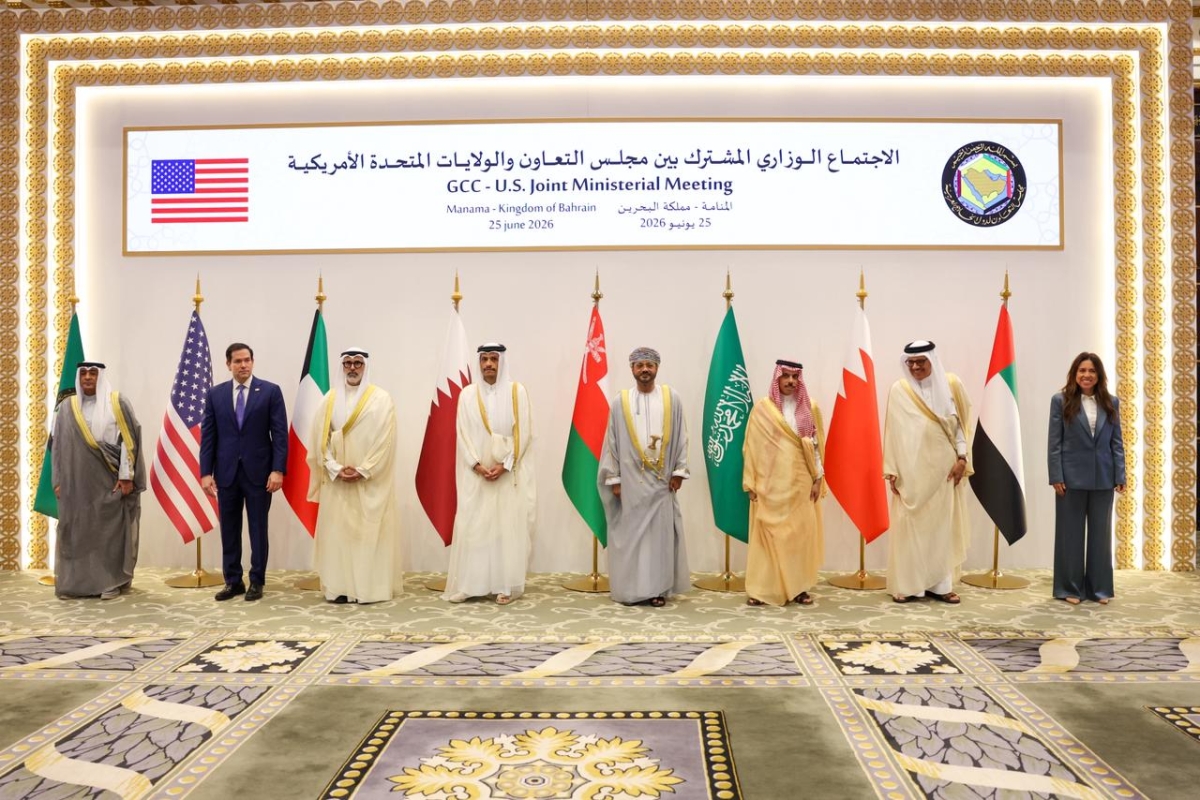
The US and GCC foreign ministers affirmed the importance of freedom of navigation in the Strait of Hormuz and rejected the imposition of fees, while focusing on countering Iranian threats and supporting stability in Gaza, Lebanon, and Iraq.
Translated by Alqyas from Al-Rai — Original source
A joint Gulf-US statement emphasized the importance of reopening the Strait of Hormuz, noting that unconditional and unrestricted freedom of navigation, including the right of transit passage guaranteed under international law, remains essential for regional and global security, and rejecting the imposition of any fees, taxes, or attempts to exert control over the strait.
The ministerial meeting between the United States and the Gulf Cooperation Council (GCC) was held today, Thursday, in Manama, co-chaired by US Secretary of State Marco Rubio and Dr. Abdullatif bin Rashid Al Zayani, Minister of Foreign Affairs of the Kingdom of Bahrain and Chairman of the current session of the GCC Ministerial Council, with participation from the foreign ministers of GCC member states and GCC Secretary-General Jassem Al-Budaiwi.
The ministers welcomed the signing of a memorandum of understanding between the United States and Iran on June 17, and highlighted the importance of the mediation roles undertaken by both Pakistan and Qatar.
They stressed the need to maintain the momentum and unity of negotiations to achieve a permanent end to hostilities and to realize the shared goal of preventing Iran from developing or acquiring a nuclear weapon in any form.
The ministers also affirmed that achieving lasting peace and security in the region requires addressing all forms of Iranian threats, including its ballistic missiles, drones, and support for proxies in the region.
They further emphasized the importance of reopening the Strait of Hormuz, noting that unconditional and unrestricted freedom of navigation, including the right of transit passage guaranteed under international law, remains essential for regional and global security.
The ministers rejected the imposition of any fees, taxes, or attempts to exert control over the strait, and welcomed the announcement by the Sultanate of Oman and the International Maritime Organization regarding the start of implementing an evacuation plan for more than 11,000 stranded sailors in the region.
The ministers expressed their support for the Syrian people in building a stable, secure, inclusive, and sovereign state that is fully integrated into its regional environment, and reaffirmed their commitment to Syria’s sovereignty, unity, and territorial integrity.
They decided to continue working with the Syrian government and providing assistance to address key challenges, such as combating terrorism, restoring basic services, improving the investment climate, and enabling the voluntary return of refugees and internally displaced persons.
The ministers reiterated their full commitment to Lebanon’s sovereignty, security, stability, and territorial integrity. To this end, they welcomed the ongoing bilateral negotiations between Israel and Lebanon, under US sponsorship, aimed at creating the necessary conditions for concluding a permanent peace and security agreement between the two countries. In this regard, the ministers stressed the importance of maintaining the negotiation track and ensuring it is not linked to any other disputes.
The ministers welcomed a practical approach that would enable the restoration of security and the extension of the Lebanese state’s authority, as well as the delineation of permanent borders. They affirmed that full Lebanese sovereignty cannot be achieved while non-state armed groups retain military capabilities outside the authority of the Lebanese state, and called for the complete disarmament of all such groups and the restoration of the Lebanese state’s monopoly on force, taking into account the importance of supporting the Lebanese Armed Forces in achieving this objective.
The ministers reiterated their support for the comprehensive plan proposed by President Trump to end the conflict in Gaza, which was endorsed by UN Security Council Resolution 2803. US Secretary of State Rubio welcomed the historic participation of GCC states in the Peace Council and expressed gratitude for their commitments to enhancing efforts to achieve stability, recovery, and reconstruction in Gaza.
The ministers emphasized the importance of disarming all non-state armed groups to enable the reconstruction of Gaza, and the necessity of transferring responsibility to an independent, technocratic Palestinian civilian committee. They praised President Trump’s statement opposing the United States’ annexation of the West Bank, and stressed that progress in Gaza’s redevelopment and in reforms of the Palestinian Authority would help create conditions conducive to a credible path toward the Palestinian people’s right to self-determination and the establishment of their state. The ministers also reiterated that no one would be forced to leave Gaza, and that anyone wishing to leave would have full freedom to return.
The ministers condemned attacks carried out by Iran-aligned groups in Iraq against Gulf Cooperation Council countries, including drone attacks that damaged civilian facilities, critical infrastructure, and energy security. They again expressed their support for the efforts undertaken by the new Iraqi government to consolidate state control over weapons and prevent non-state armed groups from using Iraqi territory to threaten neighboring countries.
The ministers also reaffirmed their respect for the sovereignty and territorial integrity of the State of Kuwait, in accordance with international law and relevant United Nations Security Council resolutions, including Resolution 833.
The ministers stressed the importance of the Iraqi government taking all necessary measures to ensure the security and safety of all diplomatic missions in Iraq, protecting them from any threats or attacks, in line with Iraq’s relevant international obligations.
