Mexican Ambassador to Kuwaitis: Welcome to the 2026 World Cup
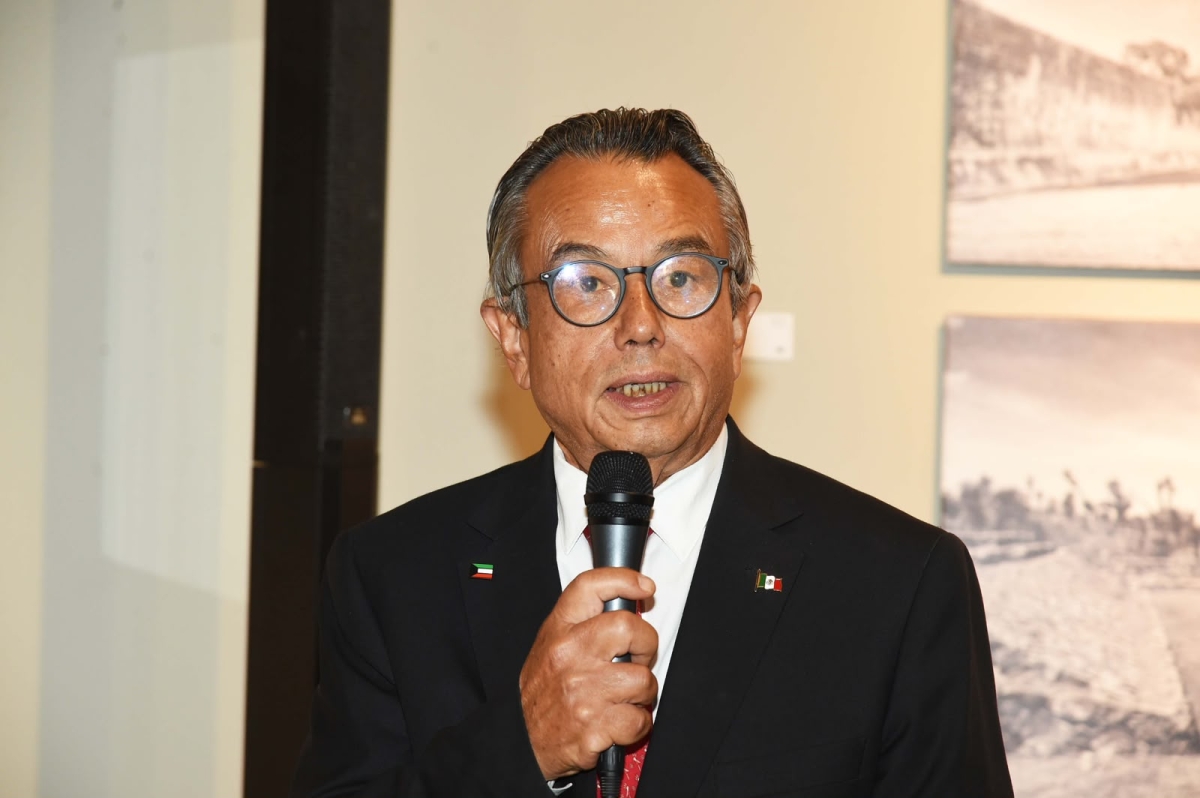
The Mexican Ambassador to Kuwait affirmed that sports and culture are two means to enhance understanding, welcoming the arrival of Kuwaitis to the 2026 World Cup without a Mexican visa.
Translated by Alqyas from Al-Rai — Original source
The Mexican Ambassador to Kuwait, Eduardo Haller, affirmed that sports and culture serve as effective means to enhance mutual understanding among peoples and resolve disputes away from violence, noting that ancient Mesoamerican civilizations used the traditional ball game as a means to settle conflicts between different communities.
This came in statements he made on the sidelines of the opening of an exhibition by Mexican photographer Javier Injossu at the Kuwait Contemporary Art Platform, which highlights the “Sacred Ball” game played by pre-Spanish civilizations in Mexico and Central America.
Haller said the exhibition carries two main messages: the first is to promote Mexico’s role as a co-host of some matches in the 2026 FIFA World Cup, while the second emphasizes that sports and culture can build bridges of dialogue and understanding among peoples.
Regarding the World Cup, the Mexican Ambassador clarified that Kuwaiti citizens holding valid visas for the United States, Canada, the United Kingdom, or Japan do not need a Mexican visa to enter the country, expressing his hope to welcome a large number of Kuwaiti fans during the tournament.
He revealed that he had discussed with the President of the Kuwait Football Association ways to enhance sports cooperation between the two countries, including the possibility of signing a memorandum of understanding with the Mexican Football Federation to develop the game and exchange expertise.
He added that the success of national teams requires long-term professional effort, expressing his hope that Kuwait will be able to participate in major tournaments hosted by Mexico and the region in the future.
Haller noted that Mexico boasts more than 250,000 archaeological sites, explaining that the exhibition documents an important aspect of the region’s history: the ball game, which dates back between 2,600 and 3,600 years.
He pointed out that the game was played using a rubber ball weighing between one and four kilograms, with players forbidden from using their hands or feet, relying instead on their hips, shoulders, and elbows to keep the ball in play, while the objective was to pass the ball through a stone ring mounted on the sides of the court.
He stressed that this game was not merely a sporting activity but carried religious and social dimensions, and was sometimes used as a means to settle disputes between different communities instead of resorting to war.
The Brazilian Ambassador to Kuwait, Rodrigo de Araujo Gabish, stated that football is an integral part of Brazil’s national identity, noting that his country’s participation in the World Cup becomes a national occasion experienced by all Brazilians with great passion and enthusiasm.
In a statement on the sidelines of the exhibition, the Ambassador said that the famous yellow jersey of the Brazilian national team has become a global symbol for football fans, adding that he has seen many Kuwaiti citizens and residents wearing it, despite the Brazilian community in the country not being large, which reflects the popularity of “Seleção” in Kuwait.
He affirmed that his national team aims to win the title for the sixth time in its history, emphasizing that hopes remain high for the team’s ability to continue writing history and adding more achievements to its illustrious record.
He noted that Brazilian football is widely admired around the world, pointing out that its style of play, based on skill, creativity, and enjoyment, has made the Brazilian national team one of the most popular among fans across different continents.
