Hezbollah 'catches its breath' from Iran front 'thaw': Threatens internal backlash and government overthrow in the streets
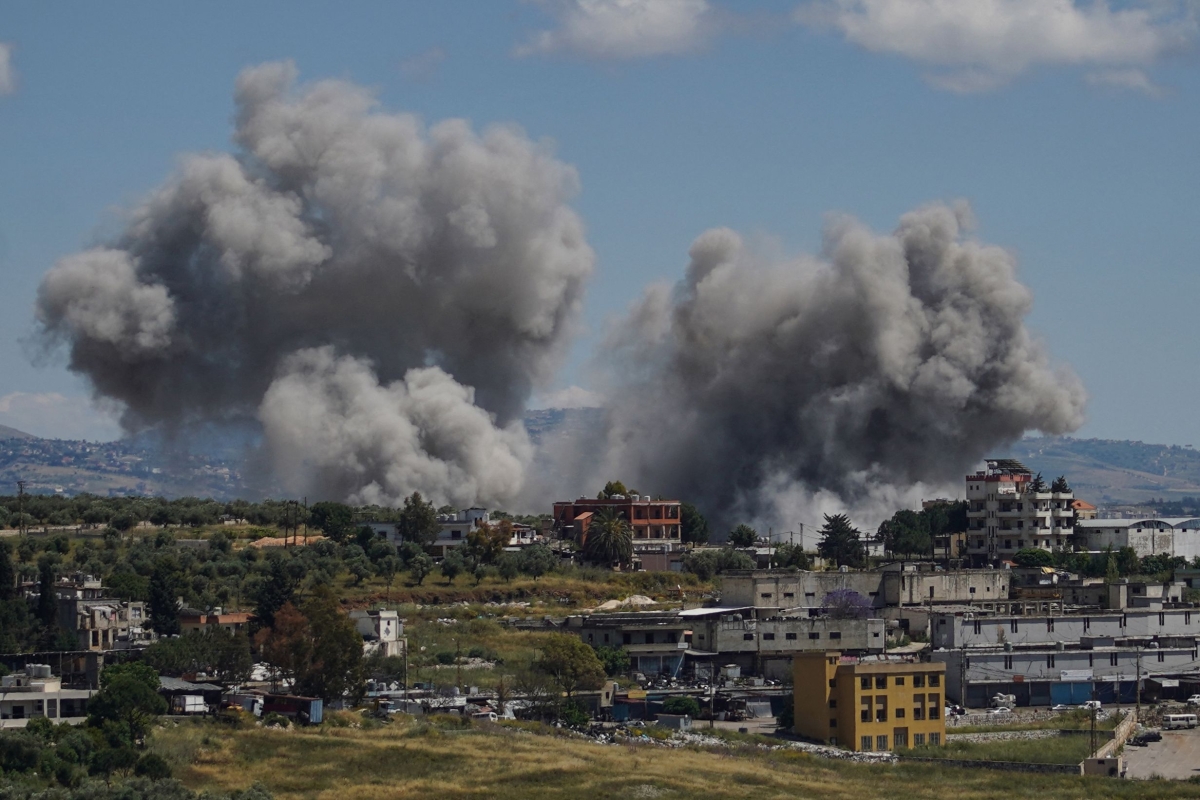
Hezbollah threatens to overthrow the government in the streets amid prospects of a ceasefire in Lebanon.
Translated by Alqyas from Al-Rai — Original source
... an announcement could come today, perhaps tomorrow, and it might be derailed by “the demons of detail.” This was the situation surrounding the memorandum of understanding between the United States and Iran, which held Lebanon, the region, and the world in breathless anticipation, waiting to see whether it would be signed, ushering the war into a tunnel of negotiations aimed at reaching a final agreement, or whether the last quarter-hour of the path to extinguishing the larger regional fire, which has persisted for decades, would bring surprises that return everything to square one.
While capitals across the region, the East, and the West were busy probing the outcomes of the most serious attempt on the diplomatic track to end the war on Iran’s front, with mediators keen to hasten filling remaining gaps before a negative surprise—whether from secondary fronts or due to shifting moods supporting a preliminary deal within Tehran itself, resulting from multiple centers of influence and possibly decision-making—Lebanon remained acutely attuned to this intense dynamic. Its war is tied to the “mother front” (Tehran), and its peace, “theoretically,” is governed by the Washington table, where direct negotiations with Israel are underway, resembling a box into which all papers for a comprehensive agreement are being prepared, but whose key—the Hezbollah arsenal—lies in Iran’s hands.
Amid heightened nerves regarding the feverish climate surrounding the substance and framework of the principles agreement and the “first rain” of its implementation results, particularly concerning the Strait of Hormuz and the maritime blockade, the conflict over Lebanon’s front and its place in the broader landscape re-emerged. Is it an “Iranian file,” i.e., one of the bargaining tools Tehran will use in the 60 days leading up to the final agreement (if the “Islamabad Declaration” is issued)? Or has its independent track’s “horse left the stable” through Washington-mediated negotiations between Beirut and Tel Aviv, which have now acquired high “immunity” thanks to the personal patronage of President Donald Trump.
This old-new conflict expressed itself again through Tehran’s insistence on including a ceasefire on all fronts, foremost among them Lebanon, as a priority in the memorandum of understanding, and its attempt to ensure that Trump pressures Tel Aviv to fully commit to a truce with Hezbollah. Political circles consider this part of the Islamic Republic’s effort to demonstrate that the Lebanese state cannot, on its own diplomatic strength, compel Israel to respect a ceasefire (which has been verbally in effect for 37 days), because it lacks the sole leverage card represented by the Hezbollah arsenal, which deliberately delegates command and control over the fate of its arsenal to Tehran and the Islamabad track.
On the other hand, Benjamin Netanyahu persists in trying, as much as possible, to separate the ceasefire on the Iran front from the continued, albeit limited and reduced, fighting on the Lebanon front. He stated that Trump reaffirmed to him “Israel’s right to defend itself against threats on all fronts, including Lebanon.” It is believed that Washington’s stance aims to help him “swallow” the understanding with Tehran, while also reinforcing the independence of the Lebanese track in negotiations from the Islamabad table, and establishing the Washington table as the exclusive reference for generating a comprehensive agreement between Beirut and Tel Aviv, with the dismantling of the Hezbollah arsenal as its entry point.
There is a prevailing impression that the issue of Iran’s proxies, led by Hezbollah, although excluded from the final agreement with Tehran, will be addressed “surgically”—that is, through field pressure exerted by Israel if necessary—alongside the political and diplomatic track led by the United States, which was elevated on Thursday with a message of the harshest sanctions against Lebanese security and military officials, the Iranian ambassador to Beirut, “shadow figures” in the inner circle of Speaker Nabih Berri, and Hezbollah MPs, with “the rope on the goat’s horns.”
Meanwhile, the Lebanese state is preparing its documents for the launch of the security track, involving direct negotiations with Israel at the Pentagon on Friday, four days before the first official round of negotiations on the enhanced political track to discuss a “declaration of intentions” that is intended to be issued. Beirut insists on consolidating the “restoration of diplomatic sovereignty” and on the principle that it negotiates on its own behalf, separating the Washington and Islamabad tracks.
Political circles have considered that Iran’s entry into a de-escalation phase and its placement on the path to a resolution, even one fraught with significant bumps, will help defuse some landmines along Lebanon’s path, particularly if Israel adheres to a more disciplined ceasefire framework. These circles expressed no fear that Hezbollah would gain strength from developments that aimed to accelerate the end of the Iran war, especially since Washington had drawn the boundaries of the Washington table through sanctions, a framework personally championed by Donald Trump as its “godfather.”
Although no official stance has been issued regarding Lebanon’s position on the likely memorandum of understanding between Washington and Tehran, LBCI channel reported from official sources that “any ceasefire reached in Lebanon would serve as support and confirmation of the ceasefire achieved by the Lebanese state in its Washington negotiations.” It added that “Lebanon has been working since the last meeting in Washington with the negotiating team to stabilize the fragile ceasefire and is conducting communications with the American side for a comprehensive halt to operations across Lebanon, but it has not yet received any clear response.”
According to the sources, “Lebanon has made the decision that it negotiates on its own behalf and is not a bargaining chip in anyone’s hands,” noting that “Iran wants to link Lebanon to its negotiations with America to tell Hezbollah that it has not abandoned it, but the Lebanese state insists on its decision to independently control the negotiation process and separate the two tracks.”
It further stated that “what Lebanon will gain through any American-Iranian agreement is a ceasefire, as Lebanon is already in a ceasefire period extended for 45 days following the last round of negotiations in which official Lebanon participated, although Israel did not comply with it.”
It concluded that “official Lebanon has not yet received any information regarding what the Lebanese front might witness in the event of an agreement, but it welcomes any agreement that leads to a complete halt of the war in Lebanon and an end to operations taking place in the south.”
While Berri was quoted as saying in response to the possibility of an American-Iranian agreement and rumors that it might include Lebanon, “the proof lies in implementation,” Israel did not delay in demonstrating that it would make, at least, the hours preceding any memorandum of understanding, a “burning battlefield,” thereby expanding the scope of its airstrikes. These strikes resulted in 11 casualties, including a child and six women, and nine injuries, including four children and a woman, in the town of Sir al-Gharbi (in the Nabatieh district), alongside the extension of the evacuation alarm belt once again to villages in the Western Beqaa and Sidon. Meanwhile, the Israeli Broadcasting Authority reported, citing a military source, that “if we are forced to breach the Blue Line to confront Hezbollah, it will happen.”
Meanwhile, Hezbollah, which has also intensified its drone operations, appeared to have taken a brief pause amid the looming prospect of an end to the Iran war and the subsequent push to threaten the government with its ouster. This stance was articulated by its Secretary-General, Sheikh Naim Qassem, in a message marking “Liberation Day,” in which he declared, “If the government is incapable of safeguarding sovereignty, it should step down.” He further asserted that “interest-free loans constitute an independent social initiative, and aggression against this institution is an attack on the poor and those with limited incomes. The people have the right to take to the streets and overthrow the government in the face of the US-Israeli project targeting our institutions.”
He called on the government to reverse its decision to monopolize weapons in the hands of the state, emphasizing that “US sanctions will not weaken us. If America becomes even more brutal, it will have no place left in Lebanon, as it will destroy the country over the heads of its people, and the responsibility will lie with it.”
He maintained that “disarmament is a precursor to genocide, and we cannot accept this (...) The resistance will defend the land and honor, and anyone who confronts us will be met with the same resolve we show against Israel. Weapons will remain in our hands until the state is able to fulfill its duties.” He also stated that “direct negotiations are completely rejected, as they constitute a pure gain for Israel.”
