10,000 killed and injured in Lebanon since March 2... Israel hints at preparations to break free from US constraints
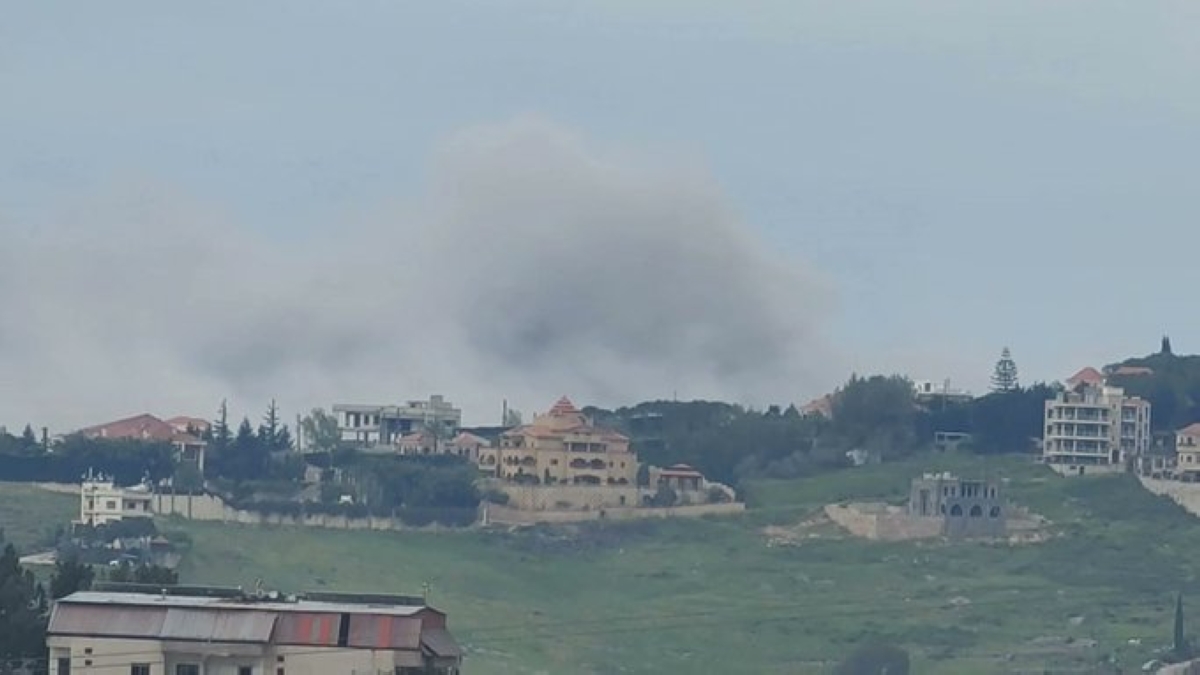
Widespread explosions in Lebanon due to tensions between Hezbollah and Israel, with negotiations between Aoun and Netanyahu in Washington
Translated by Alqyas from Al-Rai — Original source
The severity of Lebanon’s situation in the “Elephant’s Pass,” the most dangerous zone amid the front transformed by Hezbollah’s mobilization in support of Iran on March 2, has become a focal point for “opposing currents” in the form of divergent paths of “fire and water” racing and clashing in a theater that has not been extinguished, and behind diplomatic curtains that have not been lifted but feature “two wings” operating asymmetrically in an effort to end the suspended war through a ceasefire that remains only in name and a geographic zone prohibited to Israel... until further notice. The most telling illustration of this highly dangerous scenario is the push to propel Beirut out of the war vortex, which remains pregnant with rounds that portend even deadlier consequences for people and infrastructure, on an “inverted” ladder along which Washington is pressing for a meeting between President Joseph Aoun and Benjamin Netanyahu at the White House to launch formal direct negotiations.
Conversely, a parallel track is emerging that seeks to provide Lebanon with a security umbrella to avoid any leap into an abyss where conflicts linked to Israel intertwine with tendencies to ignite internal tensions, even if it means detonating the “bomb belt” with which the country was wrapped in accordance with the imperatives of Iran’s war, and perhaps preparing the ground on a “hot” basis for swaps between arms and gains in Lebanon’s internal balances.
As Lebanon enters the final decade of “Ceasefire 2,” announced by President Donald Trump for three weeks (until May 16–17), Beirut has regained its orientation toward the “mother front,” namely Iran, which was brought to its “mouth” and entered the ceasefire phase against the backdrop of adjusting the Lebanese front to the winds and directions of the war with Tehran, and with a complete diplomatic separation between the two tracks by launching preliminary direct negotiations on the Beirut–Tel Aviv line in Washington, thereby cutting off any potential use of Hezbollah’s card to “weigh down” Tehran’s negotiating position and granting it room to exchange conditions and preserve a role for its most prominent agent in Lebanon on “the day after.”
Meanwhile, the file concerning the Aoun–Netanyahu meeting, which Washington insists upon as a prerequisite for formal direct negotiations before the expiration of the “Ceasefire 2” deadline, has become the most prominent issue in the Lebanese landscape in recent hours. The prospect of renewed military escalation on the Iran front implies that any new war with Tehran would drag Lebanon into it, following the model of March 2 and its aftermath, amid the difficulty of envisioning any development in the Lebanese negotiation track, which is fundamentally based on “unique” talks between two parties that are not fighting each other, and around issues whose key lies in the hands of a third party that rejects direct negotiation outright and accepts it only if Tehran engages with Washington, with the Lebanese file under its umbrella.
The day after U.S. Ambassador to Beirut Michael Issa confirmed that the Aoun–Netanyahu meeting is not a concession and that the prime minister “is not a bogeyman,” the President of the Republic reiterated before his visitors that “what he is doing is in the interest of all Lebanese, not just a faction, and that the negotiation track is the only one remaining after other solutions, including war, have been exhausted,” declaring that “the time has come for the South to rest, along with Lebanon,” and noting his “continuation of efforts aimed at ending the state of war that everyone has suffered, so that peace may prevail permanently, not temporarily.”
Amid anticipation of a third round of preliminary negotiations in Washington, Egyptian Ambassador to Beirut, Alaa Mousa, visited Parliament Speaker Nabih Berri, amid reports suggesting that Cairo is seeking to resume its diplomatic efforts to draw up a roadmap for resolving the Hezbollah weapons file. This approach is based on freezing the use of Hezbollah’s weapons to launch a parallel process of Israeli withdrawal, followed by negotiations on other issues. However, this effort faces the objection that Hezbollah will not accept remaining outside any war that benefits Iran, let alone the fact that the US-brokered negotiation channel appears to have exited the fold, leaving no room for slowing it down or finding alternative or complementary frameworks.
Meanwhile, Al Jazeera reported that the US State Department stated that “Hezbollah continues to attempt to obstruct negotiations through attacks on Israel and threats within Lebanon.” An Israeli source told CNN that “if the ceasefire with Iran collapses, Israel is considering the possibility of expanding its strikes against Hezbollah throughout Lebanon,” and that “Netanyahu informed the US President that Israel is interested in resuming high-intensity combat.”
CNN also reported, citing a security source, that “the Israeli military is pushing to resume strikes against Hezbollah north of the Litani River,” as the number of Lebanese casualties and wounded since March 2 reached 10,000.
In a related development, the Israeli military radio reported that “the data underlying the ceasefire with Hezbollah proves that there is no ceasefire in Lebanon,” noting that since the ceasefire entered into force about two and a half weeks ago, approximately 70 explosive-laden drones were fired at army forces, with 11 resulting in the death and injury of personnel. Two of these drones penetrated Israeli territory and injured fighters inside it.
According to the report, five soldiers were killed and 33 others injured since the ceasefire, with three of the fatalities caused by explosive-laden drone strikes and two by explosive devices.
