Trump Extends Truce and Siege... Tehran Escalates in 'Hormuz'
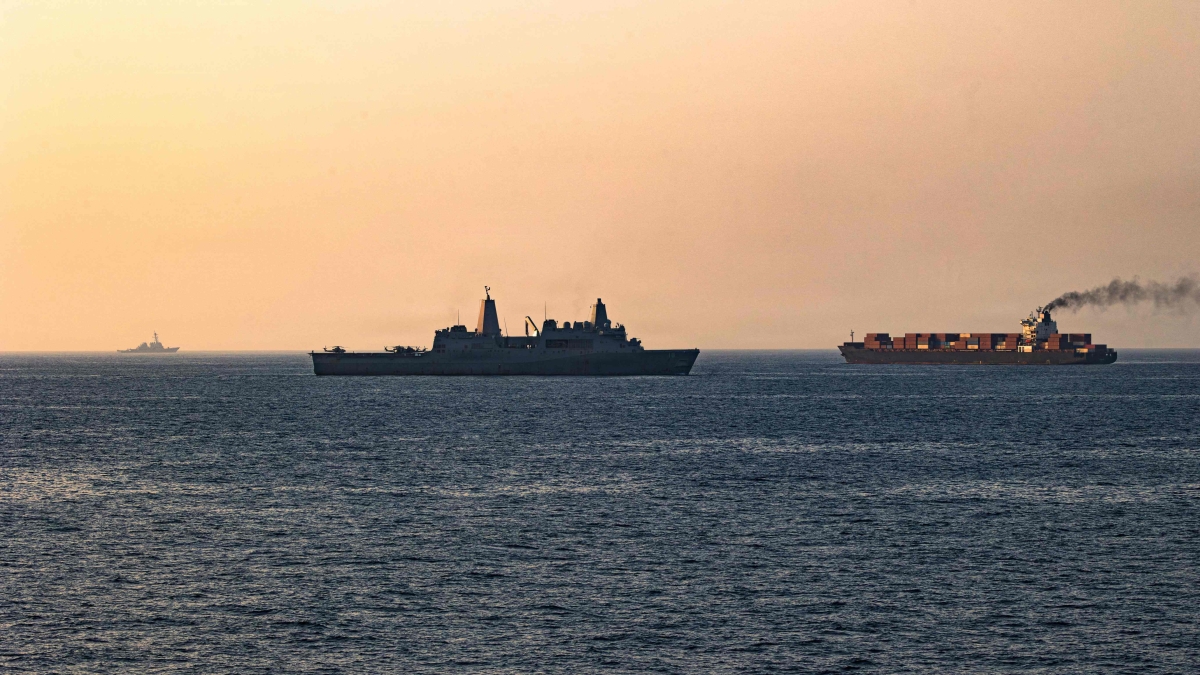
Extension of the truce with Iran at Pakistan's request, with tensions in Hormuz and accusations of violating the siege.
Translated by Alqyas from Al-Rai — Original source
Donald Trump extended the ceasefire with Iran without setting a new deadline, thereby opening an additional time window in anticipation of Tehran presenting a “unified proposal” to end the political deadlock. He stated that it is “possible” to resume talks in the coming days.
However, the extension faced a firm counter-response. Tehran informed Pakistan of its refusal to “negotiate under pressure” or while the US naval blockade on its ports continues. Meanwhile, the Islamic Revolutionary Guard Corps (IRGC) detained two ships that attempted to cross the Strait of Hormuz, marking the first such incident since the war began on February 28.
In a message exchange with the New York Post, the US President responded to a question about the possibility of holding negotiations within “36 to 72 hours,” i.e., before Friday, by saying, “That is possible.”
Earlier, Trump had ruled out extending the truce, which entered into force on April 8, for two weeks. However, on Tuesday evening, he wrote on his Truth Social platform: “Based on the fact that the Iranian government is deeply divided, which is not surprising, and at the request of Pakistani Army Chief Asim Munir and Pakistani Prime Minister Shehbaz Sharif, we have been asked to suspend our attack on Iran so that its leaders and representatives can present a unified proposal.”
He emphasized the continuation of the naval blockade, stating that lifting it would undermine any chance of reaching a peace agreement “unless we blow up the rest of their country, including their leaders.”
The US President also viewed Iran as “financially collapsing” due to the closure of the Strait of Hormuz and the naval blockade, noting that it is “suffering from a liquidity shortage.” He had previously written that Tehran supported closing the strait “to save face” amid the blockade.
He added that the administration had observed “clear fundamental disagreements” between Iranian negotiators and IRGC circles, leading to a significant split within the delegation participating in the Islamabad talks. He noted that Washington believes the new IRGC commander, Ahmad Vahidi, is behind obstructing what was agreed upon or discussed during the first round of negotiations, considering his interference contributed to hindering the possibility of tangible progress.
Fox News reported, citing sources, that communication within Iran “is not an easy task at the moment” due to the “intensive military intelligence campaign” led by the United States. It clarified that “under these circumstances, it is not easy for Iranian leaders even to make simple calls, such as using the phone, due to the genuine fear of being targeted.”
Conversely, Tasnim News Agency reported that Iran had not requested an extension of the ceasefire and reiterated its threats to break the US blockade by force.
Mohammad Bagher Qalibaf, Iran’s chief negotiator and head of the Parliament (Majlis), stated that the ceasefire “makes no sense in the face of a violation represented by the naval blockade.” He added that “opening the Strait of Hormuz is impossible under this blatant violation of the ceasefire.”
Meanwhile, the Iranian Navy detained two container ships attempting to exit the Gulf via the Strait of Hormuz on Wednesday, after firing upon them and another vessel.
The IRGC accused the ships “MSC Francesca,” flying the Panamanian flag, and “Epaminondas,” flying the Liberian flag, of “sailing without obtaining the necessary permits and tampering with their navigation systems.”
Reports indicated that Epaminondas, operated by a Greek company, was fired upon approximately 15 nautical miles northwest of the Sultanate of Oman.
The UK Maritime Trade Operations organization and sources in the maritime security sector stated that the ship reported damage to its command room caused by being hit by missile shells from a warship.
Sources in the maritime security sector said the ship’s captain reported no wireless communication prior to the attack, and that the vessel had previously received permission to transit the strait.
The “Francesca,” which the Guard declared “linked to the Zionist entity,” was fired upon about eight nautical miles off the coast of western Iran, but it sustained no damage and its crew was unharmed.
On Saturday, the United States fired upon an Iranian cargo ship and detained it, and on Tuesday raided a large Iranian oil tanker in the Indian Ocean.
In a related development, the Pentagon informed Congress that fully clearing the Strait of Hormuz of mines could take six months, according to the Washington Post.
It stressed that it is unlikely a mine-clearance operation in the strait would be carried out before the end of the war.
