Lebanon Declares It a 'Bloodless War' on the Path to Negotiation Session with Israel
President Aoun announced that negotiations do not imply concessions, and it was agreed to extend the ceasefire and determine the location for direct negotiations.
Translated by Alqyas from Al-Rai — Original source
- Washington’s second round... an extension of the ceasefire and the setting of time and place for the diplomatic confrontation
- Aoun: Negotiations do not mean concession or surrender
- The Emir of Qatar confirmed to Aoun his support for the positions he has taken to halt military escalation, foremost among them direct bilateral negotiations
- Bri: Israel will face resistance if it does not withdraw from southern Lebanon
On the eve of the second round of preliminary direct talks between Lebanon and Israel at the level of the two countries’ ambassadors to Washington, held at the US State Department on Thursday, Beirut appeared to be looking toward Islamabad and the new round of US-Iranian negotiations, which were racing against the expiration of the two-week truce deadline today, amid heightened anxiety about the ticking clock and the question of “with whom and against whom.” At the same time, it was focused on the halfway point of the ten-day ceasefire on the “Land of the Cedars”–Tel Aviv front, and on efforts to extend it so that it would cover the launch of official negotiations aimed at reaching a permanent solution that the small country desires, ensuring that war does not recur by eliminating its causes and “lightning strikes,” ranging from ending the occupation and halting attacks to withdrawing Hezbollah’s weapons—a solution that the United States and Israel view as a peace agreement.
While talks in Islamabad and their decisive new round stumbled during the day in a “one step forward, two steps back” manner, amid efforts to bridge deep gaps, at least enough to allow for a truce extension unless the conditions for a final agreement have not yet been fully met, Lebanon remained closely monitoring these negotiations, which are bound to have direct repercussions on the “Hezbollah”–Israel front if the ball of fire reignites on the Iranian stage or if cold water is poured on it, without halting the path of direct negotiations with Tel Aviv that President Joseph Aoun has been carving out in a “one-way” manner, consistently asserting, despite the party’s cries and threats and behind it Iran, without gloves, the separation of the two tracks by establishing the “diplomatic independence” of the “Land of the Cedars” in shaping its orientations and strategic choices.
Aoun had affirmed before his visitors that “diplomacy is a war without bloodshed,” while “war is the shedding of blood, destruction, and ruin,” announcing, “Therefore, the decision to engage in negotiations between adversaries was made, with emphasis on preserving rights, and most importantly, first and foremost, halting attacks, Israeli withdrawal, and the return of prisoners, in order to seek peace after decades and long years of wars, death, and destruction.”
Aoun’s reference to “peace” gained significance as an indicator of the “final product” of negotiations with Israel, which will be among the pillars of the framework governing official negotiations, the location and timing of which are expected to be determined in tomorrow’s round at the ambassadorial level. The Lebanese president’s confirmation that “negotiations do not mean concession or surrender, but rather are for resolving problems, and it is important for Lebanese to stand by their state in this particular moment, as they have grown weary of these wars” was no less significant. He concluded: “It is my duty and responsibility to do everything necessary to achieve security and peace for Lebanon.”
Parallel to the “soft counter-offensive” launched by President Aoun against what appeared to be a “white flag” campaign orchestrated by Hezbollah and its leaders against him (alongside Prime Minister Nawaf Salam), rejecting the principle of direct negotiations and what he expressed as an attempt to remove Lebanon from Tehran’s pocket in its talks with the United States by birthing the Lebanese April 17 truce under the umbrella of the historic Washington meeting on April 15 rather than the Iran truce track, the Lebanese President proceeded to gather Arab and international support for his steps, which are expected to see further momentum following the anticipated second call from US President Donald Trump.
Aoun received a call from the Emir of Qatar, Sheikh Tamim bin Hamad Al Thani, during which the latest developments related to the situation in Lebanon following the ceasefire were discussed.
According to the Lebanese Presidency’s media office, the Emir of Qatar affirmed to Aoun his “support for his positions and the steps he has taken to halt military escalation, foremost among them direct bilateral negotiations aimed at stopping military operations, the withdrawal of Israeli forces from the areas they occupy in the south, and the deployment of the Lebanese Army up to the southern border, as well as other points that ensure the extension of the Lebanese state’s authority over its entire territory.”
Aoun thanked the Emir of Qatar for his supportive positions toward Lebanon, expressing his “appreciation for the Qatari role in helping achieve what the President of the Republic is working toward for the sake of Lebanon and its people,” and they agreed on “continuing communication between them to follow up on developments.”
Meanwhile, the ceasefire and negotiations with Israel were at the heart of the meeting on Tuesday evening at the Élysée Palace between French President Emmanuel Macron and President Nawaf Salam, who had visited Paris after Luxembourg, where he met his counterpart Luc Frieden before meeting with the foreign ministers of the European Union.
This outward movement by Lebanon, along with the Arab-international diplomatic dynamic directed toward it, served as reinforcement for the second round of facilitative talks between Beirut and Tel Aviv at the US State Department (it is likely that US Secretary of State Marco Rubio will not attend again), which US Ambassador to Lebanon Michel Issa had accompanied in its preparations through two meetings on Monday with Aoun and Parliament Speaker Nabih Berri. Berri warned in an interview with “Al-Jumhuriya” newspaper that “Lebanon cannot afford to lose even one meter of its territory.” He affirmed that if Israel “maintains its occupation, whether of areas, sites, or through zero lines it draws, this means that every day it will smell the resistance.”
Following the two meetings, a post by the US Embassy on the “X” platform clarified that Issa renewed during them “the affirmation of US support for efforts aimed at restoring Lebanon’s sovereignty and restricting weapons to the state,” which was interpreted as confirming Washington’s view that Hezbollah’s arsenal remains the key to the success of any negotiations. Information from circles close to Baabda Palace (where President Aoun is based) converged, indicating that communications with the US side regarding the extension of the ceasefire showed positive signs, with US pressure toward extension to pave the way for direct negotiations. An additional deadline ranging between 10 to 20 days or 20 to 40 days is being proposed, but the matter has not yet been finalized.
According to information leaked to Lebanese media, the second preliminary round will address two issues: the extension of the ceasefire, and determining the time and place for the start of official direct negotiations, which will be led by former Ambassador Simon Karam on the Lebanese side, with his full membership to be solidified depending on the nature of the Israeli delegation.
Alongside the atmosphere suggesting that Thursday’s talks could be the final preliminary round unless a third round becomes necessary within this framework, the same sources indicated that nothing specific has been determined yet regarding the President’s visit to Washington, which Trump had revealed he would invite him to, adding, “but this does not mean it is out of the question.” Contacts between Aoun and Bri have continued without interruption, aiming to keep the latter fully informed about all ongoing communications related to the negotiations.
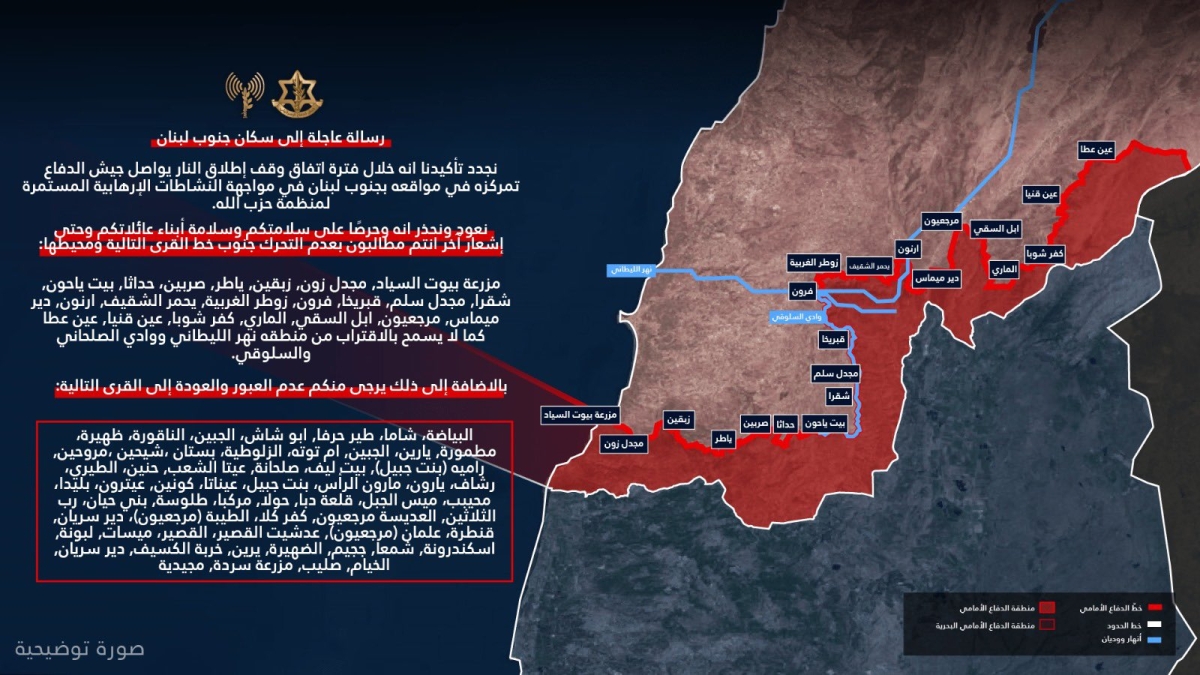
Against this backdrop, and as the Israeli army continues to consolidate and demarcate a “buffer zone” in southern Lebanon, marked by a “yellow” line that keeps expanding, nearly 100 villages have become “captured” either through direct occupation or shelling, or are now prohibited for entry and transit, amid deliberate burning of homes and destruction of others as part of a strategy to create a “non-viable” zone.
This was accompanied by Israeli Defense Minister Israel Katz’s confirmation that “the strategic objective of the campaign in Lebanon is to disarm Hezbollah through a combination of military and diplomatic measures,” while threatening that “southern Lebanon could resemble Rafah and Beit Hanoun in Gaza,” and warning Hezbollah Secretary-General Sheikh Naim Qassem that he would suffer the same fate as former Secretary-General Sayyed Hassan Nasrallah, who was assassinated on September 27, 2024.
