Lebanon on the Brink of the Region's Slide Toward... 'Hell'
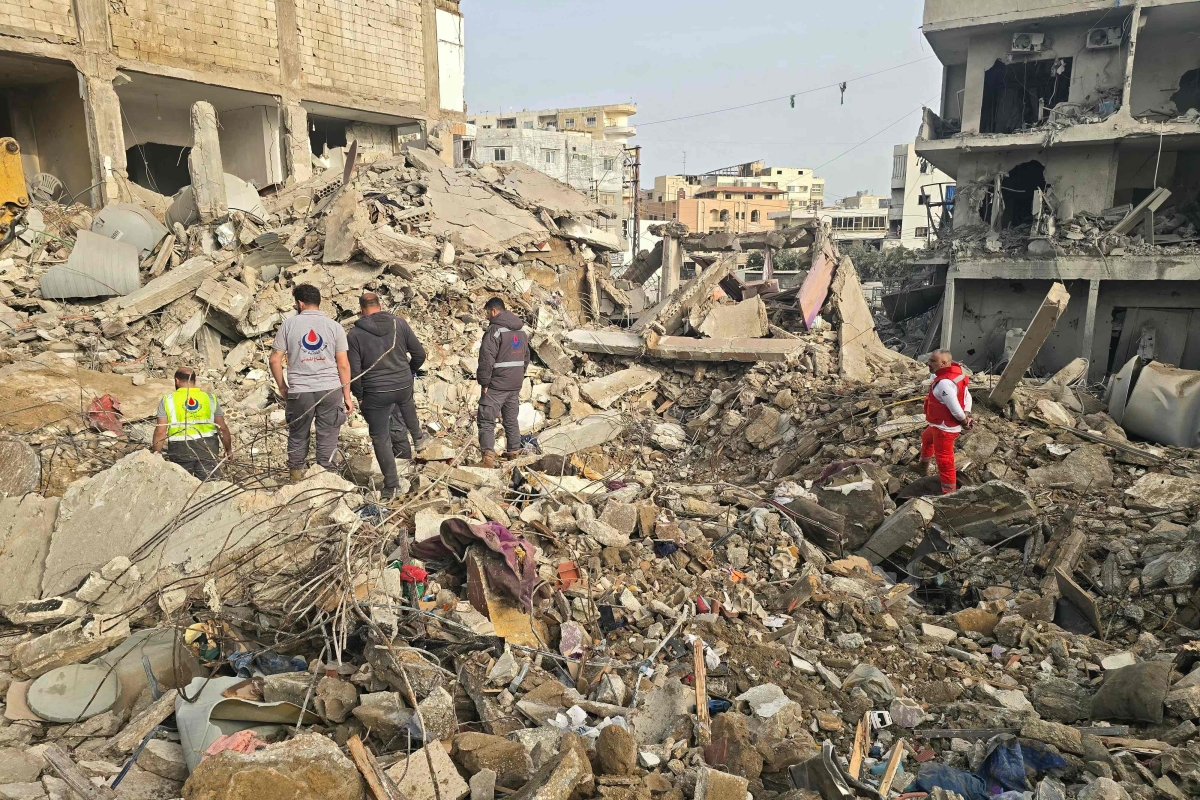
Israel expands its security cordon in southern Lebanon, targeting Hezbollah centers and arms depots, while the US Embassy warns of threats targeting Lebanese universities
Translated by Alqyas from Al-Rai — Original source
- The Sponsor: Our country’s entity is at risk due to the violation of its sovereignty by Iran through Hezbollah and Israel’s attacks.
- The US Embassy in Beirut takes seriously threats to target universities in Lebanon.
- Israel destroyed 17 surveillance cameras belonging to UNIFIL’s headquarters in Naqoura.
Amid the countdown in the region and worldwide to the expiration of the extended deadline granted by US President Donald Trump to Tehran (until Monday) to reach an agreement on his terms or open the Strait of Hormuz, or else face “great hell,” finger-biting anxiety has intensified on the Iran front and its allies, particularly Lebanon, given the fierce race between last-minute efforts to narrow the deep gap separating them from reaching an exit that stops the war in its main theater, and on-the-ground escalation that resembles open-fire negotiation and below it, along with an attempt to establish deterrence equations “of weight” for what will happen after the pivotal date of April 6.
While the shrapnel from Tehran’s blatant collective attacks on Gulf Arab countries has disrupted main negotiation tracks, others continue seeking to avoid the greatest possible outcome in the form of the fiercest storm of the major battle, with multiple scenarios ranging from US ground operations and control of islands “in the mouth” of the Strait of Hormuz, to extinguishing Iran’s “energy” and leaving the “liberation” of the strait to benefiting states, or both. Meanwhile, the Lebanese front has remained field-connected to military developments in Iran, amid relative obscurity regarding the dialectic of separating this front from the outcomes of the main war – especially if a ceasefire is reached – or not, given the perception that the confrontation is likely to continue for two to three weeks as Trump estimated, under either a third extension of the “last chance” or… the flood.
As Hezbollah continues its long-range rocket firing process – between itself and Iran – on all areas of northern Israel, Haifa, and the Upper and Western Galilee, cementing the linking of both fronts to fire and then to its cessation as Tehran pledges to the party, Israel has proceeded on a path that seemed to race against Trump’s deadline, announced (until Monday) and implicit (until April 21), to gather as many points as possible on land through the infiltration operation that has now reached the “third village circle” (between 8 and 15 kilometers deep from the border) in more than one area, paralleled by a scorched-earth strategy for the strip of frontier villages (between 3 and 4 kilometers deep), amid conflicting manifestations of the objectives of the “Fourth Lebanon War” in dimensions that go beyond establishing a “yellow strip” (between 2 and 3 kilometers deep) that would even be depopulated.
Israeli Prime Minister Benjamin Netanyahu announced that Tel Aviv “continues to expand the security belt in southern Lebanon,” affirming the continuation of striking Hezbollah and expanding and consolidating the buffer zone. His Defense Minister, Israel Katz, stated that “Israel’s goal in Lebanon is to disarm Hezbollah without connection to the Iran file,” affirming that “we will continue targeting Hezbollah leaders and operatives throughout Lebanon.”
He added: “Houses in Lebanon used as Hezbollah sites will be destroyed according to the Rafah and Khan Younis model, and we will control the Litani area (covering about 850 square kilometers) and will not allow the return of approximately 600,000 Lebanese to the south until the security of Israel’s northern residents is achieved.”
Amid the intensity of this ceiling and the concentration of ground incursions on the city of Bint Jbeil (the central sector), which holds great symbolic significance for Hezbollah and is one of the largest cities in the south now effectively under siege, alongside a push indicating an objective to reach the city of Tyre in the western sector, and in parallel with the continued isolation of southern Litani from the western Bekaa through the destruction of the bridge connecting Sahmara and Musharra, which was completely demolished on Saturday, what Israeli channel i24 reported from military sources regarding the ongoing battles against Hezbollah emerged. The Israeli army “is nearing the completion of the third phase of ground operations, aimed at pushing back the threat of anti-tank missiles and arc-trajectory shells to a distance of up to 7–8 kilometers from the border.”
According to these sources, “the third phase is being implemented gradually by four military units currently operating in the field,” noting that “control over the Ras al-Bayada area enables the Israeli army to conduct broader operations across the entire sector, including toward the city of Tyre,” and pointing out that “this army has expanded its operational control to what is known as the ‘third ring of villages,’ pushing Hezbollah fighters deep into Lebanese territory.” They added that “the objective of the ground maneuver is to control and clear all first-line villages, strike Hezbollah’s command and control centers, target elements of the organization in Beirut and north of the Litani River—with special focus on the Badr Brigade—while pursuing launch platforms and weapons depots in the Bekaa plain.”
According to the channel, “assessments indicate that the Israeli army seeks to weaken Hezbollah and degrade its capabilities, not to fully disarm it, as such a step would require occupying all of Lebanon, which is not an objective defined for the current war.” It explained that “in the coming days, a plan is expected to be approved to establish a future ‘security zone’ extending 2 to 4 kilometers inland, encompassing dozens of villages, to be free of military infrastructure and civilians, with the exception of some Christian villages, and with the return of Lebanese residents prohibited. This security zone will be built on a defensive model relying on combat control and mobile movement from the border, without permanent deployment of large forces inside Lebanese territory, as was the case with the old ‘security belt’ (during the occupation of southern Lebanon prior to 2000).”
While this plan suggests that the occupation of southern Litani—and possibly incursions across Mount Hermon toward the central and northern Bekaa to reach Hezbollah’s ballistic missile depots—indicates Israel’s intent to translate its overwhelming fire superiority into leverage at the negotiating table when the time comes, by holding the “land card” to exchange for security conditions (including the withdrawal of Hezbollah’s remaining weapons) and most likely political ones (a peace agreement), without ruling out insistence on the “yellow line,” Lebanon appears to be in a state of heavy anticipation for events it cannot control, with war looming. There is also fear that it has been deprived of the ability to influence their direction peacefully, given Tehran’s hints that it holds the upper hand in determining the fate of the “Land of Cedars.”
As attention turns to the positions that Lebanese President General Joseph Aoun is expected to articulate on Sunday from the Maronite Patriarchate in Bkerke—on the sidelines of his participation in the Easter Sunday Mass—and which will address Lebanon’s dire situation and the fate of his initiative calling for direct negotiations with Israel (which received no response), given the conflict with Tel Aviv’s objectives and Hezbollah’s priority of tying Lebanon to Iran’s front, the words of Maronite Patriarch Bechara Boutros al-Raï in his Easter message were prominent. He declared that Lebanon “is living a serious existential crisis due to the violation of its sovereignty by Iran through Hezbollah, and due to Israeli attacks on its territory.”
Al-Raï stated, “The Church continues its efforts to restore Lebanon’s peace, sovereignty over its land, and its free political decision-making. Lebanon remains committed to the speech of the oath taken by President General Joseph Aoun, the ministerial statement of Prime Minister Nawaf Salam’s government, and the Lebanese government’s decisions of August 5 and 7 (monopolizing weapons in the hands of the state) and March 2, 2026 (banning Hezbollah’s military wing), as well as relevant UN Security Council resolutions 1559, 1680, and 1701.”
Al-Raï, who is undertaking a tour on Wednesday of several southern border villages (particularly Christian ones), emphasized that “the heart aches over the victims of the war imposed on Lebanon by Hezbollah and Israel, the displaced, the destroyed homes, and those who remain steadfast, cut off from the world contrary to international laws calling for the protection of civilians and the establishment of humanitarian corridors to deliver their needs, including food and medicine.”
Meanwhile, the situation on the ground remained heated, with intense airstrikes on Beirut’s southern suburbs, which saw a series of attacks until dawn on Saturday, as well as attacks in the western Bekaa and the south, raising the death toll since the start of the war on March 2 to 1,422, with 4,294 wounded.
A UN security source told “Agence France-Presse” that Israel destroyed 17 surveillance cameras belonging to the UNIFIL headquarters in Naqoura within 24 hours. Meanwhile, observers focused on the US Embassy in Beirut’s warning that Iran and its allied armed groups “may target universities in Lebanon,” prompting it to reiterate its advice for US citizens in Lebanon to leave Beirut “as long as commercial flight options are available.”
