Israel threatens to 'isolate' Lebanon after Iran... delineates its 'yellow strip' in the south
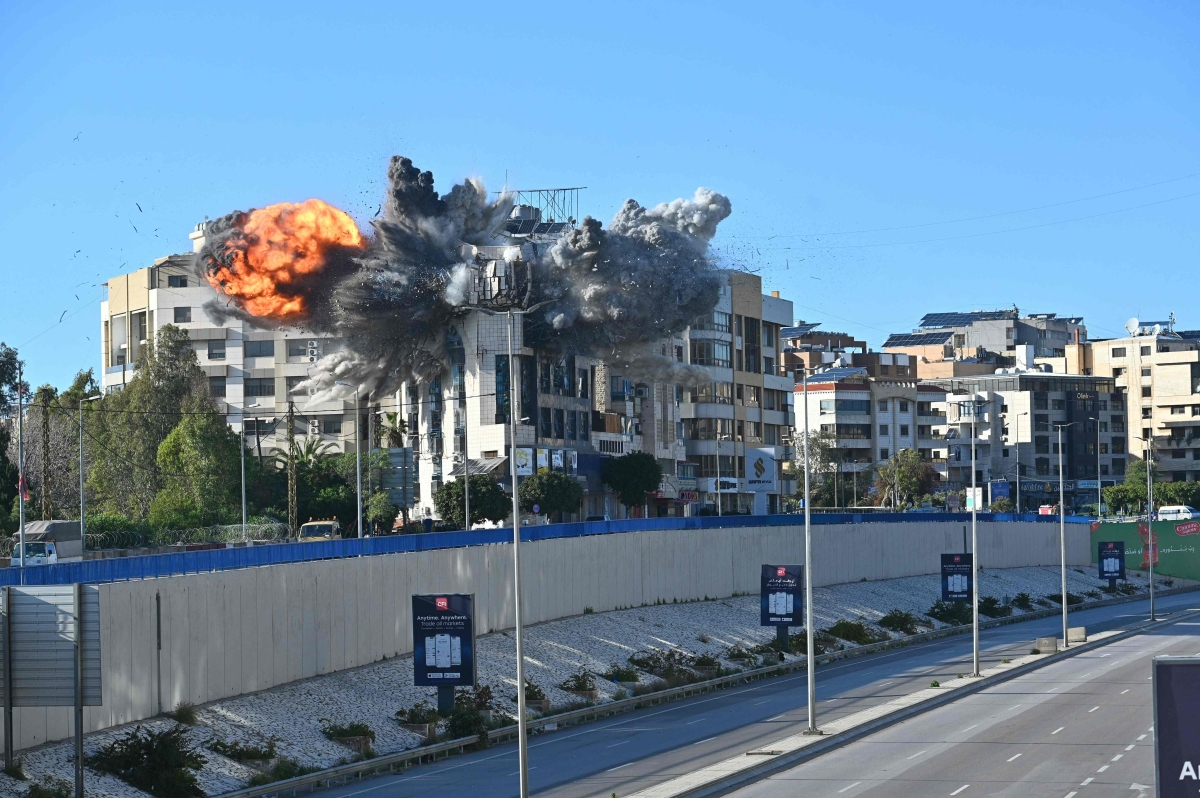
Netanyahu confirms Israel will work to clear southern Lebanon and draw a yellow strip, while Lebanon shows tensions with Hezbollah and raises threats against Israel
Translated by Alqyas from Al-Rai — Original source
- Netanyahu: We are working to ensure that a ceasefire is not imposed on Israel in Lebanon in the event of an agreement with Iran
Amid growing indications that the war with Tehran is approaching its most brutal phase, which precedes its conclusion without certainty whether it will be based on the collapse of the remaining regime or its survival to confront the catastrophic and terrifying repercussions on the volatile domestic front, early and vocal outlines have emerged from Israel regarding the framework for “the day after” the silence of artillery, which Tel Aviv desires to be confined solely to the Iranian front, excluding Lebanon.
Israeli Prime Minister Benjamin Netanyahu sought to clarify that what Iran has linked to a ceasefire across various fronts of its axis, particularly through Hezbollah, since the outbreak of war on February 28, is something Tel Aviv wants to decouple from any ceasefire or agreement with Tehran. On Tuesday, he announced that he is working to ensure that a ceasefire is not imposed on Tel Aviv in Lebanon in the event of an agreement with Iran, considering that “this decision must be independent on Israel’s part.”
According to Channel 14, Netanyahu, during a meeting of his cabinet, stated that his country is “working to build a new security reality on the northern border (...) and is acting completely independently, separate from any agreement reached with Tehran.”
Regardless of what this preemptive Israeli clarification indicates regarding the post-war landscape with Tehran—characterized by continuous pounding on the fringes of the “unity of the axis fronts” title as Iran has established it on the ground, and its “dismantling” in peacetime as Tel Aviv insists—this raises questions about whether it is realistic to assume that such a scenario could hinder the process of ending the conflict with the Islamic Republic. If that process relies on the survival of the regime, albeit severely wounded, the Israeli push on this front has deepened fears in Lebanon of a larger escalation on its front once the Iranian volcano subsides and Israel focuses “all barrels” on it.
This anxiety is further reinforced by the fact that Netanyahu’s comments regarding potential pressure to halt the ceasefire in Lebanon, coinciding with any agreement on Iran, require Beirut to possess leverage to present to the administration of President Donald Trump, specifically to prevent Tel Aviv from isolating “the Land of the Cedars.” This could occur either through more intense rounds of destructive war and further territorial gains on the ground, or through a political-diplomatic track where Israel holds the upper hand, depending on the outcomes of these rounds, thereby pushing “the Land of the Cedars” into an agreement with harsh stipulations after being cornered into a lose-lose situation, either territorially or within security contexts that better accommodate Israel’s demands, potentially leading to a peace agreement timed and conditioned according to Israel’s preferences.
In this context, informed sources believe that any agreement on the Iran front would remove a major obstacle to the direct negotiation initiative launched by President Joseph Aoun, with its entry point being a ceasefire. This is because the Iranian dimension of Hezbollah’s involvement in the war under the slogan of “supporting” Tehran and avenging the death of Ayatollah Ali Khamenei would inevitably cease to exist.
However, making this data useful in deterring Tel Aviv from launching a more intense “Fire Storm” operation requires, according to sources, tougher political tools. The lock and key remain, yesterday, today, and tomorrow, the file of disarming Hezbollah and equipping the Lebanese state with its own strength. This file will not be shaped unless there is a crystallization of the implementation of its commitment, made on August 5 last year, to dismantle its arsenal. This contrasts with the entire path followed over the past eight months, where this issue collided with Hezbollah’s refusal, citing as a pretext the apparent continuation of Tel Aviv’s occupation of border points, while its core essence is preserving the “defense line” for Iran when the hour of war strikes between the US-Israeli alliance and Tehran.
In the same context, these same circles believe that the source of concern lies in the fact that Hezbollah, in addition to threatening to turn back on its domestic base after the war, has shown since its decision to join Iran’s support on March 2 that its main priority is supplying Tehran with all the components of resilience. There is a fear that this same priority will impose itself if the old-new regime remains, meaning that if the Islamic Republic plays the card of weapons to extract concessions and respond, Lebanon will be left to a table dictated by battlefield balances. Tel Aviv is advancing in its attempt to expand its ground incursion and establish a buffer zone, the “schematic outline” of which will be completed successively to serve as a complement to the “Yellow Strip” in Gaza and its counterparts in southern Syria.
At a time when conviction is strengthening that Iran’s elevation of the ceasefire slogan “together” across its axis fronts, culminating in its public insistence on keeping its appointed ambassador in Beirut despite his expulsion order from Lebanon, reflects an attempt to signal to Washington and Tel Aviv that it holds the command over Hezbollah’s weapons, and consequently, that any “effective” negotiation must be with it. This is based on the premise of “accumulating” cards of power and pressure on the path to any agreement on its front, after it deliberately distributed pressure across its fronts during the war. Netanyahu has not hesitated to reveal what he harbors regarding southern Lebanon, despite the “painful losses” to his forces he has mentioned.
He affirmed that he is working on “creating wide security belts and cleansing villages of terrorism in southern Lebanon,” noting that he issued orders to draw a “yellow line” for the army in southern Lebanon to keep the threat of anti-tank missiles away from northern towns. He pointed to a change in field operational methods, stating that he “directed avoiding sending our soldiers into homes in southern Lebanon, and using ammunition and engineering machinery to reduce painful losses.”
This position was preceded by a commitment from Defense Minister Israel Katz to destroy all homes in villages near the border in Lebanon.
In statements reported by the newspaper Yedioth Ahronoth, he said his army would be positioned inside southern Lebanon in a security zone up to the Litani River, at the end of the military operation. He added that it “will impose security control over the entire area up to the Litani to prevent anti-tank missile threats,” noting that “Israel intends to prevent the return of more than 600,000 displaced persons from southern Lebanon, until the security of northern residents is guaranteed.”
He added: “We will change the reality in Lebanon through the presence of the Israeli army in required security positions, with full deterrence as in Syria and Gaza.”
In contrast, the Israeli army announced that it had “no intention of returning to the security zone in Lebanon,” claiming that “the goal is not to destroy all Lebanese border villages but to clear them and target Hezbollah’s infrastructure,” and that the objective of the ground operation in southern Lebanon was to control areas used to launch rockets toward Israeli towns. This was seen as an apparent contradiction in Tel Aviv’s plans toward Lebanon, yet it did not negate the pursuit of carving out a buffer zone approximately 8 kilometers deep and over 100 kilometers long along the border, which Tel Aviv might attempt to make “permanent,” or at least until a peace agreement is signed.
The Israeli army reported that four of its soldiers were killed and three others were injured during close-quarters clashes with Hezbollah in southern Lebanon, during which some of its personnel fired anti-tank missiles while attempting to evacuate the dead and wounded soldiers.
Meanwhile, the Lebanon file was discussed in the UN Security Council alongside an emergency session convened at France’s request to examine “the extremely serious incidents involving peacekeepers from UNIFIL,” three of whom were killed and five injured in less than 24 hours in two Israeli strikes on the Indonesian unit. France condemned these security violations and acts of intimidation by Israeli soldiers against United Nations personnel as unacceptable and unjustified, especially after measures to prevent clashes had been implemented. The Israeli ambassador in Paris was informed of these condemnations in the strongest terms.
The targeting of UNIFIL was a central topic in a conversation between Italian Defense Minister Guido Crosetto and French Minister of Armed Forces and Veterans Catherine Vautrin. Meanwhile, French Minister Delegate for the Armed Forces Alice Ruffo visited Lebanon to demonstrate France’s support for its sovereignty and to reaffirm its firm commitment to Lebanon, “particularly within the framework of the UNIFIL force.”
During the visit, which included a meeting with senior officials and the handover of 39 vehicles to the Lebanese Armed Forces (advanced armored vehicles, each accommodating ten soldiers), President Joseph Aoun welcomed “the support provided by President Emmanuel Macron to Lebanon to help it confront the ongoing Israeli escalation against Lebanese territory, and to achieve a ceasefire and begin negotiations in accordance with the negotiation initiative we announced a few days ago.”
He emphasized that “war will not yield any practical results but will only increase the suffering of the Lebanese people, while negotiation remains the only solution capable of restoring security and stability to the region.”
He added: “Israel continues to refuse to respond to Lebanese, Arab, and international calls to halt its war on Lebanon and begin negotiations that guarantee its sovereignty over all its territory, especially in the south up to the international border, and enable the Lebanese army to redeploy and extend the authority of the state with its legitimate military forces.”
He affirmed: “We welcome the desire expressed by European and non-European countries to maintain their forces in the south after the completion of UNIFIL’s withdrawal by the end of 2027.”
Ruffo conveyed Macron’s greetings to Aoun and his reaffirmation of support for Lebanon during the difficult circumstances it is facing, and his standing by the President of the Republic in the positions he has taken, particularly the negotiation initiative and the Lebanese government’s decisions.
Meanwhile, Al-Ahad TV reported that Lebanon had informed the United Nations in a letter that it classified Hezbollah’s military wing as an “outlawed organization,” and that the letter included the government’s decision to ban the party’s military and security activities.
The Lebanese Central News Agency reported that the message was sent on March 3, the day after the Cabinet decided to ban Hezbollah’s military activities “to inform the United Nations of the Lebanese government’s decision, particularly given that the Security Council has issued numerous resolutions stating that Hezbollah is not a legal entity and its weapons are illegal.”
These developments did not divert attention from the ground situation, which has been dominated by Israel’s efforts to advance further into the western sector and reach Sham’a, and by attempts to encircle the city of Bint Jbeil in the central sector. Meanwhile, observers noted the Lebanese Army’s redeployment in this area, withdrawing from the towns of Rameesh, Ain Abal, Al-Tayri, and Beit Yahoun (in the Bint Jbeil district).
In addition to the return of raids on Beirut’s southern suburbs and strikes on the Bir Hassan area, a raid on Tuesday targeted an apartment in a residential building in Mansouriyeh (in northern Metn), a predominantly Christian area north of the capital that has so far remained untouched by Israeli strikes.
The state-run National News Agency reported that “a hostile airstrike targeted an apartment on the ground floor of one of the buildings in Mansouriyeh,” without prior Israeli warning, while residents reported hearing an explosion and seeing smoke rising from one of the buildings in the area, which includes numerous factories and furnished apartments for rent.
