Cabinet: Unified International Will Rejects Blatant Iranian Aggressions
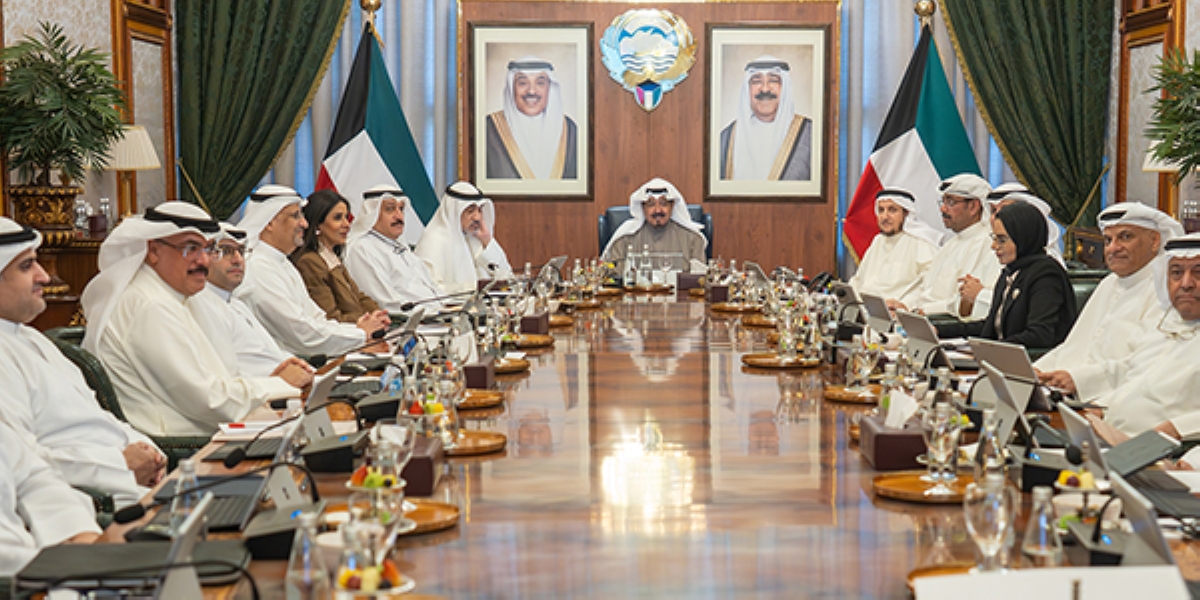
The Cabinet highlighted diplomatic communications with Latvia, Bahrain, and Pakistan regarding Iranian attacks on Kuwait, stressing support for the country's sovereignty and the need for regional de-escalation.
Translated by Alqyas from Al-Rai — Original source
Following the meeting, Deputy Prime Minister and Minister of State for Cabinet Affairs Shari’ah Al-Muwasharji stated that the Cabinet was briefed at the outset of its session on the content of a phone call received by His Highness the Crown Prince, Sheikh Sabah Khaled Al-Hamad Al-Sabah, in recent days from His Excellency Edgar Rinkevics, President of the friendly Republic of Latvia. During the call, His Excellency condemned the brazen Iranian attacks on the territory of the State of Kuwait.
He regarded these attacks as a blatant violation of sovereignty and international law, affirming his country’s full support and backing for all measures undertaken by Kuwait to safeguard its sovereignty and security. His Excellency also emphasized the need for wisdom, dialogue, and de-escalation among all parties in the region to preserve the stability and security of states and civilians.
During the call, His Highness the Crown Prince conveyed greetings from His Highness the Amir of Kuwait, Sheikh Meshal Al-Ahmad Al-Jaber Al-Sabah, to President Edgar Rinkevics, expressing his sincere gratitude and appreciation for the call and for Latvia’s supportive stance regarding the security and stability of Kuwait.
The Cabinet was also briefed on the content of a phone call received by His Highness the Crown Prince from His Royal Highness Prince Salman bin Hamad Al Khalifa, Crown Prince and Prime Minister of the friendly Kingdom of Bahrain. During the call, His Royal Highness conveyed greetings from His Majesty King Hamad bin Isa Al Khalifa, King of the Kingdom of Bahrain, to His Highness the Amir of Kuwait.
His Royal Highness expressed the Kingdom of Bahrain’s strong condemnation and denunciation of the reprehensible Iranian aggression that targeted Kuwaiti territory, resulting in the injury of ten members of the Kuwaiti Armed Forces, as well as attacks on Kuwait International Airport and several civilian, economic, and vital facilities.
His Royal Highness reaffirmed the Kingdom of Bahrain’s full solidarity with Kuwait and its steadfast support for all measures Kuwait undertakes to preserve its sovereignty, security, stability, and territorial integrity. His Highness the Crown Prince also conveyed greetings from His Highness the Amir of Kuwait to His Majesty King Hamad bin Isa Al Khalifa during the call.
His Highness emphasized the necessity of maintaining shared security and the complete rejection of any actions that could harm the Kingdom of Bahrain amid regional security tensions, noting that an attack on Gulf states is an attack on Kuwait.
The Cabinet was also briefed on the content of a phone call conducted by His Highness the Crown Prince with the Prime Minister of the friendly Islamic Republic of Pakistan, Muhammad Shehbaz Sharif. During the call, His Highness conveyed greetings from His Highness the Amir of Kuwait to President Asif Ali Zardari, President of the Islamic Republic of Pakistan.
His Highness praised the active role played by the Islamic Republic of Pakistan in supporting efforts to establish the foundations of security and peace in the region, reaffirming Kuwait’s welcome and full support for these initiatives aimed at achieving a peaceful settlement that leads to regional and international stability.
For his part, Shahbaz renewed the condemnation and denunciation by the Islamic Republic of Pakistan, a friendly country, of the brazen attacks targeting the territory of the State of Kuwait and several countries in the region, emphasizing full solidarity with Kuwait. The call also covered the latest regional developments and underscored the importance of de-escalation, halting military operations in the region, and stressing the necessity of prioritizing diplomatic solutions.
On another note, the Council of Ministers heard a briefing from Minister of Defense Sheikh Abdullah Ali Al-Salim Al-Sabah on the latest developments in the region and current military developments in light of the heinous Iranian aggression against the State of Kuwait.
In this context, the Council of Ministers expressed its strong condemnation and denunciation of the targeting of a service building at one of the country’s power and desalination plants, which resulted in the death of an Indian national and caused material damage. This was in addition to two incidents in which the infrastructure of the Port of Mishref was subjected to a dual attack using hostile drones and cruise missiles, and the Port of Shuwaikh was targeted by hostile drones. These incidents caused material damage without any human casualties.
On another note, the Council of Ministers heard a briefing from Minister of Oil and Chairman of the Kuwait Petroleum Corporation, Tariq Al-Sulaiman Al-Roumi, regarding all details related to the fire incident involving the large Kuwaiti crude oil tanker (Al-Salmi) early Tuesday morning, following a heinous Iranian attack that directly targeted the tanker while it was in the Al-Mukhabbah area of the United Arab Emirates, outside the Port of Dubai.
On another note, the Council of Ministers heard a briefing from Minister of Foreign Affairs Sheikh Jaraah Jaber Al-Ahmad Al-Sabah on the political and diplomatic efforts undertaken by the Ministry of Foreign Affairs and its diplomatic missions abroad to keep pace with the latest developments of the heinous Iranian aggression against the State of Kuwait.
In this context, Minister of Foreign Affairs Sheikh Jaraah Jaber Al-Ahmad Al-Sabah informed the Council of Ministers about the outcomes of Kuwait’s participation in the 165th regular session of the Arab League Council at the ministerial level, which was held last Sunday via video conference.
The Council of Ministers also took note of the content of the statement issued by the 165th regular session of the Arab League Council at the ministerial level.
In the statement, Arab foreign ministers renewed their full condemnation of the blatant and deliberate Iranian aggression against several Arab countries, citing its role in escalation, the blatant violation of state sovereignty, targeting of civilians, and threats to security and stability.
Arab foreign ministers condemned the Iranian attacks targeting Kuwait and friendly states (the Kingdom of Saudi Arabia, the United Arab Emirates, the Kingdom of Bahrain, the Sultanate of Oman, the State of Qatar, the Hashemite Kingdom of Jordan, and the Republic of Iraq) using ballistic missiles and drones, which hit residential areas, infrastructure, vital installations, energy facilities, civilian sites, and diplomatic headquarters, resulting in human and material losses and terrorizing civilians.
Arab foreign ministers expressed their support for all measures taken by the affected states to defend their territories, safeguard their security, and protect their citizens and residents, including the right to respond to these attacks, while praising the readiness of their armed forces and their capability to counter these aggressions.
On another note, Foreign Minister Sheikh Jaraah Jaber Al-Ahmad Al-Sabah briefed the Council of Ministers on the outcomes of his participation in the joint ministerial meeting of the foreign ministers of the Gulf Cooperation Council (GCC) countries, the Hashemite Kingdom of Jordan, and the Russian Federation, which was held yesterday, Monday, via video conference. The meeting discussed the repercussions of Iran’s despicable attacks on the region and their impact on security and stability at both the regional and international levels.
In a separate development, the Foreign Minister briefed the Council of Ministers on the results of the summons issued by the Ministry of Foreign Affairs, represented by Acting Deputy Foreign Minister Ambassador Aziz Al-Daihani, last Wednesday, to the Iranian Ambassador to Kuwait, Mohammad Toutounji, for the third time since the onset of the brutal Iranian aggression on February 28 of last year. During the meeting, a protest note was delivered to him regarding Iran’s continued attacks against Kuwait.
The Council of Ministers was also briefed on the results of the summons issued by the Ministry of Foreign Affairs, represented by Acting Deputy Foreign Minister Ambassador Aziz Al-Daihani, yesterday, Monday, to the Chargé d’Affaires of the Embassy of the Republic of Iraq in Kuwait, Zaid Shanshol, to deliver a protest note for the second time, following continued attacks by Iraqi armed factions targeting Kuwaiti territory.
On another note, the Council of Ministers expressed its strong condemnation and rejection of the despicable terrorist plot aimed at carrying out terrorist acts in the sisterly Kingdom of Bahrain. It highlighted that investigations revealed external links to Hezbollah, in an operation aimed at undermining security and stability.
The Council commended the competence and vigilance of the security apparatuses in the sisterly Kingdom of Bahrain and their ability to thwart this plot, reiterating Kuwait’s full support for Bahrain and its firm rejection of terrorism in all its forms, as well as its solidarity with efforts to safeguard security and stability in the GCC countries.
In a separate development, the Council of Ministers expressed its strong condemnation and rejection of the attack targeting the residences of the President of the Kurdistan Region of Iraq, Nechirvan Barzani, and the leader of the Kurdistan Democratic Party, Masoud Barzani. It reaffirmed Kuwait’s steadfast position rejecting all forms of violence.
On another note, the Council of Ministers expressed its welcome of the decision issued by the UN Human Rights Council last Wednesday during an emergency session of its 61st session held in Geneva, adopted by consensus, regarding the human rights implications of the unjustified Iranian attacks targeting the GCC countries and the Hashemite Kingdom of Jordan.
It emphasized that this decision embodies the unified international will rejecting Iran’s blatant aggression and reflects global condemnation of targeting the territories of sovereign states, unrelated to any conflict, and the resulting serious violations of fundamental rights and direct threats to regional and international peace and security. It praised the decision’s unequivocal condemnation of the aggression against civilians and critical infrastructure, which resulted in casualties and severe material damage.
The Council appreciated the international consensus on the inevitability of Iran complying with its international legal obligations, foremost among which are respecting the sovereignty and territorial integrity of states, immediately ceasing hostile acts, ensuring their non-repetition, and assuming responsibility for compensating for the damages caused.
He emphasized the necessity for the international community to establish rigorous follow-up mechanisms to implement the provisions of this resolution, thereby ensuring the preservation of the rule of law and the reaffirmation of the principles of the United Nations Charter. He reiterated Kuwait’s commitment, in light of its responsibility as a member of the Human Rights Council for the period (2024–2026), to continue its active role in safeguarding the international human rights system and to work with international partners to ensure the implementation of the Council’s decisions, thereby reinforcing the foundations of global stability.
In light of the Cabinet’s close monitoring of all activities undertaken by ministries and government entities under the current circumstances, the Cabinet reviewed ministers’ briefings and reports from government agencies on the measures taken to raise readiness levels to their maximum, ensuring the safety of citizens and residents and providing all their living needs in response to the military and security developments affecting Kuwait and the region.
Given the rapid developments in the current situation, the Cabinet remains in a state of continuous session to follow up on the latest developments at both the domestic and regional levels.
