Trump: Regime Change in Iran May Have Already Occurred
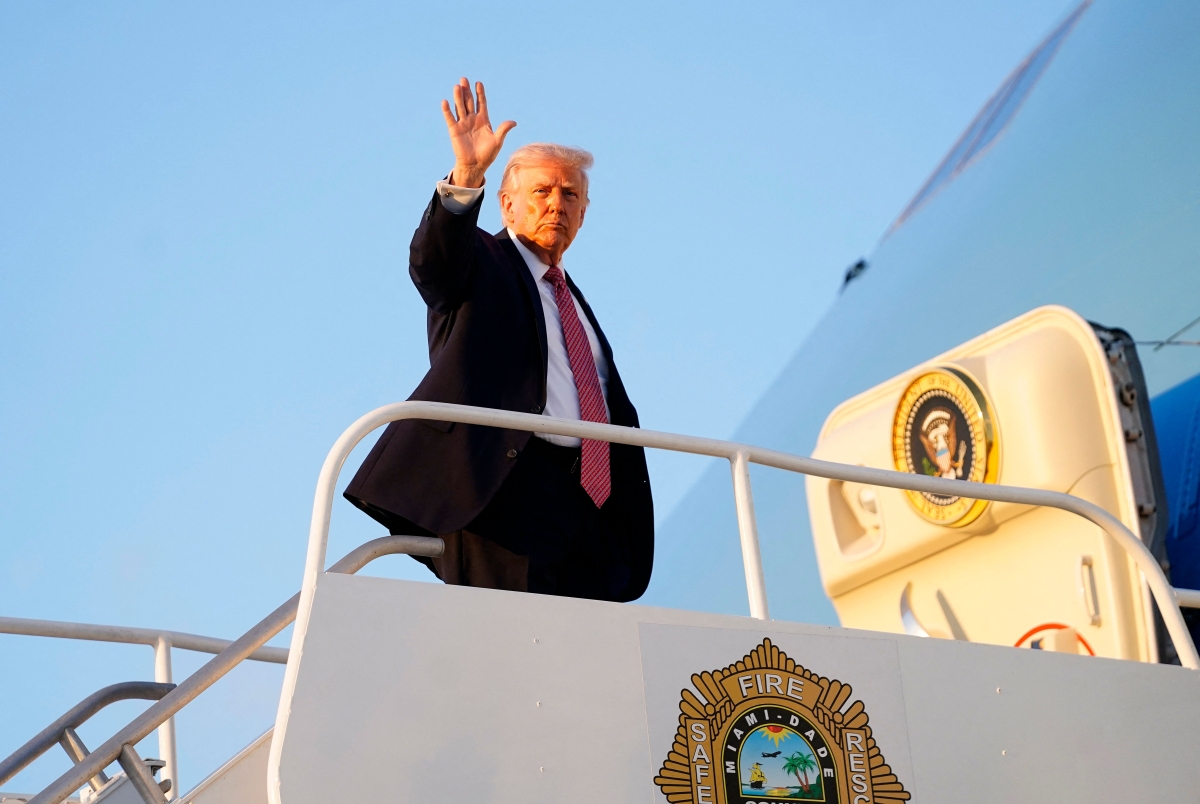
Trump confirms regime change in Iran following extensive US strikes, pointing to Gulf intervention and the collapse of Iranian military capabilities.
Translated by Alqyas from Al-Rai — Original source
- US President: We are closer than ever to the dawn of an Iran-free Middle East
- 25,000 bombs dropped on Iran
- Israel strikes nuclear facilities in Iran.. Houthis join the conflict
- Thousands of Marines arrive in the operational area
- Pakistan hosts a quadrilateral meeting
About a month after the outbreak of the US-Israeli war on Tehran, the Houthis entered the conflict, declaring responsibility for firing a missile toward Israel, which had targeted its airstrikes on Iran’s nuclear weapons program facilities and sites for manufacturing combat means.
The rebels’ involvement in Yemen in the conflict increases the likelihood of a wider regional confrontation and threatens to exacerbate the global shipping crisis, given the Iran-aligned group’s threat to another strategic passage, the Bab el-Mandeb Strait, alongside the energy crisis caused by the closure of the Strait of Hormuz, according to CNN.
As Washington strengthens its military presence, with the warship USS Tripoli arriving in its area of responsibility in the Middle East on Friday, carrying approximately 3,500 sailors and Marines, along with plans to send the aircraft carrier George H.W. Bush, President Donald Trump affirmed that “regime change in Iran” has already been achieved, noting that US forces will leave the region at a later stage after completing their missions.
He stated, “We are closer than ever to finally seeing a Middle East free from Iranian terrorism, aggression, and nuclear blackmail... Under my leadership, America is ending the threat posed by this extremist regime by destroying Iran’s capabilities through the Epic Wrath operation.”
He added that Iran “has been a bully in the Middle East for 47 years, but it is no longer so,” pointing to the impact of US strikes on nuclear facilities last summer.
Trump’s remarks came during his speech at the conclusion of the Future Investment Initiative conference in Miami, where he delivered an extended address combining geopolitical and economic messages, emphasizing that recent military operations “changed the rules of the game” in the region.
The US President also renewed his criticism of NATO countries for failing to meet Washington’s requests for assistance during the war, while praising “the role played by Gulf Arab states that stood by the United States more than NATO allies.”
He said, “I would like to extend my thanks to Saudi Arabia, which provided significant support, unlike NATO... Saudi Arabia fought, Qatar fought, the UAE fought, Bahrain fought, and Kuwait fought.”
The US President expressed surprise at Iranian missiles and drones being directed at targets in regional countries, particularly Gulf states, warning that “missiles (from Iran) rained down on the region... Saudi Arabia, Qatar, Kuwait, and Bahrain did not expect to face such attacks. The missiles were not only aimed at Israel but at everyone... They would have used whatever they had, including nuclear weapons, but we stopped them.”
He also touched upon economic relations with partners, noting that the partnership with Saudi Arabia represents “a model of strategic cooperation,” whether in investment, energy, or technology.
For its part, US Central Command (CENTCOM) announced that Iranian naval threats to global shipping traffic in territorial waters, which had persisted for decades, had ended, following intense strikes targeting Iran’s naval capabilities.
Meanwhile, amid ongoing efforts by mediators (Pakistan, Turkey, and Egypt) to facilitate talks between Washington and Tehran, two sources familiar with the situation revealed that the White House has secretly informed allies to expect that it will take time for Washington to reach an agreement with Tehran.
In this context, Pakistan announced that the foreign ministers of Saudi Arabia, Turkey, and Egypt will visit Islamabad today and tomorrow for a quadrilateral meeting as part of efforts to reach a settlement for the war.
For his part, Iranian President Masoud Pezeshkian thanked Pakistan for its efforts in a phone call with Prime Minister Shehbaz Sharif.
He pointed out that “among the targets was the heavy water plant in Arak, which is a key facility for producing plutonium used in nuclear weapons, as well as a facility in Yazd used for producing explosives related to the uranium enrichment process.”
Tasnim News Agency reported that the methanol production complex jetty in Bushehr, southern Iran, was hit by two projectiles, noting that the shelling targeted an industrial complex in the port of Deir in Bushehr province.
The steel company in Khuzestan province (southwest) announced the “suspension of production lines at the plant” after production units and facilities were damaged in strikes that hit a plant in Ahvaz and another plant belonging to Mobarakeh Steel Company in Isfahan (central), two of the largest in Iran.
Updated Israeli data indicate that the air force dropped approximately 15,000 bombs on targets inside Iran since February 28, a figure that rose to more than 25,000 bombs when including US strikes.
For her part, the International Atomic Energy Agency (IAEA) announced that Tehran reported a new attack on the Bushehr nuclear facility (south), the third within 10 days.
Writing on the X platform, he stated that the attack “contradicts” the “extended diplomatic window” announced by Washington, affirming that Iran “will make Israel pay a heavy price for its crimes.”
