Al-Badawi: Involving GCC States in Any Talks or Agreements to Resolve the Regional Crisis
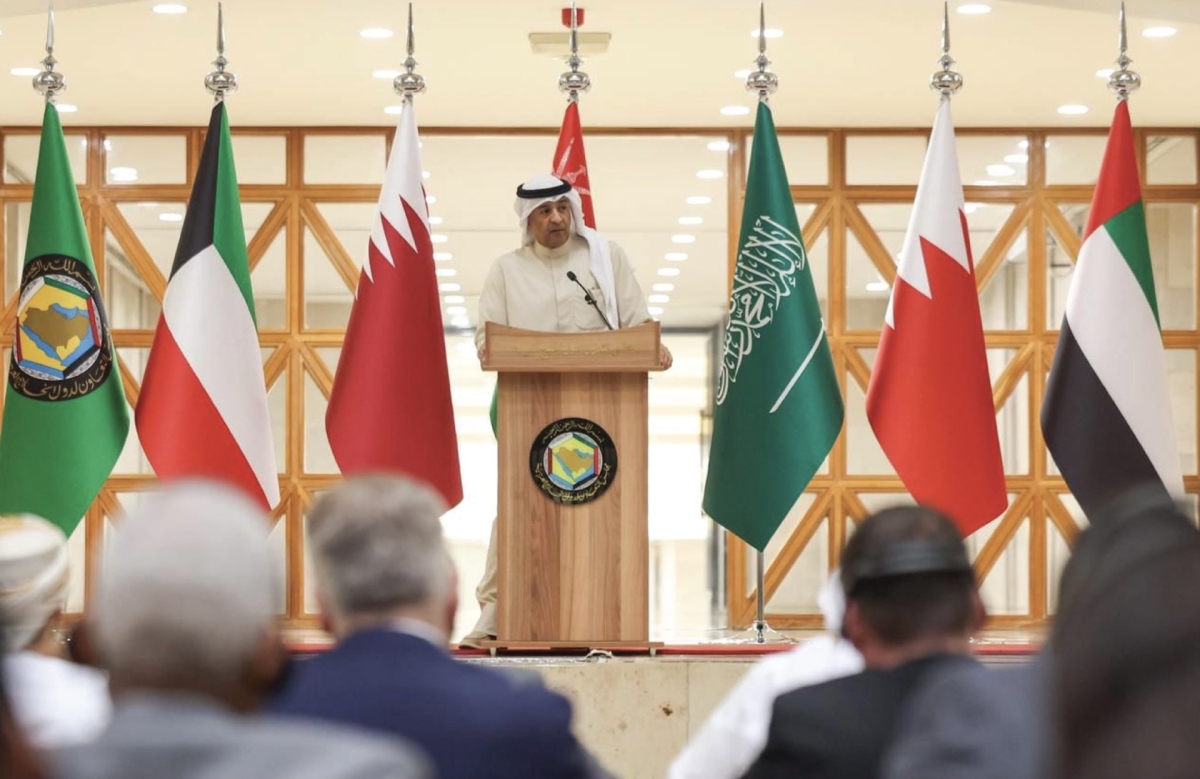
Al-Badawi stressed the necessity of involving GCC states in talks to resolve the crisis, highlighting the economic and political damages of Iranian attacks
Translated by Alqyas from Al-Rai — Original source
The Secretary-General of the Gulf Cooperation Council (GCC) Council of Ministers, Jassem al-Budaiwi, stressed on Thursday the necessity of involving GCC member states in any talks or agreements aimed at resolving the regional crisis, in order to enhance security and stability and ensure that such attacks are not repeated. He emphasized that any frameworks, initiatives, or regional arrangements intended to alter the map of the Middle East in the wake of this crisis are firmly rejected.
In a comprehensive briefing to journalists regarding Iranian attacks, al-Budaiwi stated that the toll of Iranian assaults on GCC states over 25 days exceeded 5,000 ballistic missiles and drones. While most were intercepted, some struck civilian targets, resulting in casualties and losses in property.
Al-Budaiwi added that Iran launched 85 percent of the total missiles fired during this war against GCC states.
He noted that Iranian attacks have resulted in civilian casualties and injuries among citizens and residents, with the latest being Iran’s treacherous attack on the city of Abu Dhabi earlier today, which caused deaths and injuries. The attacks have also inflicted severe damage on civilian infrastructure, including energy facilities, water desalination plants, hotels, government institutions, embassies, residential buildings, and airports, leading to the suspension of air traffic at several GCC airports.
Al-Budaiwi pointed out that air defense systems in GCC states performed well, countering these attacks with high professionalism, which mitigated their repercussions. However, this does not diminish the scale of the aggression nor absolve Iran of its full responsibility for it.
He highlighted the global economic repercussions of these attacks, noting that GCC states produce 16 million barrels of oil daily, accounting for 22 percent of global production, and export 27 percent of total global crude oil exports, equivalent to 11.5 million barrels daily. Furthermore, they hold 33 percent of global oil reserves, totaling 512 billion barrels, and 21 percent of global natural gas reserves, amounting to 44 trillion cubic meters, with an annual natural gas production of 442 billion cubic meters, representing 10 percent of global output.
Al-Budaiwi affirmed that these substantial figures make the Gulf region an indispensable pillar of the global economy, as any disruption there would immediately impact international energy security and threaten economic stability worldwide. Ensuring the stability of oil and gas supplies from this region is not a luxury but an imperative necessity for global energy markets.
He added that Iran’s destabilizing behavior in the Arabian Gulf has crossed all boundaries, including the closure of the Strait of Hormuz, the prevention of commercial ships and oil tankers from passing, and the imposition of transit fees, which violate the United Nations Convention on the Law of the Sea.
He clarified that the damage from halting navigation extends beyond GCC states to many countries worldwide, which are now suffering from shortages in their oil and gas needs. He emphasized that sea lanes and straits are governed by international agreements, and no party can disrupt navigation, control passage, or impose conditions, which is unacceptable and must cease.
Al-Budaiwi stated that GCC states were surprised by the US and Israeli strikes on Iran. He clarified that the Council has clearly declared it will not participate in any military operations nor allow its territory to be used for any operations against Iran, reaffirming the Council’s commitment to maximum restraint to avoid expanding the conflict, while continuing to call for diplomatic dialogue.
He stated that the GCC states have worked throughout the past years to de-escalate tensions in the region with utmost seriousness, professionalism, diplomacy, and transparency. Since their inception, they have been a cornerstone of stability, playing a positive role in international relations with sister and friendly nations, allies, and partners. They serve as mediators in numerous regional and international reconciliations, as a reliable partner in commercial and economic relations, and as a supplier of energy resources such as oil and gas, which are the lifeblood of the global economy.
He clarified that the GCC states’ position is based on international legitimacy and international law, including Article 2, Paragraph 4 of the United Nations Charter, and the right to self-defense under Article 51, as well as UN Security Council Resolution 2817. He also noted the Human Rights Council’s unanimous adoption of a draft resolution on the impacts of Iranian aggression, emphasizing that any attack on a member state constitutes an attack on all member states in accordance with the GCC’s Collective Defense Agreement.
