Kuwait: The region is on the brink of a comprehensive explosion... and the international community's silence is no longer acceptable
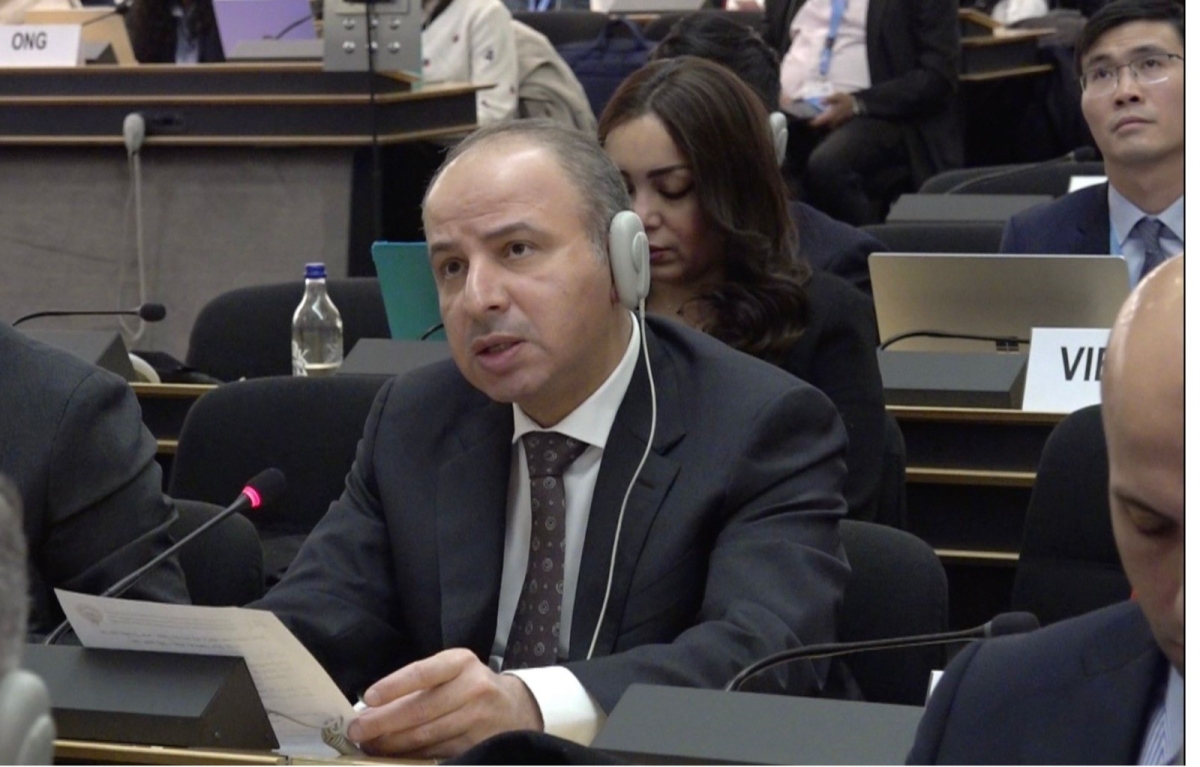
The Human Rights Council condemns Iranian attacks and demands they be stopped immediately
Translated by Alqyas from Al-Rai — Original source
- The Human Rights Council condemned Tehran and deemed its attacks a serious violation of sovereignty and international law.
- Ambassador Al-Hin: Attacks on Kuwait International Airport and vital facilities constitute systematic terrorism against civilians.
- The aggression respects no sanctity or law... and we uphold our legitimate right to self-defense in accordance with the UN Charter.
- The targeting of the Riyadh meeting is a blatant violation of diplomatic immunities.
- Threatening navigation in the Strait of Hormuz is an assault on global food and medical security.
The United Nations Human Rights Council adopted a resolution on Wednesday, condemning in the strongest terms the Iranian attacks targeting countries in the region, and calling on Iran to provide full and immediate compensation to all victims of these attacks.
The resolution, submitted by the Gulf and Arab groups in the UN Human Rights Council, was adopted during an emergency session held in Geneva at the request of Gulf states and Jordan, on the topic of “the human rights implications of the unjustified attacks launched by Iran on several countries in the region.”
The resolution affirmed that “these attacks, which targeted Kuwait, Bahrain, the Sultanate of Oman, Qatar, the Kingdom of Saudi Arabia, the United Arab Emirates, and Jordan, constitute a violation of international law and a serious threat to international peace and security, as well as a violation of the sovereignty and territorial integrity of these states.”
The resolution reaffirmed the inherent right to individual or collective self-defense in response to the unlawful armed attacks launched by Iran, in accordance with Article 51 of the UN Charter.
The Council expressed its condemnation in the resolution of the deliberate and unjustified missile and drone attacks targeting civilians and vital civilian infrastructure, and voiced its concern regarding attacks on energy infrastructure and their repercussions on the environment and human rights.
The Council called on Iran to comply with international law, including international humanitarian law and human rights law, and to fully comply with UN Security Council Resolution 2817 (2026). It simultaneously demanded an immediate and unconditional cessation of all attacks and threats, and guaranteed protection for civilians and civilian infrastructure.
The UN Human Rights Council expressed concern over the repercussions of the military escalation on international navigation, particularly in the Strait of Hormuz, and its impact on global trade, energy security, and supply chains, emphasizing the importance of preserving freedom of navigation in accordance with international law.
The Council also affirmed its intention to continuously follow up on this issue, calling on the High Commissioner for Human Rights to provide an oral briefing to the Council on developments in the situation and their implications for human rights during the next session.
During the session, Kuwait issued a stern warning regarding the ongoing blatant and brazen Iranian aggression, emphasizing that the silence of the international community is no longer acceptable in the face of this approach, which flouts all international laws and treaties and threatens a comprehensive explosion in the region.
This came during the statement by Kuwait’s Permanent Representative to the United Nations and other international organizations in Geneva, Ambassador Nasser Al-Hin, who called on the international community to take a firm stand to end this aggression, which respects no sanctity or law, in order to safeguard community and regional peace from the risks of sliding into unforeseen consequences.
Ambassador Al-Hin added that “Iranian violations have reached a level of severity that makes silence untenable, as the regional landscape has become a catastrophic reality due to the persistent breach of all relevant international treaties and laws concerning human rights.”
He emphasized that the region is currently witnessing a continuous aggressive approach that disregards all efforts and initiatives undertaken by the State of Kuwait and regional countries over many years to establish principles of good neighborliness and build trust, and that this approach constitutes an existential threat to regional and international security and peace alike.
He stressed that manifestations of this aggressive approach have reached the peak of disregard for international sovereignty and humanitarian law, through the treacherous targeting of the ministerial meeting held in Riyadh last Wednesday, describing it as “an attack that did not merely target the dignity of states but also constituted a blatant violation of diplomatic immunities and the fundamental principles upon which the United Nations is founded.”
Al-Hin said that this attack, which coincided with the targeting of oil refineries, gas fields, and critical infrastructure—with the latest being the attack on Kuwait International Airport early yesterday—embodies a policy of “psychological and material terrorism” against civilian populations, and constitutes a direct violation of Article 3 of the Universal Declaration of Human Rights and Article 6 of the International Covenant on Civil and Political Rights, which guarantee the inherent right to life and personal security.
Ambassador Al-Hin also warned that undermining the “right to development” affirmed by the UN General Assembly in 1986, and forcing states to divert their sovereign resources toward defense rather than education and health, constitutes an indirect assault on the rights of future generations to live in a stable and prosperous environment.
He added that threatening navigation security in the Strait of Hormuz “constitutes a clear violation of the United Nations Convention on the Law of the Sea,” and a blatant assault on global food and pharmaceutical security, which contradicts Article 11 of the International Covenant on Economic, Social and Cultural Rights.
He stressed that this responsible restraint has been met with “aggressive overreach through the use of ballistic missiles and drones, flouting UN Security Council Resolution 2817 and the principle of distinction stipulated in Article 52 of Additional Protocol I to the Geneva Conventions.”
He also reaffirmed the state’s legitimate and inherent sovereign right, as well as the right of neighboring states, to self-defense and to protect their citizens and assets, in accordance with Article 51 of the UN Charter.
He added that the draft resolution submitted to the session by the Gulf Group, concerning Iranian attacks, represents the minimum of legitimate demands by regional countries in light of those blatant criminal attacks on the State of Kuwait, calling on member states to support this resolution.
The Permanent Representative of the Kingdom of Saudi Arabia to the United Nations in Geneva, Ambassador Abdulmohsen bin Khathila, condemned the attacks targeting his country and the region, considering them a blatant violation of state sovereignty, and stressed that “silence is not an option.” He called on the Council to take necessary measures to protect civilians and infrastructure, and to support the draft resolution submitted by the Gulf and Arab groups condemning Iranian attacks on regional states.
The Permanent Representative of the Kingdom of Bahrain to the United Nations Office and other international organizations in Geneva, Ambassador Abdullah Abdul Latif, who also chairs the Gulf Group of Ambassadors in the Council, affirmed that the Kingdom is witnessing “unjustified aggression” that constitutes a clear violation of international humanitarian law and human rights law.
The Permanent Representative of Jordan to the United Nations in Geneva, Ambassador Akram Al-Harashah, expressed condemnation of the attacks targeting his country and the Gulf Cooperation Council states, describing them as a blatant violation of international law and state sovereignty.
Qatar’s Permanent Representative to the United Nations Office at Geneva, Ambassador Hind Al-Muftah, expressed her country’s strong condemnation of the missile and drone attacks, voicing concern over the targeting of sea lanes, particularly the Strait of Hormuz, due to their implications for the global economy and supply routes, and emphasizing the need to protect navigation and civilian infrastructure.
Oman’s Permanent Representative to the United Nations in Geneva, Ambassador Idris Al-Khonsari, strongly condemned the targeting of civilians and civilian infrastructure, reaffirming the importance of respecting the sovereignty and territorial integrity of states. He expressed Oman’s concern over the escalating humanitarian repercussions, calling for addressing the root causes of crises and the buildup of tensions to prevent further escalation, and opening channels for dialogue and building trust among all parties.
The United Arab Emirates’ Permanent Representative to the United Nations and other international organizations in Geneva, Jamal Al-Mashari, stated that the issue of Iranian attacks “is not merely a military escalation but a systematic reckless behavior that undermines the foundations of the international order,” warning of the consequences of targeting infrastructure linked to energy security and global supply chains.
The European Union and several other countries expressed strong condemnation of the military strikes, calling for an immediate halt to them and for respect for state sovereignty and compliance with international law, while affirming their readiness to support diplomatic efforts aimed at ending the escalation in the region.
• Expression of concern over the impact of the escalation on international navigation in the Strait of Hormuz
