Iraqi Foreign Minister accuses factions of targeting intelligence headquarters
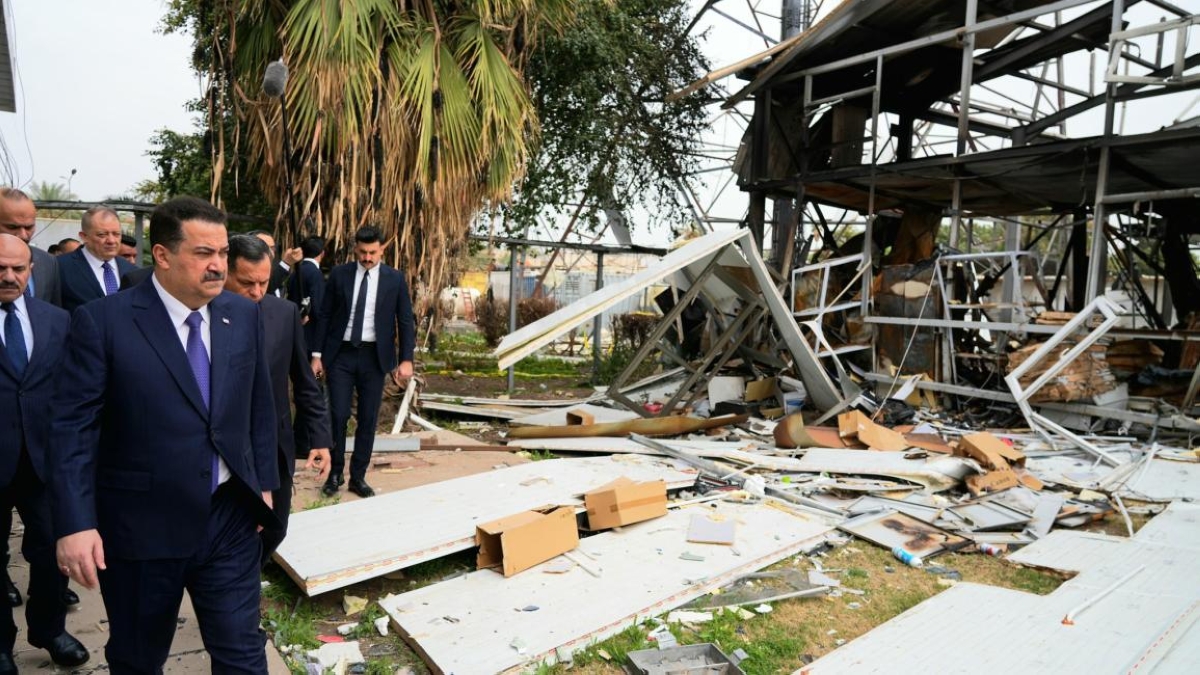
The minister accuses factions of targeting the intelligence agency and emphasizes the need to take action.
Translated by Alqyas from Al-Rai — Original source
In remarks on Monday, he stated that “the attack on the intelligence agency was internal, and the government must take action because they have gone too far.”
He added that the armed factions possess both military and parliamentary strength, noting that their attacks have extended from the Kurdistan Region and embassies to the heart of the state, including the assault on the intelligence agency.
However, he stressed that “this situation cannot continue as it is.” He affirmed that the government’s primary mission is to prevent this war from spreading onto Iraqi territory.
In an interview published on Monday with the newspaper Corriere della Sera, he declared, “We have decided, in coordination with our allies, to advance the end date of the international coalition, which was originally scheduled to last until September 2026.”
He added, “Once there are no more foreign military units on Iraqi soil, it will be easier to dismantle the armed factions.”
This announcement comes as the war, which began with a US-Israeli attack on Iran on February 28, has spread to Iraq. There, airstrikes continue to target headquarters of Tehran-aligned armed factions, while attacks target US interests, and Iran carries out strikes against opposition Kurdish groups in the north.
In mid-January, Iraq announced the completion of the international coalition’s withdrawal from its federal territories, except for the Kurdistan Region, in accordance with an agreement between Baghdad and Washington. The deal stipulates the full withdrawal of coalition advisors from the northern region by September 2026, and the transformation of Iraq’s relationship with coalition countries into security partnerships.
Washington has maintained political and security influence in Iraq since its 2003 invasion that toppled Saddam Hussein’s regime. These factions have long demanded the withdrawal of foreign, particularly US, forces deployed as part of the coalition since 2014.
While the government seeks to monopolize weapons, the most prominent factions refuse to discuss their arsenals before the departure of foreign troops.
Baghdad maintains that its armed forces are now capable, on their own, of preventing the emergence of ISIS, which controlled large swathes of Iraq between 2014 and 2017.
As it works to strengthen its defensive capabilities after nearly four decades of conflicts that have strained its infrastructure and institutions, Iraq asserts that its relations with international coalition countries will be based on cooperation, capacity building, training, and joint military operations.
The coalition is also expected to withdraw from Syria, where it has deployed forces, having recently handed over bases to the Syrian government forces.
