Growing international support for Kuwait and the Gulf in light of continuous Iranian aggression
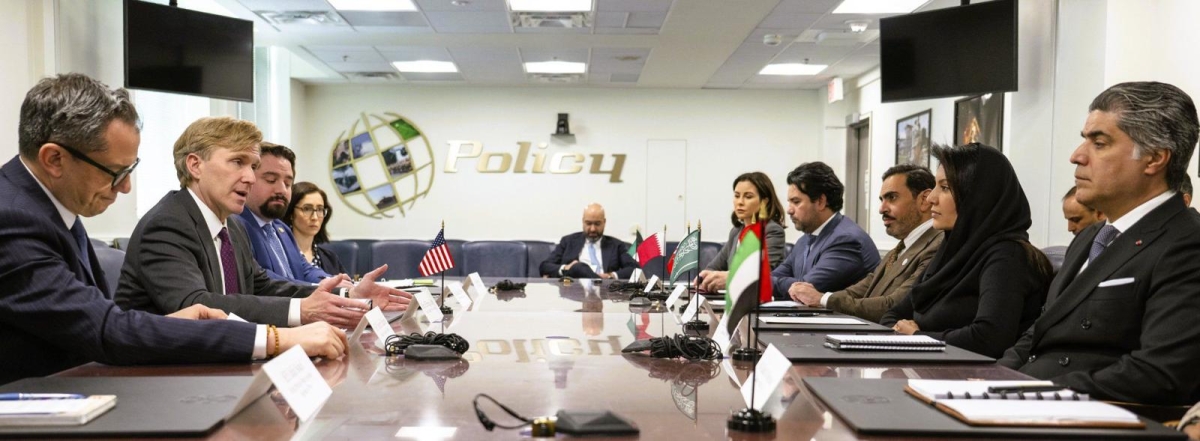
Gulf states and the United States enhance security coordination against Iranian aggression.
Translated by Alqyas from Al-Rai — Original source
In this context, Kuwait’s Ambassador to the United States, Sheikha Al-Zain Al-Sabah, affirmed that the security of the Gulf states is indivisible, describing it as a fundamental principle and cornerstone of the Charter of the Cooperation Council for the Arab States of the Gulf.
This statement came during a meeting attended by Sheikha Al-Zain Al-Sabah, alongside the ambassadors of the Gulf states in Washington, with Bridget C. Colby, Under Secretary of Defense for Policy, to discuss the latest security developments in the region.
The Kuwaiti ambassador told the Kuwait News Agency (KUNA) on Saturday that the meeting, held at the Pentagon, is part of the coordination between the GCC states and the United States, based on the historic strategic partnership between the two sides.
She clarified that the ambassadors emphasized during the meeting the importance of enhancing joint coordination to confront escalating security challenges and ensure the security and stability of the region, including protecting freedom of navigation in the air and at sea, and safeguarding the region from continuous Iranian aggression targeting Gulf states and Jordan. These attacks deliberately target civilians, critical civilian infrastructure, and vital installations, in blatant and direct violation of sovereignty and international treaties and norms.
For his part, Colby stressed the importance of the US partnership with the GCC states, highlighting the pivotal role played by the GCC countries in operating missile defense systems to counter random Iranian attacks on civilian facilities and residential areas.
He also affirmed the US Department of Defense’s determination to continue coordination with the GCC states within the framework of the strategic partnership with the United States.
Ambassador Al-Zain Al-Sabah also participated, alongside the ambassadors of the Gulf states and Jordan in Washington, in a meeting with Brian Mast, Chairman of the House Foreign Affairs Committee, and Gregory Meeks, Vice Chairman of the Committee, to discuss the latest security developments in the region.
The Kuwaiti Embassy in Washington stated in a statement on Thursday that participants in the meeting, which also included a group of members of the House Foreign Affairs Committee, emphasized the importance of enhancing joint coordination to confront escalating security challenges and ensure the security and stability of the region.
The ambassadors stressed that Iranian hostile actions represent a dangerous and unjustified escalation that could undermine regional and international security and stability. They affirmed the inherent and legitimate right of targeted states to self-defense and their full right to take measures ensuring the protection of their security, sovereignty, and territorial integrity, as well as deterring any aggression against them.
For his part, Kuwait’s Ambassador to the Kingdom of Belgium and Head of its Mission to the European Union and the North Atlantic Treaty Organization (NATO), Nawaf Al-Anazi, said that NATO allied countries expressed their full solidarity with Kuwait and the GCC states in light of repeated Iranian violations against the GCC countries, condemning these actions as a threat to regional and international security and stability.
This came during a meeting held by the Alliance last Thursday with ambassadors of the Istanbul Cooperation Initiative countries, which include Kuwait, the UAE, Bahrain, and Qatar, to discuss Iranian attacks on the GCC states, attended by Radmila Šekerinska, Deputy Secretary General of the Alliance.
Ambassador Al-Anazi told KUNA that the meeting commended the GCC states for exercising restraint in the face of unjustified Iranian attacks, affirming their commitment to de-escalation and avoiding an escalation of tensions in the region, reflecting their commitment to maintaining regional and international security and stability.
He noted that the Istanbul Cooperation Initiative, established in 2004, is based on partnership with the North Atlantic Treaty Organization (NATO), with the aim of enhancing regional stability through the exchange of expertise and practical cooperation, and by raising situational awareness to address security challenges.
