Questions raised over contradiction between official rhetoric and positions held by Iranian officials' children in the US
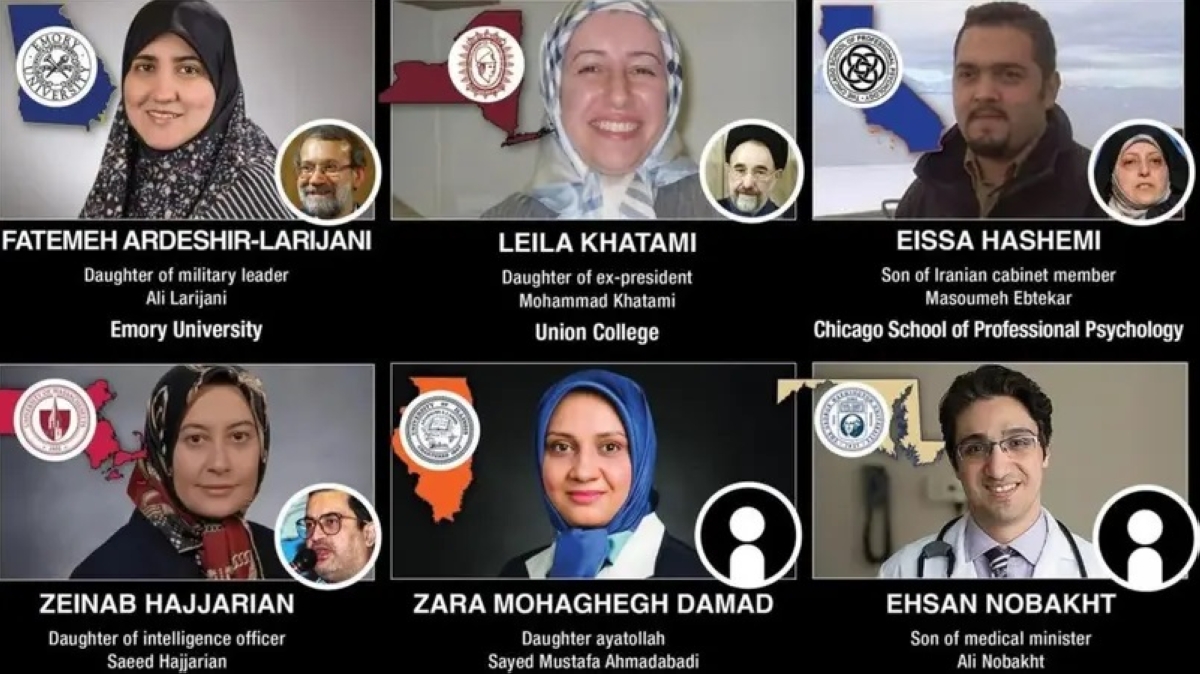
A report revealed the presence of children of Iranian officials at American universities.
Translated by Alqyas from Al-Rai — Original source
A report by the New York Post revealed that several children and relatives of senior officials and political figures in the Iranian regime are present in the United States, with some holding academic and research positions at major universities from New York to Los Angeles.
According to the report, these individuals are distributed across prestigious educational institutions such as the Massachusetts Institute of Technology, Union College in New York, and George Washington University. While their presence is viewed by some as a personal and academic right, political figures and opposition organizations have raised questions about the nature of this presence and its potential influence.
Analysts, such as Jonathan Sayeh from the Foundation for Defense of Democracies, argue that the access of individuals linked to the regime to influential positions may contribute to shaping specific viewpoints within academic circles. In contrast, the newspaper notes that there is no concrete evidence implicating any of the mentioned figures in illegal activities or actions contrary to American values.
Leila Khatami, daughter of former President Mohammad Khatami, works as a mathematics professor at Union College in New York. Her father is politically classified as a “reformist,” although opponents view him as still part of the Iranian power structure.
[The text implies a missing subject here, likely referring to another individual, but based on the provided text, it states:] She worked as a physician and researcher at Emory University’s Winship Cancer Institute until January last year, leaving her position following pressure from opposition activists.
- Eisa Hashemi, an associate professor in Los Angeles, is the son of Masoumeh Ebtekar, who gained fame as a student spokesperson during the 1979 U.S. Embassy hostage crisis and later served as First Vice President for Women’s Affairs.
The disclosure of these family ties has sparked activity on social media platforms and electronic petition websites. Thousands of people signed a petition calling for an investigation into the legal status of some of these academics, while human rights activists such as Ladan Bazrakan argue that there is a “double standard” in the Iranian elite, who criticize the West while benefiting from its educational and healthcare systems.
Experts and opponents estimate that between 4,000 and 5,000 relatives of Iranian officials reside in the United States. The report notes the difficulty in tracking all cases due to the frequent variation in family names, which makes it hard to determine direct links between academic staff and political leaders in Tehran.
The newspaper concludes by noting that the ongoing debate reflects a division over whether the academic careers of individuals should be separated from their families’ political backgrounds, or whether familial ties make them part of the strained political landscape between the two countries.
