Israel Targets Central Beirut, Masses on the Border, and Intensifies Raids
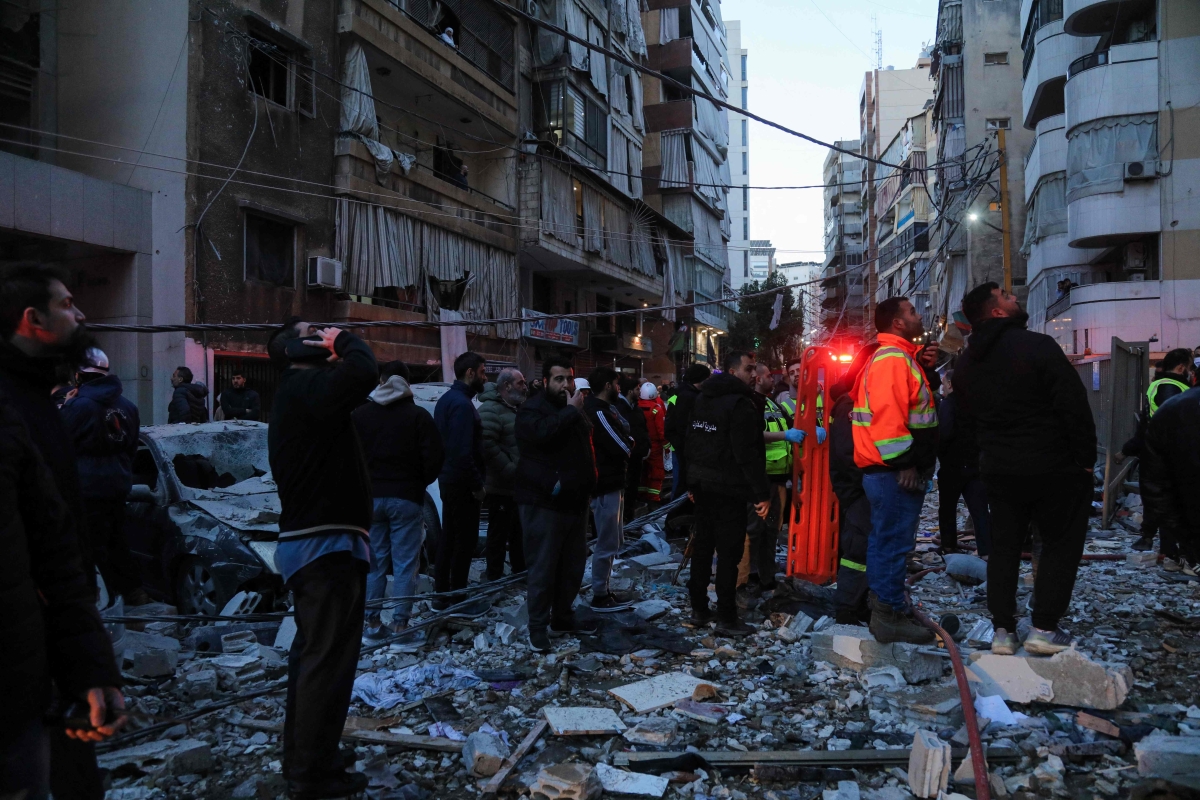
Israel targets central Beirut and reinforces its forces in the north following the assassination of Hassan Salameh.
Translated by Alqyas from Al-Rai — Original source
As the situation in the Middle East, including Lebanon, was on the agenda of the UN Security Council in New York, amid growing fears that the region was facing its most dangerous days yet before a potential ceasefire in the US-Israeli war with Iran, Beirut mirrored the same wave of anxiety regarding a more formidable future for its front. This front has increasingly become the subject of speculative scenarios regarding its fate, once the "mother of all battles" with Tehran subsides.
Tel Aviv did not hesitate to reinforce the narrative that any resolution of the confrontation with Iran would allow the concentration of military force on "Hezbollah," aiming for its "elimination" or the implementation of changes capable of removing the threat it poses to Israel for decades to come. This same ceiling is likely to serve as the ladder for bringing all parties down from the "war tree" (on the Iranian front) that drags wars across the region and beyond.
In this context, and amid fears that the coming week may witness the deployment of the most destructive cards and perhaps the use of "reserve" weapons to arrange the ceasefire stage with Tehran—thereby ensuring the achievement of strategic objectives even if the regime remains—Israel sought to create a sort of "conflict linkage" in the Lebanese battlefield, linking it to the post-Iranian front phase. This may be based on calculations that the eradication of the threat it describes as the "head of the octopus" necessitates more radical options regarding Hezbollah, requiring an escalation of the battle against it.
While Tel Aviv’s hint that a "Fourth Lebanon War" is linked to Iran war objectives in its final goals but separate from it in its timeline—meaning it will not end after the cessation of exchanges with Tehran—was considered the "other face" of implicitly cementing Hezbollah’s position that the war with Israel will not stop before the striking of the Islamic Republic ceases, and that "every incident has its own story" regarding the diplomatic track, Beirut fears being dragged into further troubles. This is amid intensifying "biting of nails" in the region and the emergence of a terrifying race between major powers and their potential surprises, versus a diplomacy feared to have no chance on the Lebanese front, which is governed by fire on the ground as well as in any negotiations.
In recent hours, signs of an Israeli military surge in a new rhythm have emerged, elevating the war with Hezbollah to a more aggressive stage. Its most prominent features include:
- Tel Aviv establishing a "synchronized" pattern of attacks via airstrikes across both the Iran and Hezbollah fronts, appearing as an attempt to disrupt the synchronization that had emerged in recent days in missile and drone attacks against it by Tehran and Hezbollah.
- Shifting the war to the heart of Beirut, which was targeted on Wednesday for the second time in approximately 72 hours, with an airstrike hitting the Aisha Bakkar area, specifically an apartment in a large residential building.
While the Sunday airstrike on the Ramada hotel in Roumieh targeted Iranian elements, the Aisha Bakkar strike remained ambiguous in its targets. The Islamic Group denied being the target, and reports claiming those in the apartment belonged to Hamas were unconfirmed, despite reports that a Jordanian of Palestinian origin affiliated with the movement had arrived there a few days prior.
However, the most striking aspect of the Aisha Bakkar airstrike was the confusion surrounding its toll. Lebanese and Arab media initially reported four deaths, with reports citing eyewitnesses and civil defense personnel stating there were at least two victims and numerous injuries, including in buildings adjacent to the targeted one. This was followed by the Lebanese Ministry of Health stating that the toll consisted of only four injured persons.
- The Israeli military announced that Chief of Staff General Eyal Zamir conducted an assessment of the situation following various developments in Operation “Lion’s Roar,” with the participation of other commanders, and “ordered the reinforcement of the Northern Command area and the transfer of the Golani Brigade’s combat team from the Southern Command to operate in the Northern Command area,” clarifying that “subsequently, based on the situation assessment, a decision will be made regarding reinforcing the command with additional forces.”
- Intensification of destructive airstrikes from Beirut’s southern suburbs, moving south through the Bekaa, with the casualty toll rising daily, including children and women among the dead. More than 35 casualties were recorded on Wednesday in less than 12 hours (up to noon alone), bringing the total number of killed to over 620 and approximately 1,500 wounded.
While Israel announced the assassination of Hezbollah’s “Nasr Unit” commander, Hassan Salameh, after he was targeted on Tuesday in Jouyia (southern Lebanon), the escalation in Israeli military operations and official statements was viewed as part of sounding the alarm for a more intense phase of the war, partly aimed at establishing a security buffer zone resembling the barrier in Gaza and Syria, with estimates suggesting it would be no less than 7 kilometers deep, possibly more. There is also the possibility of an incursion through Mount Hermon toward the Bekaa. All of this aims to create a ground reality that, eventually, would allow for negotiations “under fire” under an Israeli non-negotiable title: the complete disarmament of Hezbollah, starting with a rapid and specific timeline as a prerequisite for ending the war.
These indicators contradict Lebanon’s desire to establish a framework for direct negotiations with Israel under international sponsorship in a third country, with a ceasefire as a starting point and discussion items including arming the Lebanese Army and disarming Hezbollah. This approach is not accepted by Washington and has been rejected by Tel Aviv so far, given their belief that circumstances and past experience have exceeded the possibility of granting official Lebanon a new opportunity to address the weapons file within a context tested over months without success, and that there is no benefit to any track that does not begin with dismantling Hezbollah’s arsenal yesterday rather than today.
In this context, it was notable what the Lebanese newspaper “Al-Akhbar” reported regarding the substance of US Ambassador Michael Issa’s visit to Parliament Speaker Nabih Berri, in which the former affirmed his country’s position rejecting any political initiative before proceeding with the disarmament of Hezbollah, and that the Lebanese Army must first undertake this task before entering into any other discussion. He conveyed a clear message that Israel will continue its military operations with full US support, and advised against waiting for the results of the war with Iran, because “each front has its own conditions.”
Amid the early stages of a diplomatic track that Lebanon is attempting to launch, as expressed by President Joseph Aoun’s initiative two days ago, which appears until further notice to be “unilateral,” Prime Minister Nawaf Salam’s visit to Berri emerged, where general conditions and recent political and ground developments were discussed in light of Israel’s continued aggression on Lebanon and its repercussions on various levels, including the displaced persons file, as well as the political efforts being made to halt the aggression.
Jean-Yves Le Drian, the former French Foreign Minister and the French President’s envoy to Lebanon, reiterated a position he had previously articulated, stating that the military wing of Hezbollah—a political party—is considered a terrorist organization and is permanently linked to Iran. He noted that when Iran responded to Israeli strikes, Hezbollah immediately and in a synchronized, coordinated manner with Iran responded as well. “For this reason, I have repeatedly stated that Hezbollah chose Iran over Lebanon and against the interests of the country of which it is a part. However, Hezbollah represents approximately two million Shia. Not all of them are members of the party, but they are, in a sense, hostages to the choices made by Hezbollah’s leaders. Today, Hezbollah is being activated by the Iranian Revolutionary Guard.”
In an interview with a French television channel, the substance of which was reported by the newspaper *An-Nahar*, Le Drian emphasized that “Hezbollah is in constant contact with Iran. Following the assassination of its former leader, Hassan Nasrallah, the Iranian Revolutionary Guard regained control within the party, which not only engaged in defense but continued its attacks continuously. It was not a single attack, but a series of ongoing attacks, and it is said that they may even extend to Turkey and Cyprus (...) When Hezbollah intervenes, it provokes Israel, which is a cause of what is happening today in Lebanon.”
Does this mean the Israeli attack is justified? He replied: “This means that one can consider there is a right to respond, but I believe the Israeli attack is disproportionate, contradictory, and ineffective. In my view, it is also futile in the long term.”
Furthermore, he stated that the decision to suddenly displace 700,000 people and force them to sleep on the corniche is absolutely unacceptable. “I am not sure that Israel is serving its interests by acting in this way. The reason is simple: when Hezbollah carried out the actions we are discussing—acts that are terrorist and unacceptable—it provoked the anger of the Lebanese population, who refuse to be, in a sense, hostages to a war that is not theirs. From that moment on, divisions began. The Shia population no longer agrees with Hezbollah’s leadership after these actions. However, the scale of operations, the number of casualties, and the number of displaced persons in this country may ultimately turn public anger against Israel.”
He considered that “the solution to the problem first requires Hezbollah to declare that it will no longer engage in any military activities, either abroad or domestically. This is the precondition. When we see the suffering of the Lebanese people, their sense of despair, and their state of confusion and anger, the pressure from the Lebanese people on Hezbollah’s leaders must be strong enough. We must go through this phase, and from that point onward, the Lebanese government will implement a process to retrieve and store weapons, ensuring this decision is enforced and effective. After that, we can consider entering into negotiations with Israel, which can then make concessions and halt the strikes. This is how it was handled in 2024. It can be repeated while maintaining the same spirit. This means being able to speak with all parties about this possibility, as there is no other option.”
Lebanon’s Minister of Social Affairs, Hanine al-Sayyid, announced that there are “approximately 780,000 registered displaced persons since the beginning of the Israeli aggression, including 120,000 in shelters.”
She added, “We expect daily aid deliveries from abroad. Today, Wednesday, aid will arrive from Jordan via land, and tomorrow from France.”
