US buildup around Iran... Preparedness for war, not deterrence
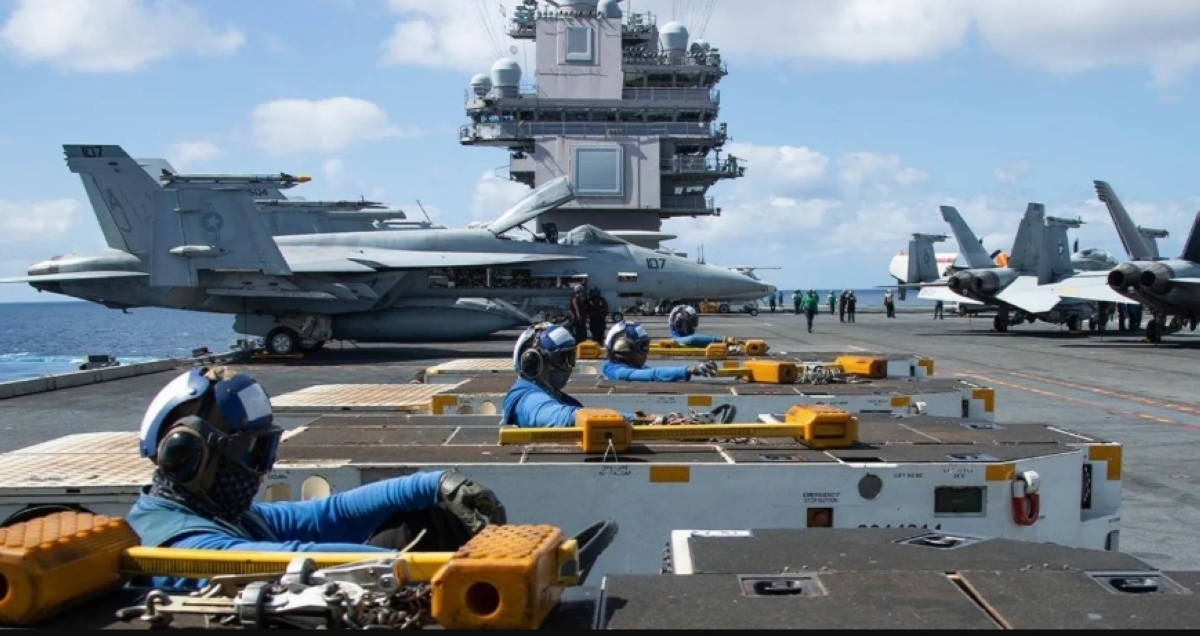
The military posture of the US and Israel indicates readiness for military war, not merely deterrence.
Translated by Alqyas from Al-Rai — Original source
The current military posture of the United States and Israel toward Iran indicates readiness for a potentially high-intensity conflict, rather than a mere symbolic display of force. Deterrence deployments are typically calculated and reversible, framed as defensive. However, what is now taking shape is an operational environment in which air, naval, intelligence, and missile assets are deployed for defensive purposes to sustain continuous operations.
The United States would not act alone in such a scenario; it would rely heavily, not only on NATO countries that would inevitably provide assistance, but fundamentally on the Israeli Air Force. Tel Aviv would provide hundreds of fighter jets capable of supporting strike, escort, and suppression missions if escalation is permitted.
Both countries are deliberately using signals through deployments, controlled leaks, and operational indicators. Nevertheless, the scale and consistency of these signals point to a readiness to escalate if diplomacy fails. From Tehran’s perspective, this posture narrows the range of available options and entrenches a strategic dilemma between concession and defense.
The Israeli and American air forces have previously operated in overlapping strike roles during periods of confrontation with Iran and its regional networks. Current reports indicate a reconsideration of a similar division of labor, with Washington preparing to provide essential support, such as aerial refueling, intelligence integration, and flight facilitation—all critical elements for sustaining an air campaign.
This indicates operational support rather than mere political alignment, as Israeli strike planning is increasingly integrated into the broader design of U.S. emergency plans.
Israel’s plans regarding Iran have long centered on air power, missile defense, and covert capabilities, but the focus has shifted toward preparing for sustained confrontation. Its air force remains the primary offensive tool, structured around long-range strike aircraft, refueling capabilities, intelligence superiority, and precision munitions.
Publicly available data indicate that Israel possesses a large and technologically advanced fleet, including approximately 66 F-15 aircraft, long-range strike platforms based on the F-15I, around 173 F-16 fighters, and roughly 48 F-35I stealth fighters in service, with orders for additional aircraft.
In practice, not all aircraft would be deployed simultaneously, but a significant proportion could be rotated in successive waves of attack, with priority given to stealth platforms for deep penetration and air defense suppression, while F-15s and F-16s would handle the bulk of traditional strike and support missions.
At the same time, Israel continues to expand its multi-layered missile defense systems designed to absorb any counterattacks. The Arrow, Iron Dome, David’s Sling, and THAAD systems aim to intercept ballistic missiles, cruise missiles, and drones across various ranges, reflecting expectations of widespread incoming fire rather than isolated attacks. This readiness for a war of attrition, rather than a single strike, means that Israel is likely to become a primary target alongside U.S. assets in the event of war.
The United States has bolstered its regional presence through the extensive deployment of air, naval, and intelligence assets, indicating pre-planned preparations rather than mere routine deterrence. In the air domain, 30 F-35A fighter jets are currently stationed in the region alongside 24 F-15E aircraft, with an additional 36 F-16 fighters en route. Six EA-18G Growler aircraft provide electronic warfare coverage, while between 8 and 12 A-10 attack aircraft are also operational.
Approximately 12 additional F-16 fighters, supported by three E-11A communications aircraft, are present in the region. Twelve F-22 stealth fighters are currently being deployed, with part of the force already stationed at forward locations and the remainder expected to proceed to Middle Eastern bases.
Intelligence and command assets are expanding in parallel. U-2 reconnaissance aircraft are heading toward the region, while an RC-135 signals intelligence platform, having operated near Iran, has been relocated. The WC-135 nuclear detection aircraft remains deployed. Additional E-3 AWACS airborne early warning and control aircraft are preparing to redeploy to forward bases, enhancing airborne command and battle management capabilities.
Aerial refueling and logistics form the foundation of this posture, with approximately 22 tanker aircraft in support. Large numbers of C-17, C-5M, and C-130 transport aircraft have moved troops, equipment, and air defense systems to forward positions to support operations and protect facilities.
At sea, the strike carrier group centered on the USS Gerald R. Ford is heading toward the Middle East, while the USS Abraham Lincoln carrier group is already operating in the region. Arleigh Burke-class destroyers are positioned across the Strait of Hormuz, the Red Sea, and the Mediterranean, supported by the USS Georgia, an Ohio-class guided-missile submarine capable of launching a large volume of cruise missiles.
Collectively, these deployments form a multi-layered structure combining the ability to deliver precision strikes, electronic warfare, airborne command, deep refueling capacity, base protection, carrier-based air power, submarine strike capability, and extensive logistical support. This configuration aligns with preparation for intensive and sustained operations rather than merely sending routine deterrent signals.
Deceptive threats rely on ambiguity and reversibility, allowing actors to escalate verbally while retaining the option to de-escalate without incurring material costs. What is clear now, however, points instead to the steady accumulation of logistical depth—a pattern typically associated with the capacity to sustain operations rather than merely threaten them.
War readiness does not arise from isolated deployments but from the gradual buildup of an enabling infrastructure: reliable supply chains, operational integration across theaters, forward positioning of strike and support assets, and closer coordination among allies. These measures, individually, may be viewed as precautionary. Together, and given their parallel development, they indicate a shift toward readiness rather than mere power display.
The question is not whether war is inevitable, but whether the current situation reflects planning for the possibility of a prolonged, large-scale conflict rather than merely temporary political pressure.
Several factors increase the likelihood that the buildup of forces will translate into actual operations. Iran’s missile and drone capabilities remain intact, meaning that negotiations that fail to curb them will leave a central threat unresolved. Israel’s doctrine has also shifted toward preemption rather than containment, based on the assumption that delaying confrontation increases future costs. The United States’ regional credibility is tied to the enforcement of deterrence, and any perceived inaction that undermines alliance confidence in the region poses a threat.
At the same time, the security situation has evolved into a multi-front configuration, where Iran’s network of regional partners complicates containment efforts and encourages proactive thinking among adversaries. These conditions reduce the political space for de-escalation once large-scale deployments begin.
Military institutions primarily plan for the worst-case scenarios rather than focusing on the most likely outcomes. A force buildup does not, in itself, mean that war has broken out, but it indicates that planners assess the probability of conflict as high enough to justify preparedness.
In practice, this preparedness includes preparing for air superiority, maritime control, intensified missile defenses, intelligence penetration, and long-term logistical sustainability. These are essential operational requirements for engaging in large-scale battles, not merely symbolic gestures.
Thus, the current U.S.-Israeli posture signals more than mere intimidation. It reflects readiness for a scenario in which negotiations fail and escalation becomes a realistic option. A force buildup alone does not ignite war; political decisions do. However, once military preparedness reaches a certain threshold, the margin for retreat narrows. Deployments cease to be mere signals and become capabilities ready for activation. For this reason, the current situation is widely viewed not as a mere maneuver, but as contingency planning for a conflict whose repercussions will far exceed Iran.
