Al-Omar: 'Joint Program Production Organization' a Pioneer Model for Media Cooperation Among GCC States
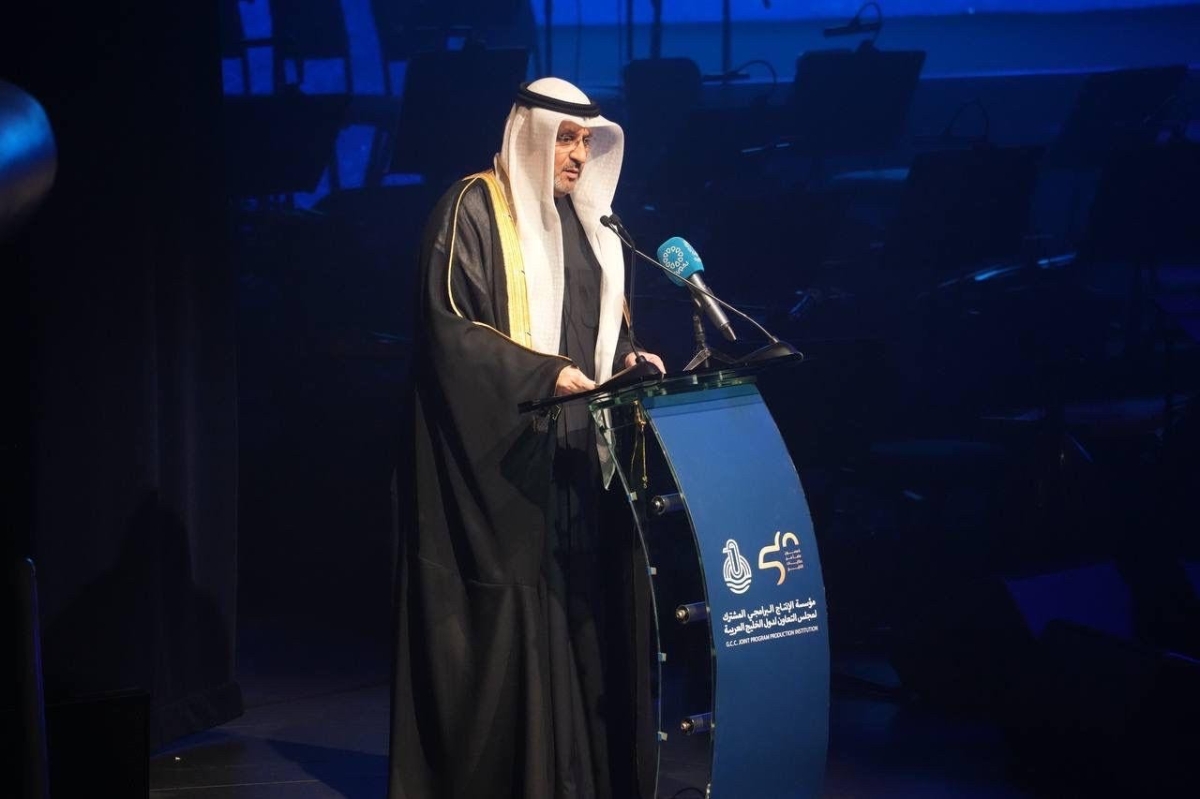
A ceremony was held marking the 50th anniversary of the establishment of the Joint Program Production Organization of the Gulf Cooperation Council.
Translated by Alqyas from Al-Rai — Original source
The Gulf Cooperation Council (GCC) Common Production Program Organization held a ceremony on Monday to mark its 50th anniversary, under the title “Fifty Years of Gulf Stories,” with the patronage of His Highness Sheikh Ahmad Abdullah Al-Ahmad Al-Sabah, Prime Minister of Kuwait.
Speaking at the event, which took place at the Drama Theater in the Sheikh Jaber Al-Ahmad Cultural Center, Mr. Omar Al-Omar, representative of the Prime Minister’s Highness, Minister of State for Communications and Information Technology, and Acting Minister of Media and Culture, described the organization as a venerable media institution and a pioneering model of media cooperation among GCC states. He noted that it has contributed to consolidating the Gulf presence, serving as a platform for awareness, a source of culture, a mirror of identity, and a bridge connecting the peoples of the region.
He added that fifty years is not merely a temporal milestone, but an extended journey of joint institutional effort. Through its diverse productions, the organization has succeeded in reaching successive generations, instilling values, and strengthening Gulf and Arab belonging, until its works became an integral part of the collective memory of the Gulf family and a hallmark of quality content that bridges authenticity and innovation.
He emphasized that Kuwait has consistently affirmed its belief that media and culture are fundamental pillars in building human capacity and shaping awareness. This conviction is reflected in Kuwait’s continuous support for joint Gulf media and cultural initiatives, based on the understanding that collective Gulf action is the guarantor of enhancing our regional and international presence.
Mr. Al-Omar affirmed his support for the development and modernization approach pursued by the organization’s current management, as well as the project it presented to the GCC General Secretariat, which included a package of recommendations aimed at strengthening governance, solidifying regulatory frameworks, and ensuring efficient and professional sustainable performance.
The Minister stated that the coming phase requires a deeper and more comprehensive vision that keeps pace with the rapid transformations in the media industry, leverages modern technologies, and enhances joint Gulf content to make it more capable of influencing, competing, and maintaining a presence in both regional and international arenas.
He stressed that today’s responsibility extends beyond preserving the legacy to developing it and expanding its impact, thereby enhancing the status of Gulf media as a soft power that expresses our values, preserves our identity, and consolidates our unity. He viewed the unification of vision in joint Gulf media production as a strategic step toward crafting a balanced and responsible media discourse that reflects the aspirations of our leaders, responds to the awareness of our generations, and safeguards our authenticity in a world characterized by accelerating changes, diverse platforms, and growing challenges.
He added, “We look forward to an organization with greater presence and impact, rooted in its venerable legacy and confidently moving toward the future as an active partner in building a unifying Gulf awareness and media that reflects our bright civilizational image.”
He appreciated the efforts of all those who contributed to the organization’s journey since its inception, from the founding members to the dedicated cadres who continued their sincere and devoted service, turning this institution into a media legacy firmly embedded in the consciousness of the Gulf family. He said, “Their contribution was a sincere message that transcended the boundaries of time, and their imprints will remain engraved in the memory of joint Gulf work.”
Minister Al-Omar expressed his hope that the Common Production Program Organization would remain a beacon of Gulf media and a cultural bridge uniting our peoples, embodying the spirit of cooperation that underpins our shared Gulf journey.
For his part, in his speech, Secretary-General of the Gulf Cooperation Council (GCC) Jassim Al-Bedaiwi expressed his highest gratitude and appreciation to His Highness the Amir of Kuwait, Sheikh Meshal Al-Ahmad Al-Jaber Al-Sabah, may God protect and guard him, for the kind care and continuous attention extended by the State of Kuwait to hosting and supporting the GCC Secretariat-General and its institutions. This reflects a sincere commitment to a firm approach that demonstrates a deep belief in the importance of enhancing joint Gulf cooperation.
Al-Bedaiwi expressed his pleasure at today’s celebration of the 50th anniversary of the establishment of a pioneering Gulf institution that, since its inception, has served as a distinguished media platform. Throughout its eventful history, it has contributed to consolidating Gulf identity, promoting shared Gulf values, and conveying the true image of our Gulf societies to successive generations through high-quality programs that combined authenticity with modernity and resonated with the hearts of Gulf citizens across various stages.
He emphasized that the Joint Production Organization was not merely a media production entity, but a pioneering Gulf school that utilized media as an effective tool for education, raising awareness, strengthening Gulf belonging, and reinforcing concepts of unity and integration among the peoples of our countries. This underscores the paramount importance of the role media plays in supporting the development process and keeping pace with rapid transformations, in a responsible spirit and with meaningful content.
He extended his sincere thanks and profound gratitude to the founding fathers of this venerable institution, to all who have served in its management and worked within it, and to its current administration, whose dedication and efforts have contributed to building and strengthening this Gulf media edifice, preserving its mission, and developing its tools, ensuring it remains a model to emulate in joint media work.
For his part, Sheikh Mubarak Fahad Al-Jaber Al-Sabah, Director General of the Joint Production Organization of the Gulf Cooperation Council, said in his speech that “this entity was never just a production institution, but an idea and a symbol of joint Gulf cooperation, and a cornerstone of Gulf media.”
Sheikh Mubarak Al-Sabah affirmed that since its inception, the institution has carried a clear civilizational message: to shape awareness, preserve identity, and convey Gulf and Arab culture to successive generations, and to serve as our window to the world and a voice that reflects our values and customs. He added, “We do not merely run a production institution; we are trustees of the cultural memory of this single Gulf.”
He noted that in light of the rapid media challenges affecting our societies, particularly among youth and children, the institution’s role today is to be a safe and reliable source in a world teeming with changes. This role is more important than ever, not only as a cultural role but as an integral part of intellectual security and social identity.
He stated that, like other venerable institutions, the Joint Production Organization has gone through different stages of strength and influence on the hearts of Gulf and Arab generations, which necessitates maximizing its role. He added, “Therefore, our development of the institution is an extension of its firm mission; we renew our tools to protect our identity.”
Sheikh Mubarak Al-Sabah said that, in compliance with the directives of Their Majesties and Highnesses, the leaders of the GCC member states, and the recommendations of the ministers of information, “we have worked on developing the institution’s operational mechanisms to highlight its status, safeguard its history, and enhance its mission through a structured institutional approach based on integrated planning and the utilization of specialized expertise.”
He explained that integration pathways include strengthening partnerships with Gulf ministries and media institutions, and opening up to production companies in the private sector of GCC member states, with the institution acting as an incubator and supporter rather than a competitor.
He clarified that the institution is working to expand its presence at Gulf and Arab events, while keeping pace with digital transformation and developing production infrastructure to serve the quality and sustainability of its content. He noted that the goal is for the institution to be at the heart of the Gulf media landscape, close to its audience, aligned with the tastes of new generations, and faithful to its authentic identity and mission.
Sheikh Mubarak Al-Sabah emphasized that celebrating the 50th anniversary is not merely a tribute to the past, but a celebration of a media pillar that serves the Gulf Cooperation Council (GCC) countries and reflects their civilizational image to the world through presence on global platforms, thereby shaping a unified Gulf media landscape.
The ceremony, hosted by the renowned artist Jasem Al-Nabhan, featured a film that traced the institution’s journey and history, highlighting its key media and programmatic productions over half a century and its role in enhancing joint media efforts among the GCC countries. The event also included a distinctive theatrical performance accompanied by a live orchestra, which captivated the audience with its warm melodies on a nostalgic journey into the past, where images and scenes harmonized with the music to evoke the childhood memories of the Gulf, with all their innocence and beauty.
Children on stage performed elegant dance tableaux that brought to mind timeless works produced by the Jointly Produced Programmes Production Organization (JPPPO), starting with “Open Sesame” (Iftah Ya Simsim), moving through the program “Salamak,” and reaching several major programmatic milestones that shaped the sensibilities of successive generations in a scene where emotions blended with pride and gratitude for a firmly established Gulf media legacy.
