Mohamed bin Zayed and Sisi: Strengthening Peace in the Region and Maintaining Stability
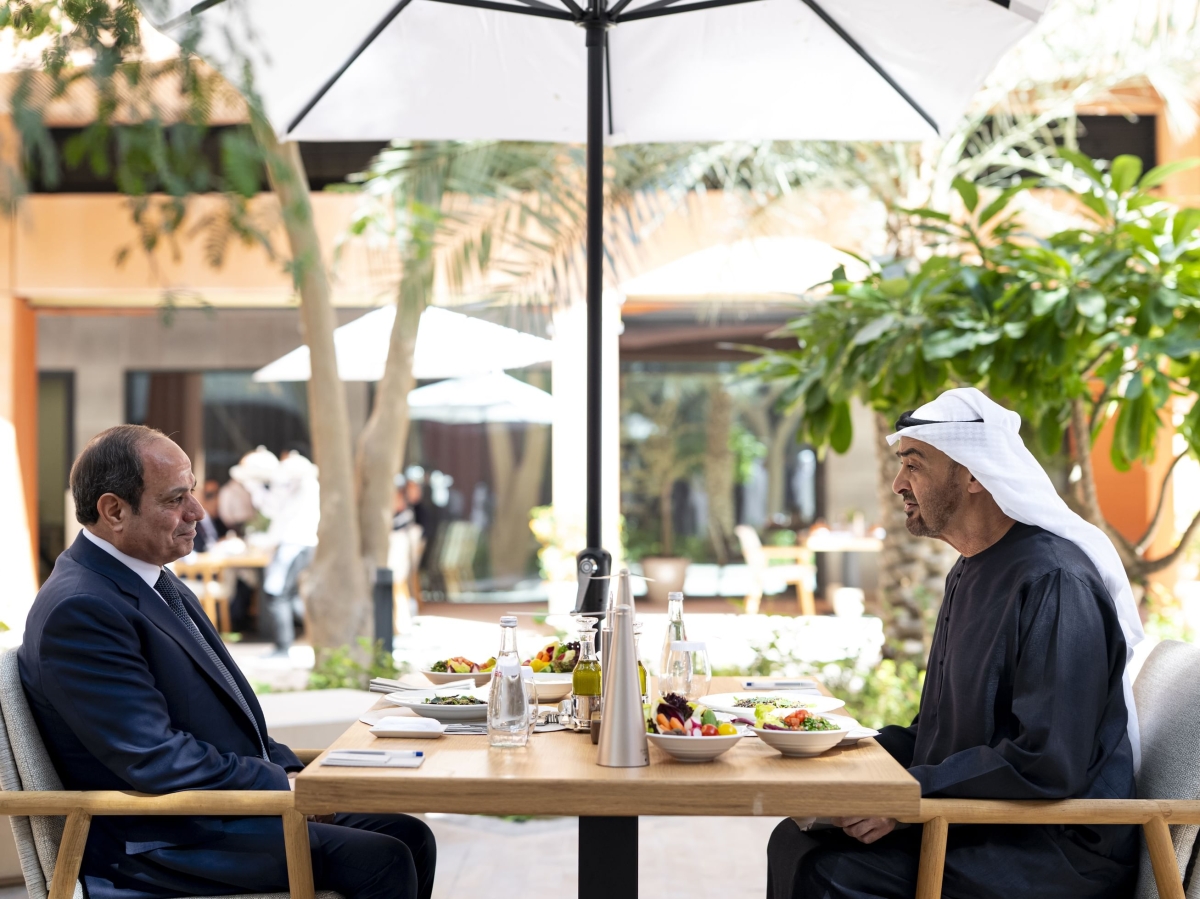
The Egyptian and UAE presidents emphasize strengthening peace and cooperation in the Middle East.
Translated by Alqyas from Al-Rai — Original source
The Emirati President, Sheikh Mohamed bin Zayed Al Nahyan, and the Egyptian President, Abdel Fattah el-Sisi, discussed in Abu Dhabi the “brotherly relations and various aspects of cooperation and joint work, as well as opportunities to enhance them, particularly in developmental and economic fields, in a manner that serves their common interests.”
The WAM News Agency stated in a statement on Monday that el-Sisi and Mohamed bin Zayed emphasized “the importance of working to strengthen the foundations of peace in the region, which contributes to preserving its security and stability and achieving development and prosperity for its peoples.”
The two presidents discussed “developments regarding the situation in Gaza, and it was reaffirmed the necessity for the full implementation of the ceasefire agreement in the Strip, the full implementation of US President Donald Trump’s peace plan, and the enhancement of the unrestricted entry of humanitarian aid to Palestinians, especially with the approach of the holy month of Ramadan, as well as the swift commencement of early recovery and reconstruction operations.”
They affirmed “the importance of advancing toward a just and comprehensive peace process in the region based on the two-state solution, which ensures the achievement of lasting peace, security, and regional stability.”
According to an Egyptian presidential statement, the two presidents pointed to “the significance of Arab solidarity at this delicate stage that the Middle East region is going through.”
The Egyptian President began his one-day visit with a visit to the Mohamed bin Zayed University of Artificial Intelligence, where he reviewed its academic programs and its distinctive innovations in advanced technology during a tour of the university’s facilities and departments with the Emirati President.
In Cairo, Foreign Minister Badr Abdelatty, during a meeting with the board of trustees of the American University in Cairo, affirmed “the Egyptian state’s commitment to the principle of strategic balance, as the governing framework for Egypt’s foreign policy movements, which has contributed to consolidating its status as a pivotal pillar of stability at both the regional and international levels.”
On another note, the Director of the Iranian Interests Office in Cairo, Ambassador Mojtaba Fardoustpour, said during the celebration of the 47th anniversary of the Islamic Revolution’s victory that “Egypt and Iran, as two ancient and influential countries in the Islamic world and the Middle East region, bear a shared responsibility toward enhancing peace and stability and supporting development paths in the region.”
Amid public interest, Egyptians are awaiting on Tuesday the outcome of the general session convened by Speaker of the House of Representatives Hesham Badawi, which he described as “important,” amid expectations that it will see the expression of opinion and voting on the formation of an anticipated new government, followed by the announcement of a governors’ reshuffle.
Parliamentary sources stated that if a vote takes place, the entire ministerial cabinet must be approved or rejected as a single package by a majority of 50 percent plus one of the attendees present. It is not permissible to approve some names and reject others. The decision is then submitted to the President of the Republic to determine the swearing-in of the new ministers.
