Iran Announces Integration of '1,000 Drones' into Its Forces; EU Designates 'Guardians... as Terrorists'
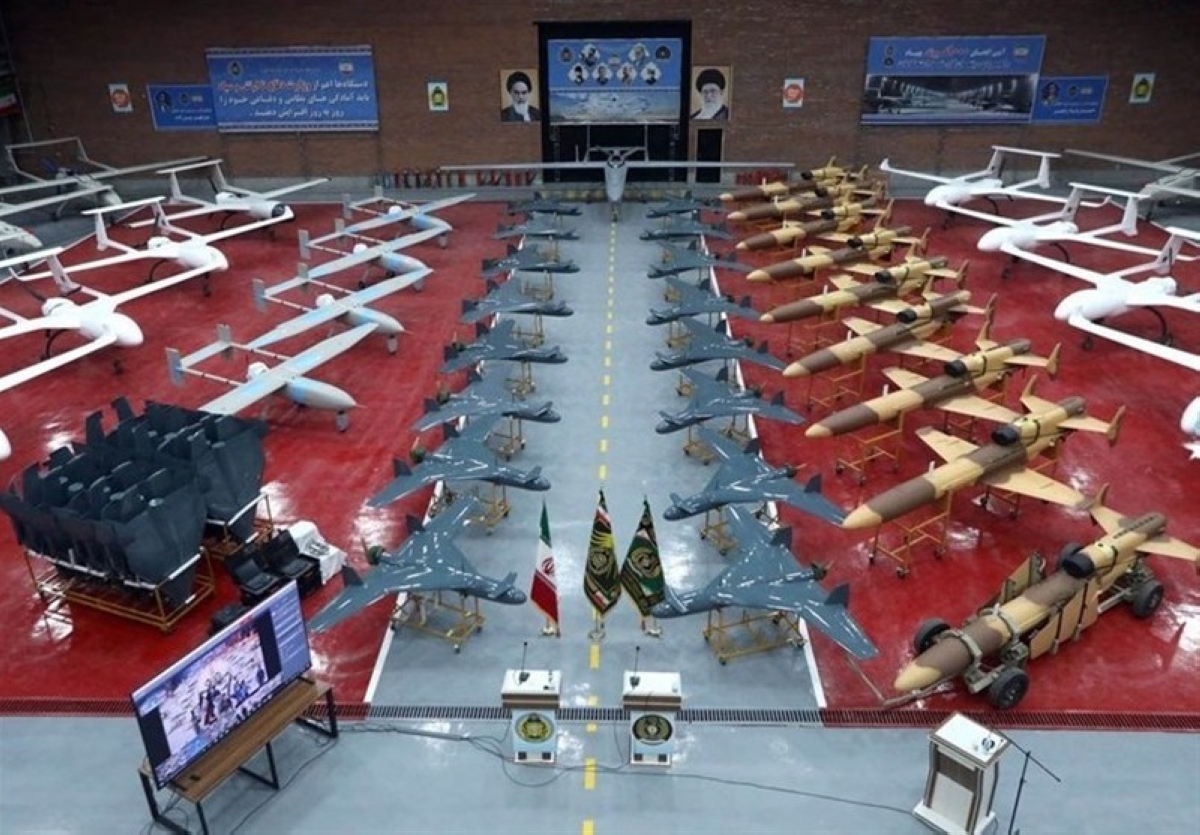
Iran announces integration of 1,000 drones and training of Guards in the Hormuz Strait, while Trump calls for military action against Tehran
Translated by Alqyas from Al-Rai — Original source
- Iravaji: Europe is committing a grave strategic error
- The Guard will conduct live-fire drills in the Strait of Hormuz
- “Wall Street Journal” warns of a “deadly force” with Iran threatening the region
As President Donald Trump continues to threaten a “devastating” military operation against Tehran, the Iranian military announced the integration of “a thousand strategic drones” into the combat system of the four armed forces, pledging a “decisive” response to any strike. Meanwhile, the Islamic Revolutionary Guard Corps (IRGC) Navy will conduct live-fire drills in the Strait of Hormuz on February 1 and 2.
While Western sources expressed the belief that the US president’s objective is to change Iran’s leadership rather than “overthrow the regime”—a similar outcome to what occurred in Venezuela, where US intervention led to the ouster of President Nicolás Maduro without a comprehensive change in government—media reports revealed that Turkish President Recep Tayyip Erdoğan proposed a trilateral meeting involving Trump and Iranian President Masoud Pezeshkian.
In Tehran, Army Commander Lieutenant General Amir Hatami announced that “in light of the threats we face, maintaining and enhancing strategic advantages for rapid combat and a decisive response to any invasion or aggressor is always on the army’s agenda.”
A military statement stated that the new drones were manufactured locally and are suited to “modern threats” and lessons learned from the 12-day war with Israel last June.
Meanwhile, the “Kayhan” newspaper, affiliated with the office of Supreme Leader Ayatollah Ali Khamenei, called for the closure of the Strait of Hormuz, considering the step a “legal and legitimate right of the Islamic Republic,” citing that the 1958 Geneva Conventions and the 1982 Convention on the Law of the Sea grant coastal states the authority to determine whether the passage of ships is “innocent” or not.
In this context, the “Wall Street Journal” cited informed sources stating that despite suffering economic exhaustion and political and military pressures, Iran still possesses one of the largest missile arsenals in the Middle East, giving it significant capability to threaten regional targets.
The report also noted that Iran maintains large stockpiles of short-range missiles capable of targeting US bases deployed in the region, as well as military and commercial ships in the Strait of Hormuz, with varying estimates regarding the number of these missiles.
In addition to ballistic missiles, Tehran possesses, according to the report, a wide arsenal of anti-ship cruise missiles, fast torpedo boats, and a large number of drones that pose a direct threat to US ships and their allies in the region.
In Ankara, the “Hürriyet” newspaper reported that “the main topic of the recent telephone discussion between Erdoğan and Trump was Iran.”
It quoted sources stating that “Trump responded positively to Erdoğan’s proposal.”
As Iranian Foreign Minister Abbas Araghchi visits Ankara today, a Turkish Foreign Ministry official stated that Foreign Minister Hakan Fidan will emphasize during the meeting that Ankara “is ready to contribute to resolving current tensions through dialogue.”
According to the source, who requested anonymity, Fidan will “reiterate Turkey’s opposition to any military intervention against Iran, stressing the risks such a step poses to the region and the world.”
The official told “Agence France-Presse” that “Turkey supports reaching a peaceful resolution to Iran’s nuclear program in the near future and is ready to offer assistance if necessary.”
In addition to its diplomatic efforts, Ankara is considering taking additional security measures along its border with Iran in the event that a US strike destabilizes the country.
American officials: Two U.S. sources familiar with the discussions said that President Trump is considering options to target leaders and institutions that Washington holds responsible for the violence, in order to bolster protesters’ confidence in their ability to breach government and security buildings.
One source added that the options also include a much larger strike aimed at achieving a lasting impact, possibly against ballistic missiles capable of targeting U.S. allies in the Middle East, or uranium enrichment programs.
The arrival of a U.S. aircraft carrier and supporting warships in the Middle East has enhanced Trump’s capacity to take potential military action. However, four Arab officials, three Western diplomats, and a senior Western source familiar with the discussions expressed concern that such strikes might weaken a protest movement already reeling from the shock of the authorities’ crackdown, rather than encouraging people to take to the streets.
On Thursday, a U.S. official said the destroyer USS Decatur entered the region within the past 48 hours, bringing the number of destroyers in the Middle East to six, along with an aircraft carrier and three other combat ships.
The European Union also imposed sanctions on Iranian officials, including the interior minister and commanders in the Islamic Revolutionary Guard Corps, in response to the targeting of recent protests.
