Europe and Western Powers Head to Asia... to Counter Trump's Trade Measures
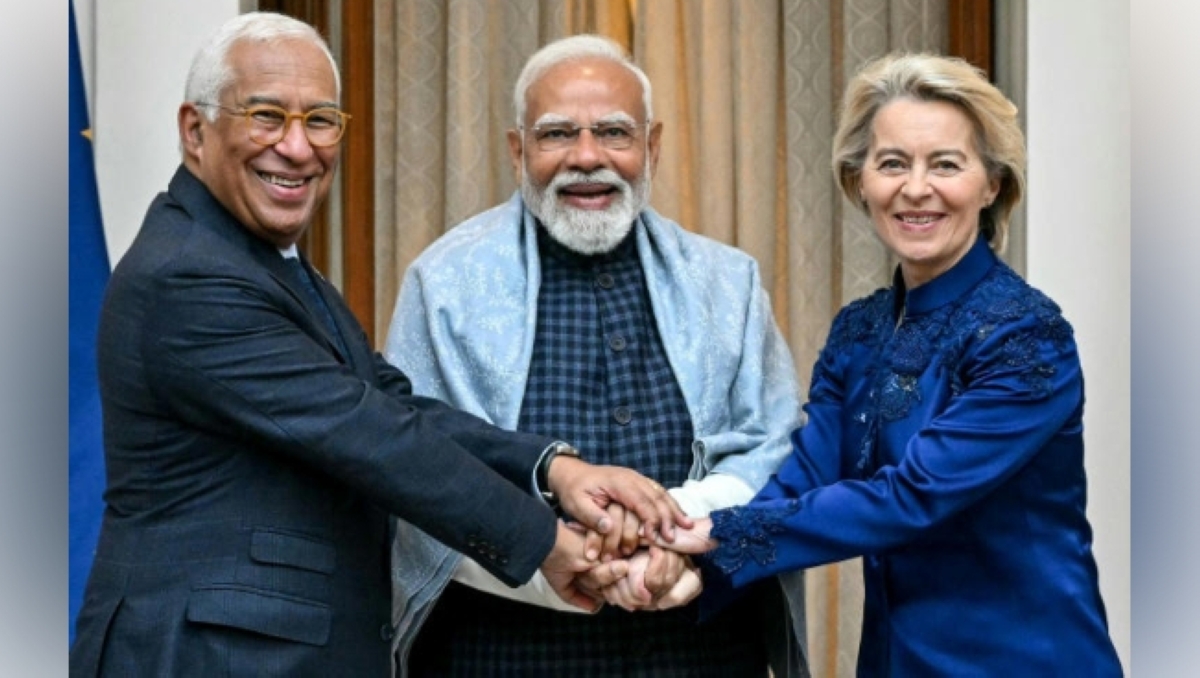
The European Union expands cooperation with India to counter Trump's trade measures
Translated by Alqyas from Al-Rai — Original source
The protectionist measures adopted by US President Donald Trump, along with his erratic foreign policy, are pushing the United States’ traditional trading partners to draw closer to China and India, a trend whose latest example was the signing of a free trade agreement between the European Union and New Delhi.
At a ceremony held on Tuesday in the Indian capital, European Commission President Ursula von der Leyen and Prime Minister Narendra Modi did not mention Trump as a driver behind the agreement’s signing.
However, the European official emphasized that this understanding would reduce “strategic dependence at a time when the trade weapon is increasingly being used,” an implicit reference to the tariffs Trump has employed as a tool of foreign policy toward both partners and adversaries.
Vincent Vicard, an economist at the Institute for International and Strategic Studies in Paris, told AFP that “Donald Trump’s trade measures significantly accelerated the signing of this agreement.”
The agreement provides for the elimination of a large portion of trade tariffs between EU member states and India. For example, Indian tariffs on cars manufactured in Europe will be reduced from 110 percent to 10 percent, and tariffs on wine will drop from 150 percent to just 20 percent.
The continental bloc also expressed in late 2025 its desire to strengthen relations with Indo-Pacific Partnership countries, particularly Vietnam, which holds the rotating presidency this year.
Yet, the gaze of many of the United States’ key partners—the world’s leading economic power—is turning especially toward the second-largest power: China.
British Prime Minister Keir Starmer arrived in Beijing on Wednesday for a three-day visit, accompanied by an economic delegation comprising officials from the banking and pharmaceutical sectors. He affirmed that the goal was to enhance a “pragmatic partnership” after years of tension between the two sides.
Meanwhile, relations between Canada and China have improved over recent months, culminating in Prime Minister Mark Carney’s January visit to Beijing, where he praised a “new strategic partnership.”
During the visit, the two sides signed a “preliminary but historic trade agreement” to lower customs duties, although Trump warned of severe consequences if it were implemented.
In response to Trump’s threats, China stressed that its preliminary trade agreement with Canada does not target “any third party.”
In a widely noted speech delivered at the World Economic Forum in Davos, Switzerland, Carney argued that the global order, in place for decades, is experiencing fractures, calling on “middle powers” to pool their capabilities in the face of forces seeking hegemony.
As Western countries move to draw closer to key Asian powers, particularly India and China, tensions with Beijing have not entirely disappeared, especially since China imposes steep tariffs on certain essential imports from the European Union.
However, this researcher believes that dialogue with Beijing, which Trump considers a strategic adversary, also sends “a strong message to the United States that it is not the world’s only major trading partner.”
In 2024, the United States accounted for 20 percent of EU exports, while China’s share was 8 percent, and India’s share was limited to 2.4 percent.
Vicard believes that for the United States’ main trading partners, the stakes are not necessarily about finding an alternative trading partner to the US “for any market that cannot compete with it in terms of size.”
However, he pointed to “the need to reduce reliance (on the United States) and diversify relations in order to mitigate risks, including engaging with countries that do not necessarily share our values.”
US Commerce Secretary Scott Bessent expressed Washington’s deep displeasure with European Union member states on Wednesday, following their signing of an agreement with India, as New Delhi continues to “purchase Russian oil” despite Western sanctions imposed in the wake of the war in Ukraine.
