Gaza's Future... 'Hostage' to Israel and the United States
The United States presents a peace plan but fails to achieve real progress in Gaza
Translated by Alqyas from Al-Rai — Original source
- From Netanyahu’s perspective, any international entity overseeing Gaza represents an encroachment on Israel’s unilateral control.
- What is presented as a peace process... is not a path to recovery or sovereignty, but a mechanism to entrench a new reality on the ground.
Israel has never viewed US President Donald Trump’s announcement of moving to the second phase of the Gaza peace plan as a genuine means to end the war. Instead, it regarded it as a mechanism to manage, reshape, and politically contain the conflict—a conflict that has already inflicted severe military, diplomatic, and moral damage after two years of destructive fighting. Israel’s international standing has fallen to its lowest historical levels, and the plan offered no opportunity for a solution, but rather an opportunity to improve the image of both Israel and Trump himself.
Immediately following the ceasefire announcement, media interest in Israeli movements in Gaza waned, replaced by a new political discourse centered on the promise of a “peace plan.” This shift had little to do with the reality on the ground. This contradiction became evident when US envoy Steve Witkoff announced the launch of the second phase of the plan, despite the fact that the first phase had not been completed or fully implemented.
The sequence of events revealed that the initiative was merely an impromptu announcement, more akin to a public relations tool than evidence of a serious effort to end the war.
The clearest indicator of Washington’s bias toward Israel was Witkoff’s decision to abandon efforts to open the Rafah crossing, a step that should have been taken months earlier. This was not a technical delay, but a political signal. Tel Aviv had no intention of withdrawing, nor of advancing to the second phase, nor of handing over Rafah, nor of allowing genuine reconstruction in Gaza.
At the same time, Israel resumed its military operations under clear political cover. More than 400 Palestinians were killed during what was supposed to be the first phase, alongside targeted assassinations of “Al-Qassam Brigades” leaders. The message was unambiguous: any assumption that the second phase would bring calm or stability to Gaza is an illusion. Israel retained full freedom of action. The only element that held during the first phase was the Palestinian side’s commitment to the agreement, a commitment that went unreciprocated.
Hamas chose not to directly confront the US initiative, despite its full awareness of Washington’s bias in favor of Israel. The movement faced a real dilemma: either accept a US framework that would at least halt the most destructive phase of the war, or risk a return to all-out war and annihilation—a burden the Palestinian people could no longer bear. Under these circumstances, the movement continued to adhere to the agreement despite repeated Israeli violations.
The objective of this stance was to pave the way for a Palestinian technocratic government, consisting of 12 members, tasked with managing Gaza in an attempt to rebuild and resist Israel’s ambition to maintain a permanent presence in the strip. However, this government was never designed to exercise real authority. It lacked enforcement mechanisms, security control, or influence over Israel’s actions. Its role was administrative and symbolic, not sovereign.
Israeli Prime Minister Benjamin Netanyahu interpreted the agreement solely according to his own terms, making no concessions. He only responded to US pressure when it was coupled with unrestricted operational freedom: continued assassinations, closure of the Rafah crossing, and refusal to withdraw from more than 54 percent of the Gaza Strip. He was prepared to wait for the right moment to blame the technocratic government itself for the failure.
In reality, Netanyahu cared about only one issue: the failure to disarm Hamas. The broader Palestinian issue remained secondary. Under these circumstances, Palestinians had no effective means to change the status quo or to enforce the terms of the peace plan proposed by Trump.
This logic shaped Netanyahu’s reaction to Washington’s announcement of the so-called “Gaza Peace Council.” His public claim that he had not been briefed on its details was hardly convincing to anyone within Israel. He is informed of every significant American step concerning Gaza, especially those affecting governance or the security architecture. His denial was not merely a slip of the tongue, but a calculated move to position himself, signaling defiance without provoking an outright rupture with Washington.
From Netanyahu’s perspective, any international entity overseeing Gaza represents an encroachment on Israel’s unilateral control. Internationalization implies shared authority, external oversight, and constraints on Israel’s military freedom of action. This is the red line he promised his far-right coalition partners not to cross. As a result, American frameworks are not flatly rejected; rather, they are hollowed out through delay, ambiguity, and procedural obstruction.
This approach has led to a fundamental divergence between Washington and Tel Aviv. The United States views international intervention as a mechanism for stability, a means to curb escalation, and a way to demonstrate political progress. Netanyahu, by contrast, sees it as a burden that weakens deterrence and sets precedents for external interference.
The resulting stalemate has turned coordination into bargaining. Netanyahu’s decision, reportedly to send the head of Mossad to Washington, was widely interpreted not as routine consultation, but as an attempt to renegotiate the broader regional equation. Gaza has become a bargaining chip rather than an independent issue, linked to American stances toward Hezbollah and Iran. Limited concessions in Gaza have been made conditional on American commitments elsewhere.
For Israel, the priority remains maintaining freedom of action against Hezbollah and Iran while avoiding any political process in Gaza that might constrain future military operations or enable unwanted governance structures. For Washington, the challenge lies in managing an ally whose domestic political survival depends on resisting the very outcomes the United States seeks to promote.
What has emerged on the ground is a new reality with dire consequences. The so-called “Yellow Line,” to which Israel withdrew within Gaza, has become a de facto border. This line is not temporary; it is the strategic gain Israel seeks to entrench, geographically and politically, to reassure its far-right base and normalize a permanent Israeli presence within the Strip.
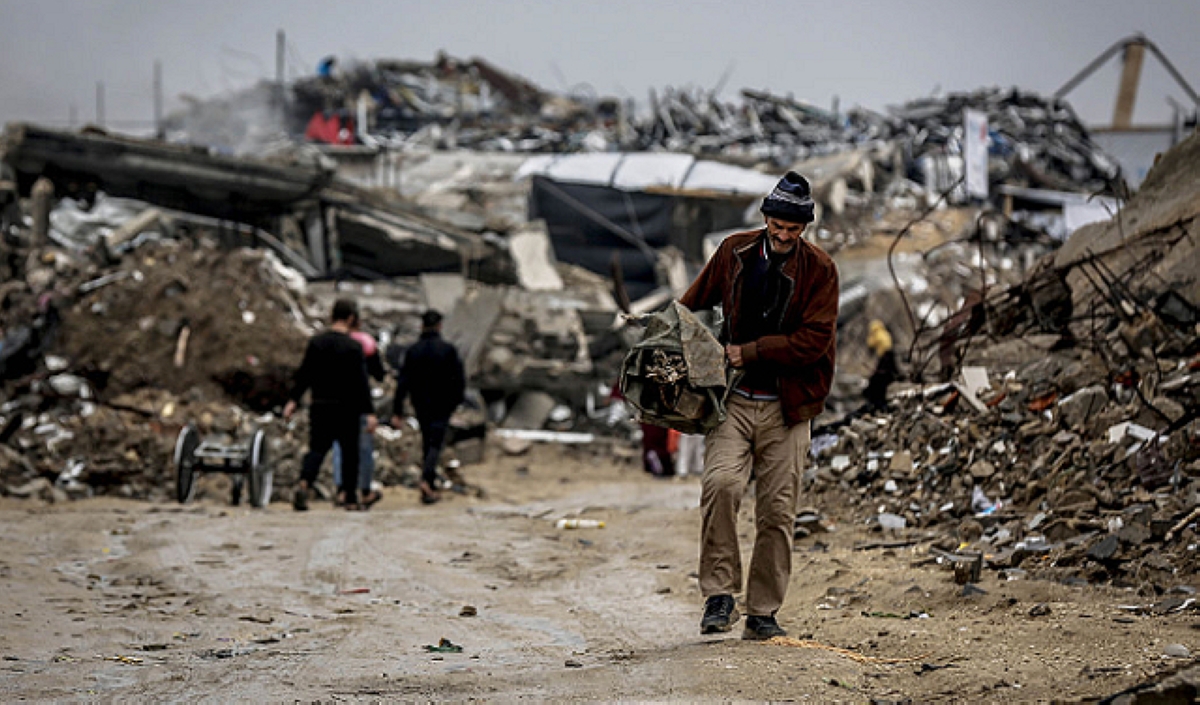
In this sense, the peace plan has frozen at its first stage. The second stage is mere rhetoric. It has been reduced to formalistic measures, including a technocratic government and a peace council, while its core provisions remain dormant. The Rafah crossing remains closed to effective humanitarian aid. Food assistance is restricted, civilian movement between Gaza and Egypt is hindered, commercial flows are paralyzed, and there is no serious reconstruction effort, despite the destruction of approximately 80 percent of Gaza during two years of devastating war.
What is presented as a peace process is not a path to recovery or sovereignty, but a mechanism to cement a new reality on the ground. Gaza is no longer merely besieged; its borders are being redefined, it is being politically neutralized, and it is being administered in a manner that preserves Israel’s freedom of action while suspending Palestinian rights indefinitely. This is not a failure of implementation, but the success of a strategy.
